Hikrobot CI Series Adds LWIR Thermal Imaging to Production Inspection
- Saba Aafreen
- 679 reads
Hikrobot’s CI Series uses 8–14μm infrared imaging, GigE connectivity and multiple lens options to monitor temperature patterns on production lines.
Thermal imaging gives production inspection a way to detect temperature patterns that visible-light cameras cannot capture. Hikrobot’s CI Series long-wave infrared (LWIR) cameras are designed to bring that capability into automated inspection equipment, with specifications aimed at applications including battery manufacturing, automotive parts and semiconductor production.

The cameras sense infrared radiation in the 8–14μm band with an uncooled vanadium oxide (VOx) detector. Rather than forming an image from reflected visible light, the detector maps differences in emitted infrared energy across a scene. Those differences can help inspection systems flag localised heating and give engineers a view of thermal variation during a process.

Resolution, speed and temperature readings
Baseline CI Series models provide 640 x 512 thermal resolution and operate at up to 50 frames per second. That combination gives a machine vision system a stream of thermal images for observing components as they pass through a production station. The practical value depends on the inspection task: a camera can reveal a heat pattern, while the production team still needs to determine whether that pattern indicates a defect, a process change or an expected operating condition.
Selected models specify automatic temperature measurement accuracy of ±2 degree centigrade or ±2 percent of the reading. The stated alternatives are relevant when choosing a unit for a measurement task, but the accuracy figure alone does not define the performance of a complete inspection. Camera setup, the target and the way the measurement is evaluated all shape how useful temperature data will be on a line.

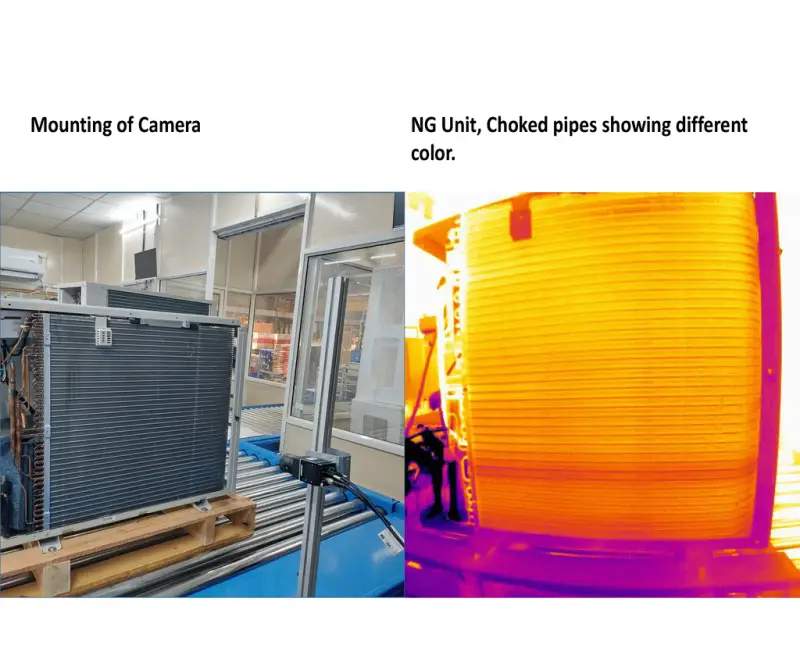
For battery production, automotive components and electronics or semiconductor processes, thermal data can complement conventional image checks. A visible camera can show geometry and surface appearance; an LWIR camera adds a temperature view. Used together, the two image types can help engineers examine both what a part looks like and whether its thermal behaviour varies across the inspected area.
Built for machine vision integration
The CI Series transmits data over GigE, with a specified reach of up to 100 metres without an external relay. The cameras support GigE Vision 2.0 and GenICam, allowing integration with third-party software that uses those machine vision standards. That matters for system builders who need a camera to work within an existing inspection stack rather than requiring a dedicated interface from the same manufacturer.

Production-line timing and control are addressed through multiple trigger modes and event outputs. These functions let system designers coordinate image capture with equipment events and pass camera events into the wider inspection setup. The available details do not identify the particular trigger modes or output electrical characteristics, so those points need to be checked against the relevant model documentation during system design.
Image presentation options include different thermal palettes and grayscale detection. Palettes change how temperature differences appear to an operator or image-processing system; grayscale detection provides another way to represent the captured scene. The cameras’ compact housings have mounting holes on four sides, giving machine builders more choices when positioning a unit within inspection equipment.

Lens choices shape the inspection view
Hikrobot lists variants with focal lengths of 6.3mm, 15mm, 25mm and 35mm. The field of view changes with lens selection: the 6.3mm model is specified at 88.5 x 73.2 degrees, while the 25mm version has a narrower 24.6 x 18.5 degrees view. In practice, this gives integrators a choice between covering a broader scene and concentrating on a smaller area, subject to the camera’s placement and the part geometry.

A separate model, MV-CI003-GL-T6, is specified for inspection and automated temperature calibration. That variant points to a use case where thermal measurement needs to be incorporated into an automated process, though the available specifications do not describe its calibration procedure or operating conditions.
The main engineering decision is whether a thermal image provides a meaningful signal for the production check at hand. Where a process produces useful temperature differences, an LWIR camera can extend machine vision beyond visible appearance and help locate areas that merit investigation. Lens selection, field of view, interface compatibility and the required measurement accuracy will determine how well a CI Series camera fits a particular line.