First Light Fusion and CLF Develop Fast Ignition for the FLARE Fusion Concept
- Georgina Jedikovska
- 406 reads
The collaboration will study how laser driven electrons can heat compressed fuel efficiently, reducing the energy needed for FLARE ignition.

Separating fuel compression from ignition could let a fusion system use a simpler driver for the first stage and reserve a powerful laser for the brief, targeted heating that follows. First Light Fusion and the Science and Technology Facilities Council’s Central Laser Facility (CLF) are working on that second stage for the company’s FLARE concept, with a focus on how laser energy reaches dense fuel.
First Light Fusion, based in Oxfordshire, announced the collaboration on November 12. The work centers on fast ignition: a short, intense laser pulse generates energetic electrons, which then carry energy into compressed fuel to raise its temperature and trigger fusion. The practical challenge is not simply producing a powerful pulse. Researchers need to understand how those electrons move through the fuel and how much of their energy they deposit in the region where ignition is intended.
Compression and ignition as separate stages
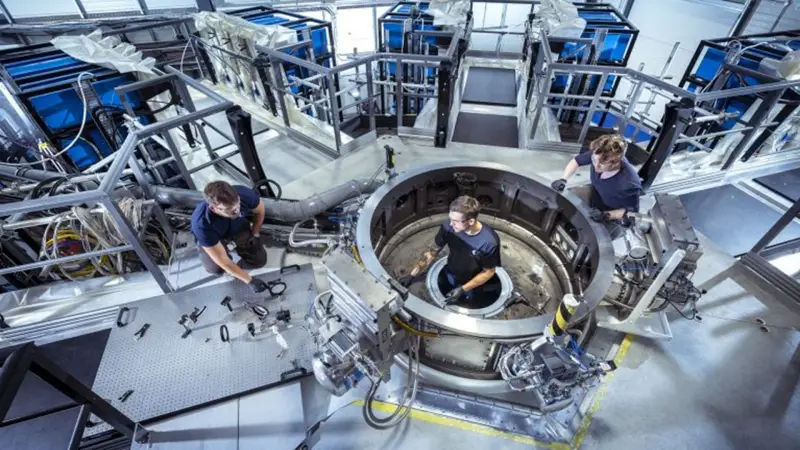
Many inertial confinement approaches use lasers to compress and heat the fuel. FLARE, short for Fusion via Low-power Assembly and Rapid Extraction, divides those jobs. A pulsed-power system first compresses deuterium-tritium (D-T) fuel to high density. A separate laser pulse then rapidly heats the already compressed material.
First Light Fusion says it has successfully tested the compression stage at its M3 facility. Company chief scientist Jonathan Skidmore, PhD, described that stage as using a simple pulsed-power driver to bring the fuel to high density. The next technical task is to deliver heat quickly enough to the dense fuel to initiate fusion.
That division of labor changes what the engineering team must optimize. Compression sets up the fuel state; ignition depends on getting enough energy into a small, relevant region before the fuel conditions change. The two stages still have to work together as a system, but they can be studied as distinct problems. That gives researchers room to test the laser and target arrangements against the conditions produced by the compression stage.
The collaboration will examine electron transport through the fuel and the efficiency of energy transfer. It will also investigate engineered target structures and magnetic fields that could steer electrons toward the ignition region. These choices matter because energy carried away from the intended region does not contribute as effectively to starting the reaction. The stated aim is to lower the laser energy required for ignition while preserving high energy gain.
Credit: First Light Fusion
Why the laser energy budget matters
For a future power system, the energy needed to drive a fusion reaction is part of the overall engineering calculation. A laser pulse that ignites fuel only by consuming a large amount of input energy would make the plant harder to operate efficiently. Improving the fraction of laser energy that reaches the ignition zone could therefore affect the size and demands of the driver, as well as the design of the target and surrounding equipment.
FLARE’s cylindrical target design is intended to provide access to a larger area of compressed fuel. First Light Fusion says that geometry could give the team more flexibility in developing the ignition system. The company’s approach is to design the fuel target, compression stage and ignition stage together, so choices made for one part of the setup can be considered alongside the requirements of the others.
High energy gain is relevant to that system-level work. The partners say greater gain could allow a future plant to produce electricity with fewer fusion cycles and could ease demands on the driver, chamber and fuel delivery system. Those are aims, not demonstrated plant performance: the collaboration’s current task is to identify and test ways to improve fast ignition.
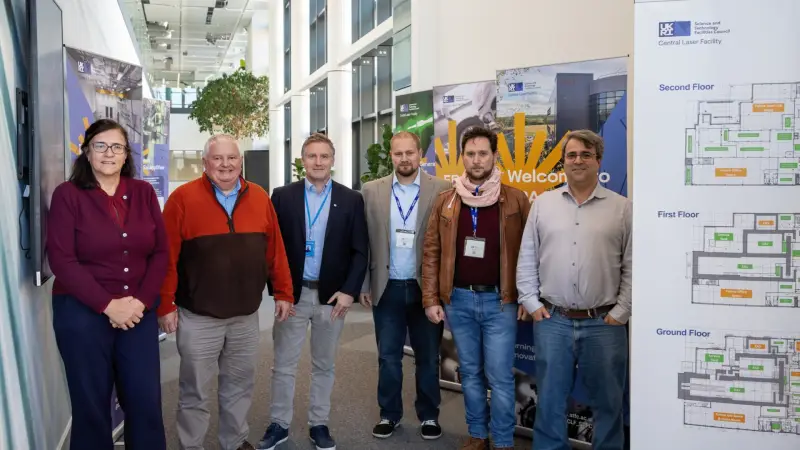
First Light Fusion brings 15 years of research spanning target design, pulsed-power technology, machine learning and simulation. CLF contributes experience in high-power lasers, plasma physics and energetic electrons. Its work includes fast ignition modeling and experiments, which the partners plan to use to select approaches for further study. Skidmore described the facility’s laser and plasma expertise as support for accelerating the heating stage.
Credit: First Light Fusion
The partners also plan to consider engineering requirements, costs and the potential to expand the approach for commercial use. Those questions connect laboratory physics to plant design: a promising ignition result would still need to fit equipment that can deliver repeated pulses, accommodate targets and operate as part of an integrated system. The collaboration has not reported a laser energy target, a test schedule or an ignition result.
CLF director John Collier, PhD, said the team will draw on modeling and experiments to address the fast-ignition challenge and identify useful experiments. The next evidence to watch is whether the electron guidance and target designs improve energy coupling under the conditions created by FLARE’s compression stage. That result will show how much of the concept’s claimed efficiency depends on the laser and target working together as planned.