HD Hyundai and Anduril Launch 600-Ton Autonomous Vessel Prototype
- Ameya Paleja
- 930 reads
The 600-ton Al001 pairs autonomous navigation with equipment monitoring and a modular deck container; sea trials are planned at Ulsan.
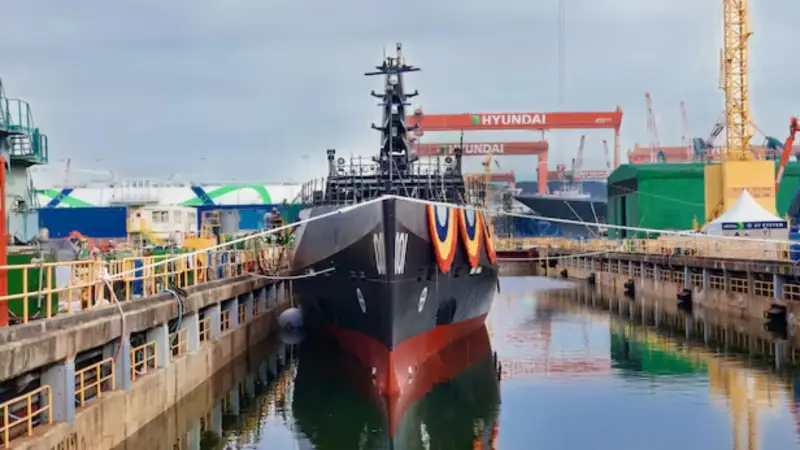
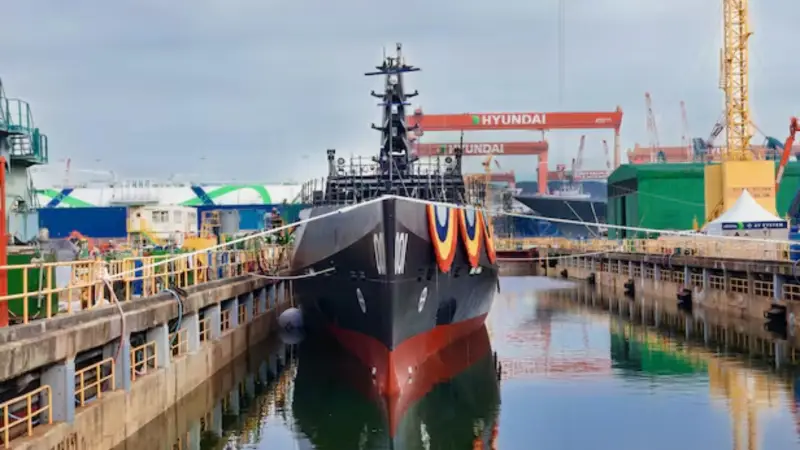
A 600-ton uncrewed vessel built in nine months is now afloat in Ulsan, South Korea. The prototype, temporarily named Al001, brings together HD Hyundai’s shipbuilding and vessel-control systems with Anduril’s software for remote mission management. Its engineering interest lies in combining navigation, machinery monitoring and a modular payload space in one platform, rather than treating autonomy as a route-planning feature alone.
HD Hyundai and Anduril built the vessel without an order for it. The companies have not disclosed a full specification, so details such as propulsion output, endurance, speed and sensor fit remain unknown. The stated schedule calls for three months of sea trials at Ulsan, followed by further testing in the United States in 2027. Those trials should provide a clearer picture of how the integrated systems perform beyond the shipyard.
Two layers of autonomy
The vessel uses VAone, an autonomous system from HD Korea Shipbuilding and Offshore Engineering, to manage propulsion and navigation. VAone can select a predetermined route and avoid obstacles along the way. It also monitors critical equipment, including engines and generators, and can respond when it detects a problem. That combination links movement with basic machinery oversight: the system is intended to do more than keep the vessel on a planned course.
Anduril’s Lattice system handles mission autonomy. It sends reconnaissance and surveillance data to human operators at a remote location. The division of work described by the companies leaves the vessel to navigate and monitor its equipment while people review information and direct operations from elsewhere. The available details do not specify how the systems divide control during an abnormal event, or what communications links the vessel uses.
That distinction matters in practical engineering. A route-following system can avoid known obstacles yet still depend on people to recognize a developing machinery fault. Adding equipment monitoring and response brings another layer of decision-making onto the platform. How useful that capability proves will depend on its detection limits, the actions it can take safely, and how it reports faults to operators. The companies have not published those performance details.
Hull and machinery monitoring built in
HD Hyundai describes Al001 as extending autonomy into hull and machinery management. The intended capability includes detecting anomalies and responding to them during deployment, including cases involving equipment failure or hull damage. The description does not identify particular sensors, damage thresholds or repair mechanisms. It therefore points to a design goal rather than a quantified ability to diagnose or correct every fault without assistance.
For an uncrewed platform, that distinction is central. Without people aboard to inspect equipment, a monitoring system has to identify signs of trouble, relay useful information and determine whether the vessel can continue. A system that detects an anomaly but cannot distinguish a manageable fault from a serious one may still require rapid human assessment. Sea trials can test how these functions behave together under operating conditions, although the planned trial schedule alone does not establish the system’s reliability.
A configurable deck module
Al001 carries a 39-foot (12 m) container module on deck. Its interior can be reconfigured with equipment for different missions, and the companies describe it as compatible with equipment used internationally. They say that compatibility is intended to avoid retrofitting. The module gives the vessel a defined space for changing its payload while leaving the underlying hull and control systems in place.
Modularity can make a platform easier to adapt as requirements change, but it also brings integration questions. Any new equipment has to fit the container, connect to the vessel’s power and data systems, and work with the autonomy and operator interfaces. The companies have not published the module’s internal dimensions, power capacity or connection standards, so the practical limits on payload changes are not yet clear.
Designing around propulsion equipment
HD Hyundai says it shortened construction to nine months by procuring propulsion systems first and designing the vessel around them. That sequence differs from a process in which the full vessel design is settled before major systems are selected. Starting with available propulsion equipment can reduce the time spent waiting for long-lead components, while placing constraints on the hull layout and the way other systems fit around the machinery.
The approach shows how component availability can shape a shipbuilding schedule. It does not, by itself, show how much of the nine-month timeline came from that decision, or whether the same pace would apply to a production run with different equipment or requirements. The companies have not provided a detailed build schedule or cost breakdown.
Al001 is a prototype, and the information released so far leaves key performance questions open. The upcoming trials at Ulsan are the next opportunity to assess its navigation, equipment monitoring and integrated control in operation. Testing in the United States is planned for 2027; until then, the clearest evidence of the design’s practicality will come from how well those systems work together at sea.