REVA University Builds a Vision-Guided UR3 System for Flexible Robotic Gluing
- Alex Owen-Hill
- 491 reads
A YOLOv8 camera system and RoboDK adapt a UR3 glue path to each part’s detected position and orientation, without external markers or laser scanners.
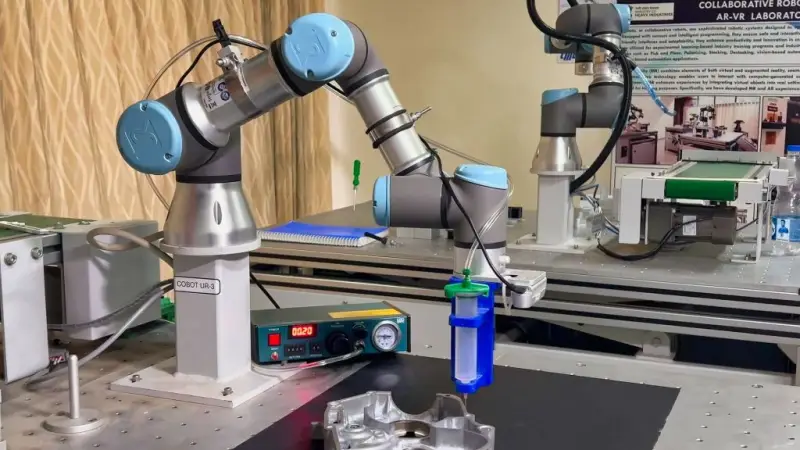
Adapting a glue path to a part’s actual position and orientation is the key engineering result of a system developed by researchers at REVA University in Bengaluru, India. Their setup combines an Intel RealSense camera, a YOLOv8 vision model, RoboDK and a Universal Robots UR3 cobot to detect a workpiece and adjust the robot’s adhesive path in real time.
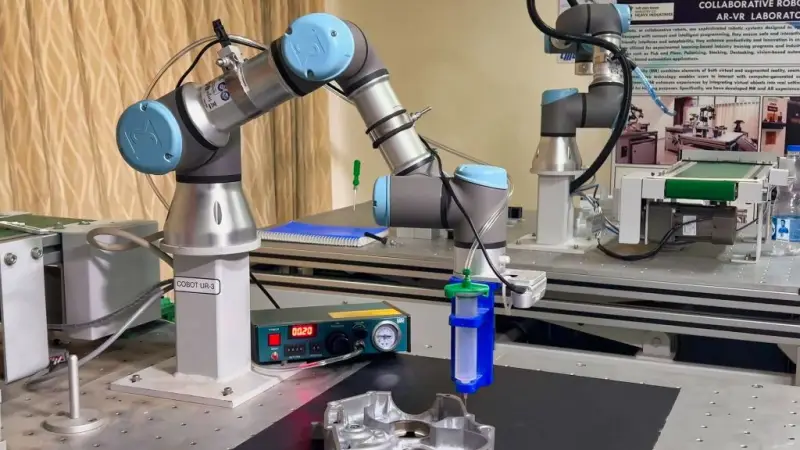
That approach targets a practical weakness in automated dispensing: a programmed trajectory can apply adhesive consistently only when the part is located as expected. By identifying features on the workpiece and calculating its pose, the system can handle placement variation without relying on external markers or the costly laser scanning setup described as a challenge in earlier research.
Why automate adhesive dispensing?
Manual gluing makes it difficult to maintain a uniform bead over a long production run. Variations in application can contribute to defective joints and scrap. A robot can repeat a defined motion and dispense a consistent amount of adhesive, while reducing workers’ exposure to solvent fumes and repetitive or awkward tasks.
The REVA team focused on a collaborative robot, which can be used around people when the application and risk controls support that arrangement. The source describes reduced need for safety fixtures as a potential benefit of cobots; it doesn’t provide details of a risk assessment or specify the conditions under which people and the robot shared a workspace.
The researchers were Prof. Bharath S.H, Akshay Ajit Bhawar and Joshua John, from the university’s School of Electronics and Communication Engineering. Their work was presented at an IEEE conference on Digital Signal Processing.
Detecting the part with YOLOv8
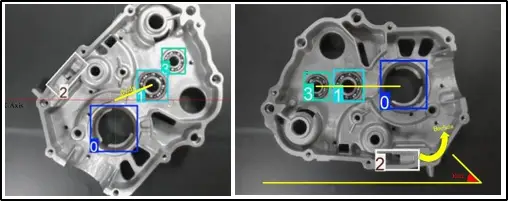
The vision system uses an Intel RealSense camera to capture images of components. The team assembled a custom image dataset, labeled features such as circular openings, cavities and reference holes, then trained a YOLOv8 object detection model using GPU acceleration. The selected model was intended to run in real time.
YOLO, short for “You Only Look Once,” is a family of neural network models used for computer vision tasks including object detection. Here, the important design choice was training it to recognize features that could help locate and orient the particular workpieces. That gives the robot visual references on the part itself, rather than requiring a separate marker to define its position.
The researchers’ approach also responds to drawbacks they associate with point cloud scanning: complexity, instability, cost and dependence on complex laser cameras. Their system instead combines a camera and feature-based detection with robot programming software and a Python interface.
From camera coordinates to a glue trajectory
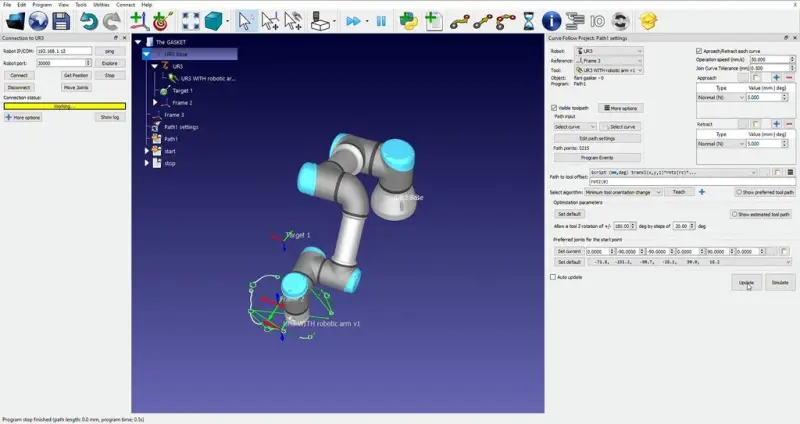
After YOLOv8 detects the part, the vision output describes its full 360° orientation. The team converts that result into a 4×4 transformation matrix. Applied to the reference frame and glue curve in RoboDK, the matrix shifts the programmed path to match the detected part pose.
The team used RoboDK’s Python API to connect the detection result to the robot program. The adjusted trajectory is stored as a curve-follow project, then RoboDK post-processors translate the path into joint commands for the UR3. Those commands are streamed to the robot over Ethernet in real time.
The adhesive is delivered through a pneumatic syringe fitted with a 0.3 mm nozzle. The dispenser was designed to be controlled by a foot pedal; in this system, the team wired that pedal to a robot digital output and activated it through the RoboDK program. This links dispensing to the programmed motion, so glue application can be coordinated with the robot’s path.
Reported results and next steps
The team reports that the setup achieved part alignment, trajectory adaptation and synchronized glue deposition in real time, with minimal error rates and deviation. No numerical error values, test conditions or production throughput figures are provided, so the results show the approach’s reported feasibility without establishing how it would perform across different materials, part shapes or factory duty cycles.
The system’s practical appeal is its combination of camera-based pose detection and a path that can be transformed before execution. That may help with applications where parts arrive in varying positions and external scanning equipment is difficult to justify. Integration still depends on the camera’s ability to see the trained features and on the dispensing hardware delivering adhesive as expected.
Next, the researchers plan to extend the method to multi-part assemblies, explore deeper learning approaches for more complex geometries, and apply it to processes such as sealing, welding and coating. Their stated aim is to support work from different approach angles while keeping tool alignment and trajectory control precise. Those extensions will test how well the vision and path-planning workflow carries beyond the component shapes used in the initial project.


