Renesas RZ/T2N MPU Integrates Four Axis Motor Control and Industrial Ethernet
- Saba Aafreen
- 532 reads
Renesas combines application processing, real time motor control and industrial networking in the RZ/T2N, with support for up to four motor axes.
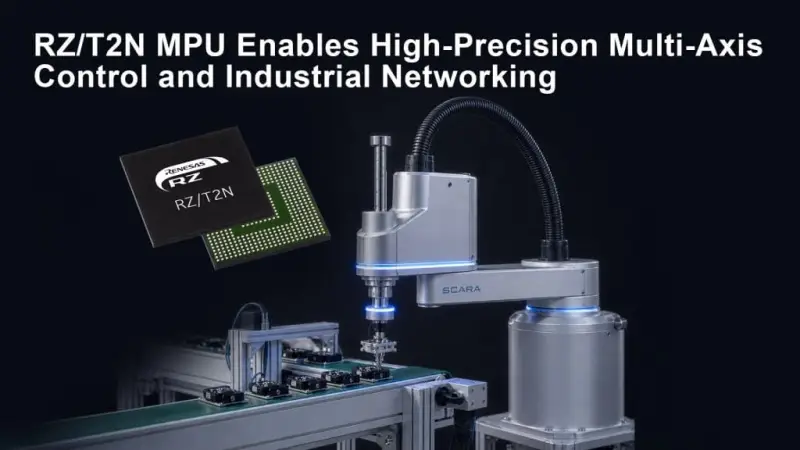
Renesas Electronics Corporation’s RZ/T2N brings application processing, real time motor control and industrial networking into one 64 bit microprocessor. For robot controllers, multi axis servo drives and programmable logic controllers, the integration could reduce the number of separate chips and simplify board design. The engineering question is how well one device can serve these different workloads while maintaining predictable motor control and network communication.

Separate cores for application and real time work
The RZ/T2N pairs two Arm Cortex-A55 application cores, running at up to 1.2GHz, with two Cortex-R52 real time cores, running at up to 800MHz. That division gives equipment designers processing resources for application tasks alongside cores intended for time sensitive control functions.

Each Cortex-R52 core has 576KB of tightly coupled memory with error correcting code (ECC) protection. Tightly coupled memory can give the control code a more direct, predictable route to data than relying on shared memory access. Renesas says this arrangement helps reduce execution time variation during motor control. That predictability matters in a servo system, where control computations must keep pace with feedback and scheduled updates.

Keeping application and control processing on one MPU can reduce the need to coordinate separate processors across board level interfaces. It also brings integration choices: designers will need to allocate tasks across the available cores and confirm that their software, timing requirements and system architecture fit the device. The published specifications describe the core arrangement and memory capacity; they don't state performance results for a particular robot or control algorithm.
Motion control for as many as four axes
Integrated motion control peripherals support up to four motor axes, a fit for equipment such as SCARA and Delta robots. The MPU provides two encoder interface channels per axis, giving control designs access to position feedback from supported encoder types.

Encoder compatibility spans Tamagawa T-Format, HIPERFACE DSL, A-format, EnDat 2.2, EnDat 3, BiSS C and BiSS Line. This range may help manufacturers build around different feedback systems, but the exact interface requirements still depend on the selected encoder and the machine design. The stated channel count is two per axis, so teams evaluating a multi axis application will need to map their feedback needs to those interfaces.

For an equipment maker, combining the motion peripherals with the Cortex-R52 cores can consolidate control functions that might otherwise sit across several components. The practical benefit is a smaller component set and potentially less board area, as Renesas describes it. Actual board savings will depend on the other devices and circuitry a product still needs.
Network interfaces and redundancy
Industrial communication is handled through three Gigabit Ethernet media access controllers, a three port Ethernet switch and an EtherCAT SubDevice Controller. The RZ/T2N supports EtherCAT, PROFINET RT/IRT and EtherNet/IP, as well as Time Sensitive Networking (TSN). Renesas positions the integrated network hardware as a way to handle communication without external communication ICs.
The device can act as a network controller or as a networked device, giving manufacturers the option to use the same processor family in different roles across industrial equipment. The three Ethernet MACs and switch provide the hardware basis for network connections; system designers still need to match ports, protocol software and network topology to each product.
Support for High availability Seamless Redundancy (HSR), Parallel Redundancy Protocol (PRP) and Frame Replication and Elimination for Reliability (FRER) addresses communication continuity when a network connection is interrupted. These protocols provide different ways to maintain or restore data delivery across redundant paths. The announcement does not specify network recovery performance or operating conditions, so those details need to be checked against the target installation.
Security and integration trade offs
Security features include secure boot, secure firmware updates and Arm TrustZone. Together, these features give designers hardware and platform mechanisms to protect startup, software updates and separated execution environments. Their effectiveness in a finished machine depends on how the product team configures and uses them.
The RZ/T2N’s central proposition is consolidation: application compute, deterministic motor control and industrial networking share one MPU. That can reduce component count and board complexity in systems that need all three, while placing more of the platform’s workload and integration planning on a single device. For engineers comparing controller architectures, the key checks are axis count, encoder compatibility, required Ethernet protocols, timing behavior and the software effort needed to bring those functions together.
Renesas announced the RZ/T2N on November 13, 2026. Its stated feature set targets robot and industrial equipment designs where motor control and network processing must operate alongside application software; final fit will depend on the requirements of each machine.