Nuvoton Gerda and Qt for MCUs Target Rich HMI Graphics Without External Memory
- Saba Aafreen
- 879 reads
Nuvoton pairs Gerda’s integrated memory and interfaces with Qt for MCUs graphics tools to support richer vehicle and appliance displays with fewer components.

Adding a more capable graphical interface to an embedded product usually puts pressure on memory capacity, component count and system cost. Nuvoton Technology Corporation Japan (NTCJ) and Qt Group are pairing the Gerda HMI controller platform with Qt for MCUs to address that trade-off: the combination is designed to run rich displays without external memory.

The target applications include motorcycle instrument clusters, head-up displays and washing machine panels. These products need interfaces that can present graphics and animation while remaining responsive to user input. By keeping the display workload within Gerda’s resources, the design can avoid adding a separate memory device to the bill of materials.


Memory use is the central design constraint
Gerda combines internal RAM with display, connectivity and control interfaces. Qt for MCUs supplies the graphics engine, reusable components and development environment. The software’s graphics are optimized to work with Gerda’s texture compression, reducing the memory needed to store and render visual elements.

That division of work matters in products where the interface must look more capable but the hardware budget is tight. External memory can add a component, board area and associated design work. If the graphics workload fits inside the controller’s available resources, removing that device can simplify the hardware and reduce component count. Nuvoton and Qt say this can lower system cost, particularly in products manufactured at high volume.

There are limits to what can be concluded from the announcement. It gives no RAM capacity, supported display resolution, frame rate, graphics benchmark, power figures or cost comparison. Those details determine whether a particular interface can fit the available memory and meet its response-time requirements. Product teams will need to assess their screen assets, animation complexity and application workload against the platform’s actual specifications.
Design tools and interface development
Qt for MCUs includes a component library and uses QML to describe user interfaces. Its development environment also includes simulation tools and AI-driven tools intended to reduce development effort. For embedded teams, reusable interface elements and simulation can help structure the work of building a display application, while the controller’s memory limits remain part of the design constraint.

The pairing is relevant where the display is an important part of the product experience but a separate graphics processor or memory device would be difficult to justify. A motorcycle cluster, for example, can use graphics to organize instrument information, while an appliance panel can present controls and status on a touch screen. The published examples show a motorcycle instrument cluster and a washing machine interface running on Gerda with Qt for MCUs.

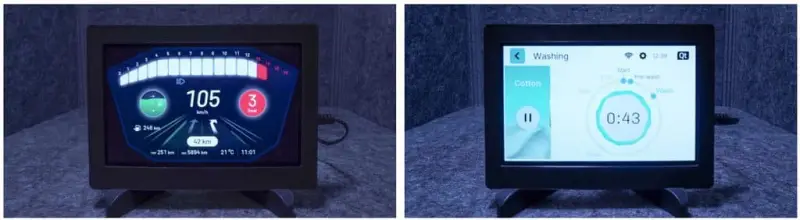
For engineers evaluating the platform, the practical question is whether its integrated memory and compressed graphics can support the intended screen content, animation and interaction at the required performance. The announcement describes the architectural approach, but does not publish limits or test conditions for those workloads. A design review would therefore need to confirm display compatibility and resource use for the specific application.
Updates over the air
The solution also supports over-the-air (OTA) updates for interface changes and added features. Gerda’s security features are intended to work with Qt for MCUs to enable that capability. This may help manufacturers maintain the user interface after products are deployed, especially in connected vehicles, two-wheelers and home appliances.
OTA capability adds a software lifecycle consideration alongside the graphics design. A product team needs to plan how interface updates will fit into its existing update process and how the controller’s security features support that implementation. The announcement does not specify update protocols, storage requirements or security mechanisms, so those details remain platform questions for system designers.
Yoshihide Kanakubo, vice president of Nuvoton’s Battery and Automotive BG, said the pairing is intended to balance graphical performance, memory efficiency and system cost. The clearest engineering value is the attempt to keep those goals in one controller-based design: the next step for developers is to verify that their actual interface fits Gerda’s resources and display capabilities without an external memory device.
Nuvoton’s announcement provides further details on the Gerda and Qt for MCUs combination.