SparkFun IoT RedBoard Pairs ESP32-P4 Processing With ESP32-C5 Connectivity
- Ananthu Ashok
- 747 reads
SparkFun’s RedBoard combines a 400 MHz ESP32-P4, ESP32-C5 wireless, MIPI interfaces and open KiCad files for embedded and HMI projects.
The SparkFun IoT RedBoard is built around a split design: an Espressif ESP32-P4 handles application processing, while an ESP32-C5 provides wireless connectivity. That division gives developers a board aimed at embedded systems and human-machine interface projects, with camera and display connections alongside familiar expansion options.

The ESP32-P4 runs at 400 MHz and is intended to process workloads involving images and sound. Wireless functions sit with the ESP32-C5, which supports dual-band Wi-Fi 6, including 5 GHz, Bluetooth 5 LE and Zigbee. The board also includes 32 MB of PSRAM and 16 MB of flash, with a microSD card for additional storage.

Processing, wireless and I/O on one board
Separating the application processor from the wireless companion establishes a clear division of work on the RedBoard: the P4 runs the main application, while the C5 manages radio communication. For projects combining a local interface with network links, that arrangement provides distinct processing and connectivity resources on a single development board. SparkFun positions it for embedded and HMI work; the listed capabilities also give developers a starting point for projects that combine visual or audio data with wireless communication.
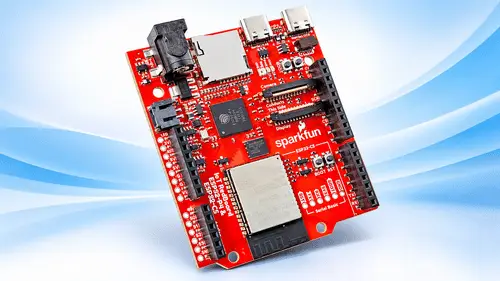
MIPI connectors provide interfaces for cameras and displays, giving the board a path to projects that need image capture or a screen. Two USB-C ports serve different development roles: one supports serial/JTAG programming, and the other provides high-speed USB OTG. Qwiic offers a connector option for compatible peripherals, while RedBoard/R3 expansion headers preserve access to the established board format.
For portable builds, a JST connector accepts a single-cell LiPo battery. Onboard charging and battery monitoring are included, though the supplied product information does not specify charging current, battery capacity limits or runtime. Those details would need to be checked against the board documentation and the chosen battery before designing a power budget.
Open files and software support
SparkFun publishes KiCad schematic and PCB design files in the project repository. Developers can use them to inspect component connections and board layout, or adapt the design as a reference for custom hardware. The repository also contains Arduino board support files, installation scripts and patches for the ESP32-C5 wireless interface.

The board ships with MicroPython and also supports Espressif’s ESP-IDF and the Arduino IDE. There is a software qualification to account for: standard Arduino ESP32 Core version 3.3.12 does not yet natively support the board’s ESP32-C5 wireless co-processor. SparkFun supplies a temporary patch while upstream support is being developed. Teams choosing an Arduino-based workflow should therefore include the patch and its installation steps in their setup, and verify that the required wireless functions work with their selected software versions.

That support status matters because the board’s appeal depends partly on the interaction between its two processors. The P4 can run application code, but projects using Wi-Fi, Bluetooth or Zigbee also rely on the C5 software path. The available patch provides a route to development now; developers will want to track native core support as it changes, particularly if their project needs a stable, repeatable build environment.
Variants and listed price
The ESP32-P4 and ESP32-C5 Wi-Fi/BLE version is listed at US$49.95. SparkFun also offers a separate PoE variant of the RedBoard that uses wired Ethernet instead of the wireless companion. The two configurations point toward different integration choices: the wireless version brings several radio options to the board, while the PoE model is intended for a wired network connection. The supplied details do not state the PoE variant’s price or provide a fuller specification comparison.
For a project that needs image or sound processing, a display or camera interface, and wireless links, the RedBoard brings those pieces together with expandable memory and open design files. The practical checks are software support for the C5, interface compatibility with the chosen peripherals, and power requirements for the intended build.