TAPe+ML v3.5 Runs Classification, Detection and Segmentation on One CPU Core
- Saba Aafreen
- 606 reads
Comexp’s 4.2 MB vision platform combines three tasks, with reported inference times of 20.4 ms on Raspberry Pi 5 and 34.7 ms on Pi 4.

Running image classification, object detection and instance segmentation on a compact computer doesn’t necessarily require a GPU. Comexp Research Lab’s TAPe+ML v3.5 combines all three tasks in a shared recognition core with fewer than 100,000 parameters, and is designed to run on one CPU core. The system’s reported results make it a candidate for embedded vision workloads where model size and compute resources are limited.

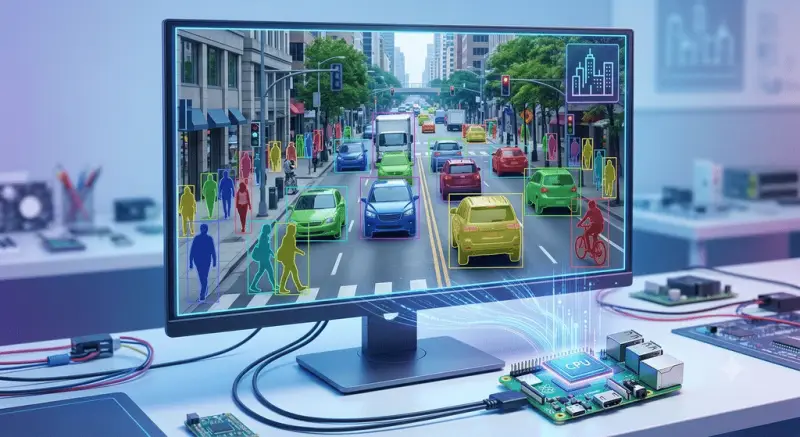
One shared image representation
Many vision applications combine several model functions: classification identifies what an image contains, detection locates objects, and instance segmentation marks the pixels belonging to individual objects. A system built from separate models may need to manage multiple inference paths. TAPe+ML’s approach is to construct a structured representation of the image first, then use that representation to support the different tasks.

That shared core is the main architectural point. The platform isn’t presented as three independent networks running in sequence; it aims to provide the three outputs through a common recognition system. For larger images, it also uses a learned region selector. In practical terms, selecting image regions can focus processing on portions that matter to the task, though the available description doesn’t specify the selector’s operating details or quantify its effect on speed.

The parameter count is below 100,000, and the complete system occupies about 4.2 MB. That total includes model weights, inference code and libraries, so it describes more than the weights alone. A small package can make deployment easier on storage-constrained devices, but file size by itself doesn’t establish memory use while running, power draw, or performance on a particular camera stream. Those figures aren’t provided.

Reported speed and accuracy
Comexp reports testing across several CPU configurations, including Raspberry Pi 4, Raspberry Pi 5 and Intel N100. Across the reported configurations, inference takes between 8.6 ms and 34.7 ms per frame using a single CPU core. The platform is listed at 20.4 ms per frame on Raspberry Pi 5 and 34.7 ms on Raspberry Pi 4.
Those per-frame times are useful reference points for teams evaluating edge hardware, but they don’t establish a universal frame rate. The description doesn’t give image dimensions, CPU clock settings, software versions, thermal conditions or the exact workload used for each timing. A deployment with a different input size or preprocessing pipeline may behave differently. The Intel N100 is included among the tested configurations, but no device-specific timing is given for it.

On ImageNet-1k, the system is reported to reach 88.0% top-1 accuracy. For object detection, it records 71.1 box average precision (AP) on the COCO validation set; for instance segmentation, it records 60.3 mask AP. The COCO test-set results are given as 66.0 and 58.0, without identifying which score corresponds to which metric in the description. These figures offer a view of the model’s task coverage, but the evaluation details provided don’t specify the input resolution or comparison conditions.

Deployment and workflow
The TAPe+ML workbench supports uploading images, adding annotations, training, evaluating and integrating through APIs. That workflow could help teams move from a set of sample images to an application-specific model, while keeping evaluation and deployment tools within the same environment. The description doesn’t specify supported image formats, API protocols, model export options or the steps required to run the platform on a particular board.
The system is available through an online platform, and Comexp says it can also be provided for local use on devices or on-premises. Some newer processors may need adjustment before they work with the software. That caveat matters for embedded projects: a low parameter count and small package don’t guarantee immediate compatibility with every processor or software stack. Teams will still need to confirm that their target processor is supported and measure performance under their own operating conditions.
The strongest case for TAPe+ML v3.5 is its attempt to combine three useful vision outputs in a compact package that can run on a single CPU core. Its reported Raspberry Pi timings make the platform relevant to low-cost edge systems, while its published accuracy figures provide starting points for evaluation. The next practical check is whether those results hold for a project’s images, input dimensions and target processor.
Comexp Research Lab’s TAPe+ML platform is available online, with local deployment offered for device and on-premises integration.


