UGCA 320’s Dark Matter Core May Extend 78,000 Light-Years Across
- Atharva Gosavi
- 822 reads
Two rotation-curve models point to a broad, low-density core in dwarf galaxy UGCA 320, challenging common explanations for its shape.
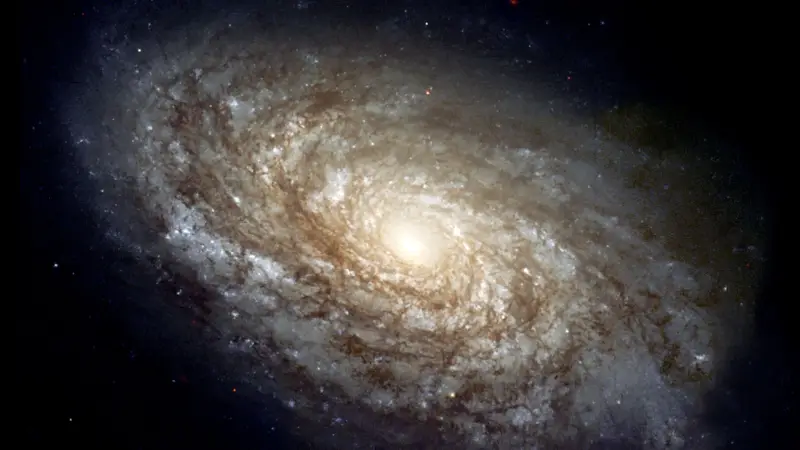
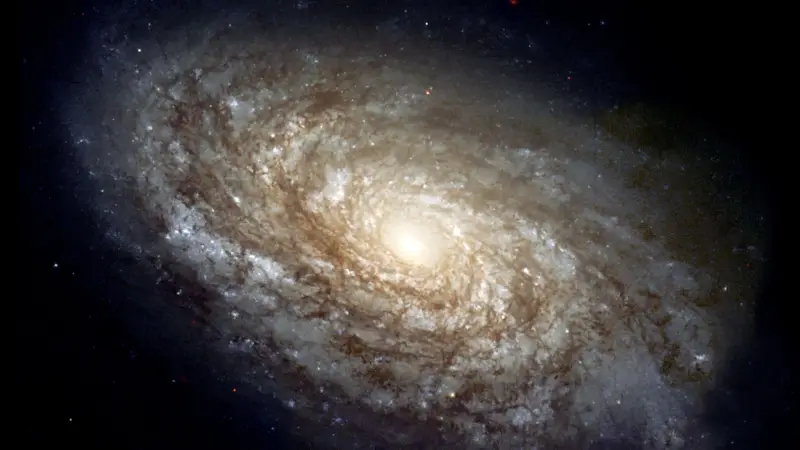
UGCA 320’s inferred dark matter core may extend far beyond the galaxy’s concentrated starlight. A study led by Qinwei Yuan of Nanjing University estimates a core radius of about 24,850 light-years in its main model; another model that fits the measured gas motions gives roughly 39,000 light-years, or about 78,000 light-years across. Either estimate describes an unusually broad, nearly uniform central region for a dwarf galaxy.
The scale matters because it puts pressure on explanations for how dark matter is arranged in small galaxies. A commonly used cold dark matter profile predicts density rising sharply toward the center. In UGCA 320, that profile implies faster inner rotation than the observations indicate. Models with a flatter central density distribution fit the measured rotation curve better.
Two telescopes trace gas at different radii
The team combined optical measurements from the MUSE instrument with radio observations from the MeerKAT telescope. MUSE tracked glowing hydrogen gas in the inner galaxy, while MeerKAT followed neutral hydrogen farther out. Together, the measurements cover gas moving around UGCA 320 at different distances from its center.
Those speeds form a rotation curve: a record of how quickly material orbits as its distance from the center changes. The curve provides a way to estimate the gravitational pull across the galaxy, including the contribution from matter that does not emit detectable light. The researchers first estimated the gravity from visible stars and gas, then used the remaining pull to infer the dark matter distribution.
This inference depends on the models used to connect orbital speeds with the galaxy’s mass. The rotation curve does not directly image a dark matter boundary or measure its density. Instead, different density profiles are tested against the observed motion. In this case, a central density peak produced too much predicted rotation in the inner region, while flatter-center profiles better matched the data.
The findings were posted to arXiv on November 11. The two best-fitting core sizes differ because the models describe the decline in dark matter density at larger distances in different ways. That spread is a reminder that the quoted diameter is a model-based estimate, not a directly measured edge.
The core dwarfs the galaxy’s bright center
Half of UGCA 320’s starlight comes from within about 6,600 light-years of its center. The smaller core-radius estimate is nearly four times that distance; the larger estimate is about six times as large. The implied dark matter structure therefore reaches well beyond the region containing half of the galaxy’s light.
The researchers describe a core of this size as uncommon among dwarf galaxies. That makes UGCA 320 useful for examining why some galaxies appear to have a shallow central density profile where a sharper rise might be expected. The measurement also highlights a practical distinction in galaxy studies: stars show where much of the visible matter lies, while gas motions help reveal the larger gravitational structure around it.
Known processes leave a size gap
One proposed route to a flatter center begins with repeated bursts of star formation. Supernova explosions can drive gas out of a galaxy’s central regions. As the gas moves, the gravitational field changes; repeated changes can redistribute dark matter and soften a central density peak. This mechanism links activity in ordinary matter to the inferred arrangement of invisible matter.
In UGCA 320, however, the team found that existing simulations of this process generally produce cores much smaller than the one indicated by the rotation data. That mismatch does not by itself identify a different mechanism, but it makes the galaxy a demanding case for models that rely on gas outflows alone.
The team also examined warm and fuzzy dark matter explanations. The particle masses required to produce a core this large were difficult to reconcile with other observations, according to the researchers. Self-interacting dark matter offered a closer fit to the findings: if particles scatter off one another, they can redistribute energy and help produce a broad core.
That explanation remains a possibility, not a particle identification. The observations constrain how mass appears to be distributed under the tested models, while the nature of dark matter remains unresolved. Finding similarly large cores in other dwarf galaxies would give astronomers a useful comparison and help test whether particle interactions can account for the pattern. For now, UGCA 320 stands out because its measured gas rotation points to a central structure that familiar simulations have difficulty making.