LCAC 32 Carries Three Apparent LAV-25s Near USS Boxer
- Daniel Kamberski
- 394 reads
Imagery shows LCAC 32 carrying three vehicles identified as apparent LAV-25s near USS Boxer, highlighting the craft’s ship-to-shore role.
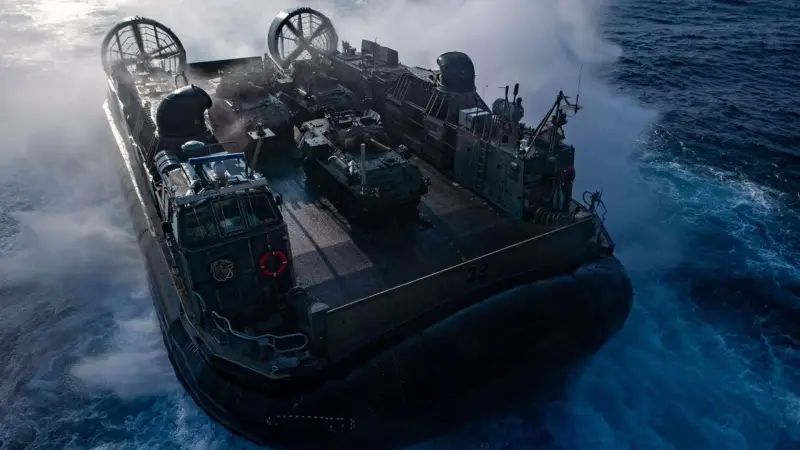
LCAC 32 was photographed carrying three vehicles identified as apparent LAV-25s near USS Boxer on Nov. 25. The scene shows the practical connection between a ship’s floodable well deck and a landing craft that can move heavy vehicles across shallow water and coastal terrain. The vehicle identification comes from an assessment of imagery; the Naval Forces Central Command (NAVCENT) captions confirm the craft operation but don’t name the vehicles.
LCAC 32 is a landing craft, air cushion. Its fans lift the hull on a cushion of air, allowing the craft to travel over water and across some surfaces that would stop a conventional boat. That air cushion is central to its ship-to-shore role: vehicles can move from a ship to shore without needing a port or a conventional ramp landing. The Navy lists the craft’s payload as 60 tons, or 75 tons in overload, and its speed as more than 40 knots (46 mph).
Vehicle identification and carrying capacity
The three vehicles appear to be LAV-25s, according to Army Recognition, which examined the released imagery. The LAV-25 is an eight-wheeled armored vehicle with a 25 mm M242 Bushmaster cannon. It has served in reconnaissance, security and direct fire support roles. The Marine Corps has used the type for roughly four decades, and the ARV-30 is planned as its replacement, as described in this overview of the LAV-25 replacement.
Three vehicles on one craft make the payload rating a useful point of reference, but the images don’t establish their exact configuration or weight. The Navy’s listed 60-ton payload provides the nominal capacity; the 75-ton figure applies to overload conditions. Neither the images nor the cited captions specify which rating applied during this movement, or disclose the vehicles’ individual weights.
The Navy says an LCAC can carry an M-1 tank. That comparison helps show the intended scale of the platform, though it doesn’t establish what LCAC 32 carried on Nov. 25 beyond the three vehicles visible in the imagery. More broadly, hovercraft can approach shore across shallow water and a range of coastal terrain, giving crews a way to transfer vehicles when conventional harbor access isn’t available. A similar overview of hovercraft vehicle transport explains the basic operating principle.
How the well deck fits into the transfer
Boxer is a Wasp-class amphibious assault ship measuring about 844 feet (257 meters) long, with a displacement of 40,500 tons, according to the Navy. Its well deck is an internal dock at the stern that can be flooded so landing craft can enter and leave the ship. In the reported scene, LCAC 32 was approaching that dock; the available description doesn’t establish what happened after the approach or document a landing ashore.
This ship-and-craft arrangement links two different parts of the transport task. The well deck gives the craft a place to load or unload while alongside the ship, while the LCAC’s air cushion supports movement across the water and toward shore. Together, those features let crews handle vehicles and cargo without relying solely on port infrastructure. That’s a practical capability described in general terms; the Nov. 25 imagery alone doesn’t show a specific destination or confirm a shore transfer.
LCAC 32 is assigned to Assault Craft Unit 5 (ACU-5). NAVCENT captions on other images of Boxer place the ship in the U.S. 5th Fleet area, supporting maritime security in the Middle East, and say the 11th Marine Expeditionary Unit is embarked. Those details provide deployment context, but they don’t identify the purpose of this particular craft movement.
What the imagery establishes
The date sequence is clear: the craft operation took place near Boxer on Nov. 25, and NAVCENT released imagery on Nov. 26. Army Recognition published its assessment on Nov. 27. The captions confirm the LCAC operation and its proximity to the ship, while the LAV-25 identification remains an interpretation of the visible vehicles. No landing ashore is described, and the available information doesn’t connect the images to a specific operation.
That distinction matters for engineers and operators assessing the scene. A photograph can show a craft, its position and the equipment apparently aboard, but it can’t by itself establish payload mass, operating conditions or the next stage of a movement. Here, the published specifications describe the LCAC class, while the exact load and purpose of this particular trip remain unspecified.
Craft replacement and ship work
The Navy accepted LCAC 114, a Ship to Shore Connector built by Textron Systems, on Aug. 28, 2025. The successor craft has a stated capacity of 60 to 75 tons, matching the range listed for the LCAC. Those figures point to continuity in the load range as newer craft enter service; the available details don’t establish how quickly older craft will leave service.
Separately, BAE Systems received a $149.8 million contract in August to repair and modernize USS Boxer at Naval Base San Diego, according to the company. The available information doesn’t clarify how that work relates to Boxer’s current deployment, so the contract and the Nov. 25 craft movement should be treated as separate developments.
The clearest takeaway is operational: LCAC 32 can carry a heavy vehicle load between a ship’s well deck and shore, while the particular vehicles seen near Boxer remain identified as LAV-25s by image assessment. Further detail about the load or the craft’s next movement would be needed to confirm more.