215-Foot Hydrocarbon Reservoir Found in Angola’s Block 15
- Georgina Jedikovska
- 669 reads
ExxonMobil’s Tchihumba West-01ST1 well encountered 215 feet of hydrocarbon-bearing sandstone in deep water off Angola.
A 215-foot (65.4-meter) hydrocarbon-bearing sandstone interval adds a new exploration result to Angola’s Block 15, where ExxonMobil and its partners are also investing in the next phase of offshore production. The discovery came from the Tchihumba West-01ST1 well, about 90 miles (145 kilometers) off the country’s northern coast. No estimate of recoverable oil or gas has been disclosed, so the thickness of the reservoir alone does not show how much production it could support.
The find is the 21st hydrocarbon discovery reported in Block 15 and the second there in 2026. Angola’s National Oil, Gas and Biofuels Agency confirmed the reservoir on November 19. The announcement came alongside approval of about USD 4 billion in planned investment for work on three offshore fields: redevelopment of Kizomba A and Kizomba B, and development of Likembe.

What the well encountered
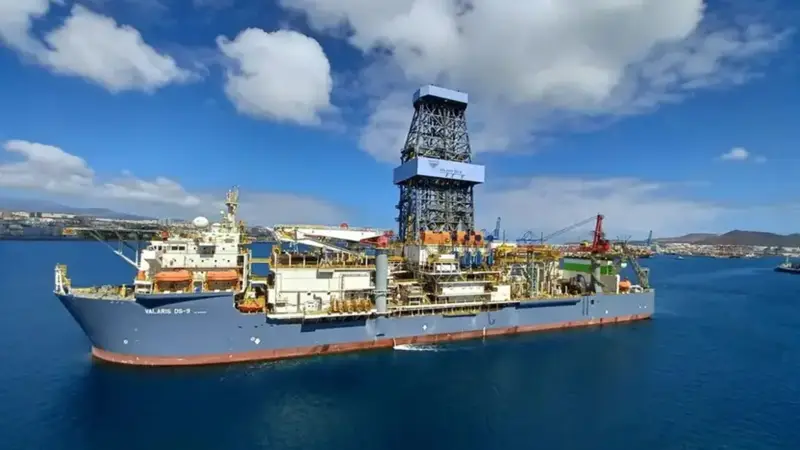
The Tchihumba West-01ST1 well was drilled by the Valaris DS-9 drillship at a water depth of 4,600 feet (1,400 meters). The location is roughly 217 miles (350 kilometers) northwest of Luanda. The vessel, formerly known as Ensco DS-9, is a sixth-generation drillship rated to operate in water depths of up to 12,000 feet.
The reported 215-foot interval consists of sandstone containing hydrocarbons. Its porosity and permeability are described as favorable: porosity gives rock space to hold fluids, while permeability indicates how readily those fluids can move through connected spaces in the rock. Both affect the reservoir’s ability to store oil and natural gas and allow them to flow toward a well. They are useful indicators of reservoir quality, but they do not by themselves establish recoverable volume or commercial production rates.
The agency has not provided an estimate of the reservoir’s size in place, its recoverable resources, or a development plan for the discovery. Those details matter for judging its practical contribution. A thick reservoir interval can still require further evaluation to determine its extent, fluid content and connection to surrounding rock. For now, the well adds evidence of remaining exploration potential in a block with a long production history.
Redevelopment and new field development
The broader investment decision is intended to extend activity across Block 15 by making use of existing offshore facilities and developing additional resources in the Kizomba area. Kizomba A and B are slated for redevelopment, while Likembe is planned as a new field development. The investment decision followed approval of the Kizomba C redevelopment in 2025 and completes the investment approval process for the Block 15 Life Extension Project.
Using existing facilities can give an operator a route to reach additional resources without building an entirely separate offshore system. The approach depends on whether those facilities can support the new work and whether the discovered resources can be produced through them. The plans announced for Block 15 point to infrastructure reuse as part of the production-life extension effort, though specific engineering scope, schedules and production targets were not provided.
The production-sharing agreement for Block 15 runs through 2037. That timeframe underpins the planned redevelopment and new field work, giving the partners a defined period in which to continue production and pursue further resources. The agreement’s extension and the roughly USD 4 billion investment plan were cited by ExxonMobil’s general director, Brian Unietis, as support for continued activity in the block.
What the milestones establish
ANPG board chairman Paulino Jerónimo described the Kizomba A and B investment decision, together with the Tchihumba West-01ST1 discovery, as a milestone for Angola’s oil industry. He said the well highlights exploration potential in mature producing areas. Unietis likewise pointed to investment, technology and exploration as continuing parts of the Block 15 program.
These announcements establish two distinct developments: a new hydrocarbon-bearing interval in an exploration well, and a funded plan to redevelop two producing fields while advancing Likembe. The discovery’s contribution to future output remains uncertain until its recoverable volume and development prospects are assessed. The immediate engineering question is whether further evaluation can connect the well result to a producible resource, while the field program tests how much life existing offshore infrastructure can support through 2037.