ATLase Project Sets Diode Laser Tests for Future Fusion Power Systems
- Muskan Bhatia
- 823 reads
FBH and PTB are developing measurement methods for diode lasers that may need to deliver 10–20 billion pulses in future fusion plants.
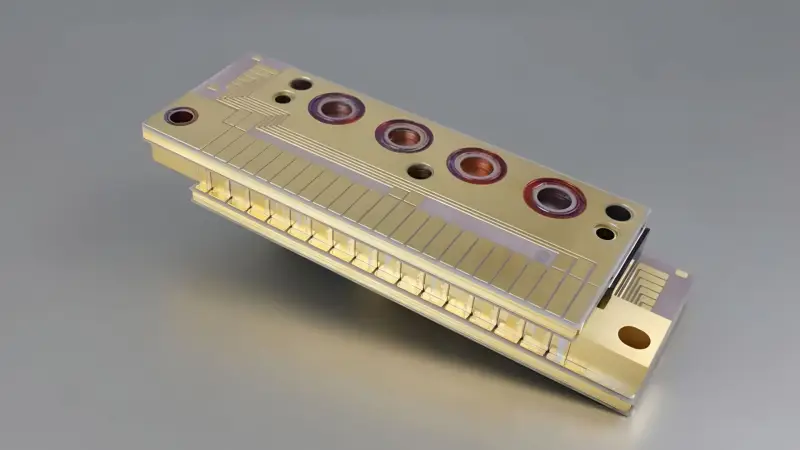
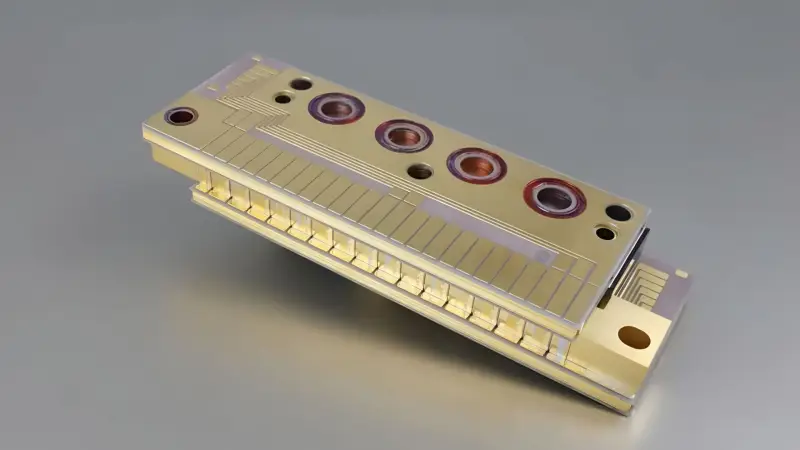
For a laser-driven fusion plant, the diode lasers that pump its main laser system may be needed in vast numbers and must withstand extraordinary pulse counts. Germany’s ATLase project is aimed at making those components easier to measure and compare, with test methods focused on output, efficiency and long-term reliability.
The Ferdinand-Braun-Institut (FBH) and Physikalisch-Technische Bundesanstalt (PTB), Germany’s metrology institute, began the project on October 1, 2026. Its goal is to develop standardized measurement methods and a qualification framework for high-power diode lasers. The partners intend for the work to provide a basis for an international qualification standard.
Why the pump lasers matter
In inertial confinement fusion (ICF), powerful laser pulses compress and heat small fuel pellets until light atomic nuclei fuse and release energy. Future plants are expected to use solid-state laser systems, with high-power diode lasers acting as their pump sources. The diode devices therefore sit upstream of the pulses that drive the fusion process, but their performance could have consequences for the size, cost and operating demands of the wider system.
The researchers estimate that a fusion power plant could require about 100 million diode laser bars. Each bar would be expected to survive 10 billion to 20 billion pulses over its operational lifetime. At that scale, modest differences in efficiency or service life could matter across a large installed base. Reliability is also central: if a component cannot maintain its required output for the expected pulse count, a plant would face replacement and maintenance demands that affect its operating economics.
That makes a shared way to assess performance useful for both component makers and the teams designing laser systems. Measurements made under comparable conditions can help distinguish device performance from differences in test setup. A qualification process can also give system integrators and researchers a common basis for judging whether diode lasers meet the demands placed on them.
The underlying solid-state laser systems are another part of the engineering picture. Diode lasers convert electrical energy into optical energy, which then pumps the larger laser system. The conversion efficiency of those pump sources affects how much input electricity is needed to produce the required optical output. For a plant expected to fire repeatedly over long periods, improving that efficiency is one route to limiting operating costs. The project’s measurements are intended to capture this performance alongside lifetime and reliability.
Testing output, efficiency and aging
FBH is building testing infrastructure to measure optical power, efficiency, lifetime and reliability in high-power diode lasers. The work will include accelerated aging tests designed to show how devices lose optical power or fail during quasi-continuous-wave (QCW) operation. Such testing can expose degradation patterns more quickly than waiting for devices to complete their full operational lifetimes, while helping researchers identify how performance changes as the components age.
The experiments will use next-generation wavelength-stabilized diode lasers with multiple p-n junctions. These devices will be assessed under the project’s test methods, with the findings intended to support improvements in pump-laser lifetime and reliability. The source provides no specific test duration or acceptance threshold, so the central deliverable is the measurement and qualification approach rather than a published lifetime result.
Comparability depends on measurement quality as well as test conditions. PTB will develop a calibration system for pulsed laser power up to one kilowatt, with relative measurement uncertainty below one percent. That capability is intended to give the partners a precise reference when assessing laser output. PTB will also build an identical secondary reference system at FBH, so qualification measurements can be checked against a consistent reference and traced to Germany’s national measurement standards.
A qualification route for suppliers and integrators
ATLase’s planned protocol is intended for manufacturers, research organizations and system integrators. Reproducible methods would let these groups evaluate diode lasers using aligned procedures, which matters when components from different manufacturers are considered for the same demanding application. A stable measurement basis can also help research teams compare devices as designs evolve.
The project’s reach depends on how well its procedures capture the conditions that matter in use. Optical power alone cannot describe whether a device will retain output through billions of pulses; efficiency and aging behavior need to be considered alongside it. The proposed combination of calibrated power measurements, reliability testing and qualification procedures addresses those connected questions, though the supplied project details do not specify the final protocol or the exact pass criteria.
FBH expects to begin offering qualification services during the third year of the project. That will give manufacturers and system teams a route to apply the methods as the framework develops. For future fusion plants, the practical takeaway is clear: the economics of laser-driven systems will depend in part on diode bars that deliver the required output efficiently and survive repeated operation. ATLase is setting out to make those properties measurable on a common basis.