Blaze Laser Cell Combines Robotic Welding, Hand Teaching and Enclosed Operation
- marketing team
- 746 reads
The Blaze Laser Cell pairs a seven-axis cobot with a 1 kW or 2 kW laser, hand-taught weld paths and an enclosed work area.
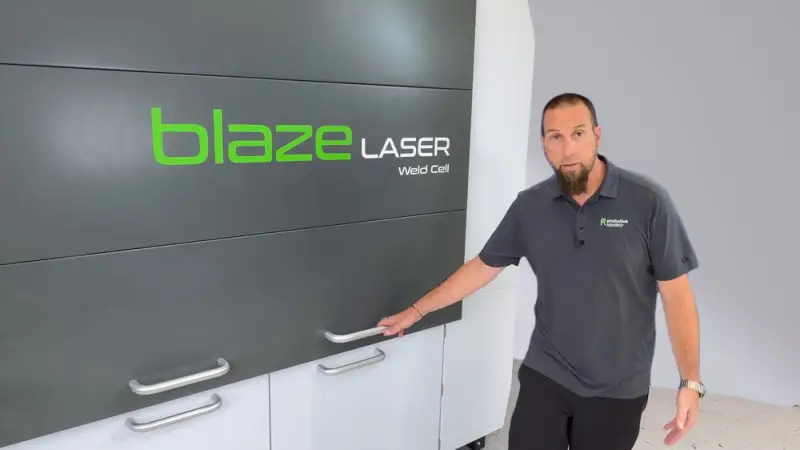
The Blaze Laser Cell packages robotic laser welding, part setup and operator monitoring in one enclosed station. Its main shop-floor proposition is straightforward: weld paths are taught by hand, while the robot works inside the cell and an operator watches from outside. That arrangement may reduce the space and programming demands that can make laser welding difficult to add to a shop.

The manufacturer says laser welding can run up to 5X faster than TIG. It also describes a more concentrated heat input, which can reduce thermal effects around the joint, and welds that may need less grinding or finishing. Those are useful aims for precision work, especially on thin parts or components prone to distortion. Actual results will depend on the part, joint and process setup; the stated speed is a maximum comparison, not a production guarantee.
Enclosed work area and operator monitoring
Blaze puts the welding robot inside a standalone enclosure, with a door interlock that stops the weld if the door is opened during operation. A green indicator blinks when the cell is safe to open. Live video from two angles appears on an external monitoring screen, so the operator can observe the weld without looking into the cell. Active fume extraction is built in, with ducting routed out of the station.
The product is presented as eliminating the need to construct a separate laser darkroom. That can simplify the physical layout for shops considering laser welding, though installation still requires attention to the cell’s siting, extraction ducting and operating requirements. The enclosure and interlock are central parts of the system’s safety approach; operators still need to follow the equipment maker’s instructions and applicable workplace procedures.

Teaching a weld by hand
The cell uses a seven-axis Blaze cobot and a hand-guiding method to define the weld path. In the demonstrated process, two sheets of cold rolled steel are placed in a fixture and secured with a bar. Buttons on the robot handle let the operator guide the torch to the start and end points. A torch positioner holds the torch angle as the robot moves, helping keep that orientation consistent along the taught path.
After setting the path, the operator moves the robot out of the way and previews the job. The weld runs after the door is closed, while the operator monitors the process on the external screen. This workflow avoids conventional robot path programming for the demonstrated task, but it still depends on accurate fixturing and a properly taught path. Repeatability is specified as ±0.1 mm (.004"), a figure relevant when assessing how consistently the robot can return to a taught position.

In the steel-sheet demonstration, the finished bead is described as uniform on the top side, with full penetration and no burn-through across the back. That result illustrates the cell’s process, but it does not establish a universal outcome for other materials, thicknesses or joint designs. Production qualification still has to be based on the parts and weld requirements at hand.

Power, work area and material limits
The cell is offered with a Miller OptX laser rated at 1 kW or 2 kW. The 2 kW version also provides cleaning before and after welding, in passes up to 15 mm wide. The package includes a 4 ft x 8 ft table with LED lighting, two-angle Blaze Vision video and active fume extraction. The Blaze Laser Cell, Blaze cobot and Miller welder each carry a stated three-year warranty.
Listed material and thickness limits are:
| Material | Maximum thickness |
|---|---|
| Stainless, galvanized and mild steel | Up to 0.315" |
| Aluminum 3 and 5 series | Up to 0.315" |
| Aluminum 6 series | Up to 0.200" |
| Nickel alloys | Up to 0.275" |
| Titanium | Up to 0.275" |
| Copper | Up to 0.120" |
These figures give shops an initial screening range, but they do not specify joint geometry, process settings or acceptance criteria. Teams assessing a particular job will need to confirm that the material grade, fit-up and weld requirements suit the available process and power level.
What the package changes for a shop
The cell’s practical appeal rests on combining several pieces of the workflow: an enclosed welding area, a robot taught by hand, external video monitoring and extraction. For shops with suitable parts, that could make it easier to trial robotic laser welding without building a separate room or relying on a specialist to write every robot path. The listed California facility designs and builds the Blaze cobot, and the company says it provides direct factory support.
The useful next step is to compare the listed material limits and table size with actual parts, then establish whether the required joint quality and cycle time can be achieved in a representative trial. Laser welding’s speed and lower heat input can matter most where distortion, finishing time or throughput constrain the existing process; the cell’s value depends on how those factors line up with the shop’s work.