ChessCoreXY: Raspberry Pi 5 Powers a Voice-Controlled Physical Chessboard
- James Martinez
- 785 reads
Johannes Kindler built a physical chess opponent around a CoreXY mechanism, custom sensor boards and a Raspberry Pi 5 2GB.
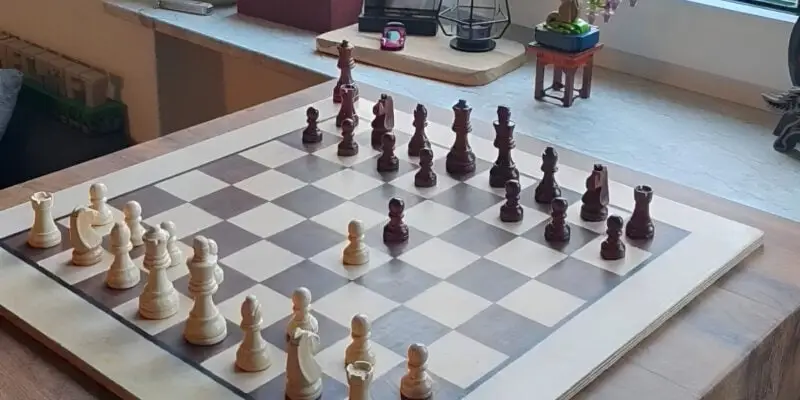
A physical chess-playing robot has to solve two problems at once: it needs to run a chess engine, and it must move pieces reliably across a board. Johannes Kindler’s ChessCoreXY project brings those jobs together in a compact machine, with a CoreXY mechanism handling piece movement and a Raspberry Pi 5 2GB coordinating the system.

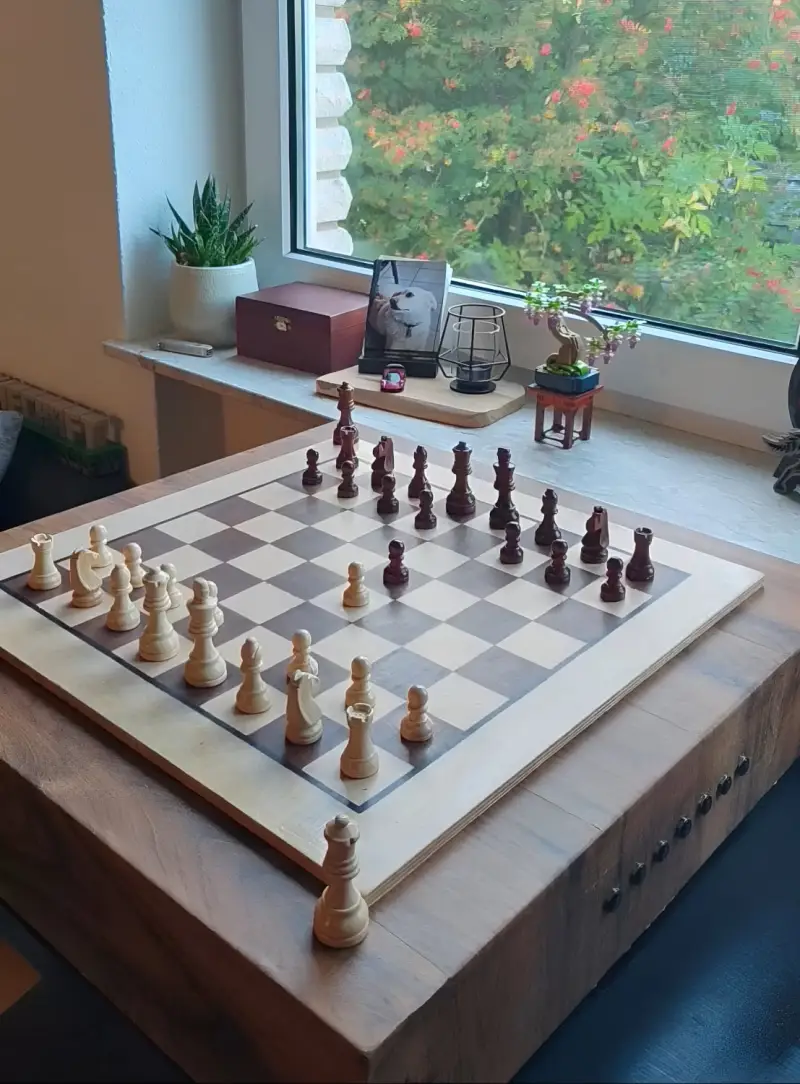
Designing around the mechanism
Kindler began by setting requirements for the computer at the centre of the build. It had to accept voice commands, provide an I2C bus for custom sensor boards, run chess engines, and fit beneath the chessboard without obstructing the moving parts. Wi-Fi, Bluetooth and a graphical user interface were also on the list.
Those requirements point to a small embedded computer doing more than one kind of work. It needs to host the software that decides on a move, communicate with sensors, and provide a way for a person to interact with the machine. At the same time, its physical placement matters: electronics tucked under the board must stay clear of the CoreXY assembly as it travels to move pieces.

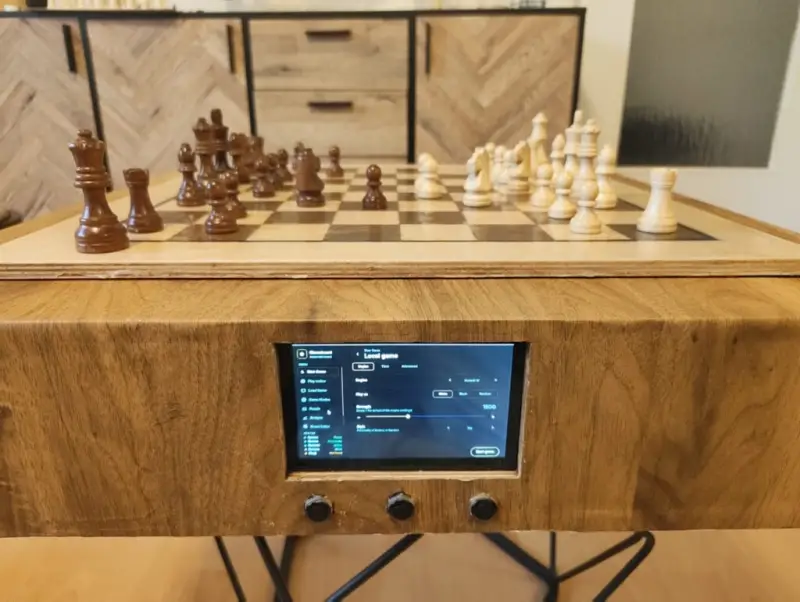
Kindler chose a Raspberry Pi 5 2GB. The specified memory capacity and the board’s small form factor suited the project’s stated constraints, while its I2C interface gave him a route to connect custom printed circuit boards carrying sensors. Built-in Wi-Fi and Bluetooth addressed the wireless connectivity requirement, and the Pi could also support the graphical interface and chess-engine software.
Why use CoreXY?
CoreXY describes a motion arrangement in which belts and motors coordinate movement along two axes. By combining motor inputs, a carriage can travel across a work area while the motors remain mounted away from the moving head. In a chessboard application, that kind of planar motion offers a way to position a tool or magnet over different squares, with the mechanical system responsible for carrying a piece to its next location.
The choice makes the board’s usable area and the mechanism’s clearance central design concerns. The carriage must reach the relevant squares, while the computer, wiring and sensors need to occupy space that does not interfere with the belt path or moving assembly. That is why Kindler’s requirement that the computer fit beneath the board is more than a packaging preference: it connects the electronics layout directly to the motion system.
The available project description doesn’t specify the exact belt layout, motors, sensors, piece-handling method or motion accuracy. Those details determine how the machine translates a chess move into physical movement, so they can’t be inferred from the CoreXY name alone. What’s clear is that the mechanism and sensing hardware are part of a coordinated build rather than a chess engine attached to an ordinary screen.

Connecting software to physical play
Chess engines calculate moves, but a machine playing on a physical board also needs a reliable account of the position. Sensors on custom boards can contribute information about the board state; the I2C connection gives the Raspberry Pi a way to communicate with those boards. The source material doesn’t identify the sensors or describe how the system detects a player’s move, so the precise sensing approach remains unspecified.
Voice input adds another interaction path. In principle, it can let a player issue commands without using a touchscreen or keyboard, while a graphical interface can present information and control options. The build’s requirements include both voice commands and a GUI, though no particular speech-recognition software, interface design or command set is described.
This mix of computation, sensing and motion is what makes ChessCoreXY an engineering project as much as a chess gadget. The Pi has to sit at the boundary between software decisions and physical actions: it runs the chess-related workload, exchanges data with the sensor boards, and forms part of the user interface. The project’s compact layout puts those roles into a machine designed to play over a real board.
A compact platform for a physical opponent
The choice of Raspberry Pi 5 2GB follows from the combination of requirements Kindler set at the outset: processing for chess engines, I2C support for custom sensor hardware, wireless connections, a GUI and a small footprint. The description doesn’t give benchmark results, engine strength, move time, cost or a release schedule, so there’s no basis for comparing its playing performance with other systems.
For builders, the useful lesson is in the system-level planning. A board computer may be fast enough for an application and still be unsuitable if it blocks the mechanism, lacks the needed interfaces, or leaves no practical route to connect sensors. Here, the computer choice was tied to the physical envelope and the electronics architecture from the start.
ChessCoreXY turns a familiar board game into a small robotics integration task: compute a move, connect to sensors, accept a player’s input and coordinate a mechanism that moves pieces. Its defining idea is that a chess opponent can occupy the space under the board and interact with the game through physical motion, with the Raspberry Pi 5 2GB selected to fit that combination of software, connectivity and packaging needs.