Staunch Electronics India Builds EMS Capacity Across Batteries, Audio and Appliances
- Semiconductor For You
- 678 reads
Staunch combines product engineering, testing and manufacturing across four consumer electronics categories, while pointing to component localisation as the next step.
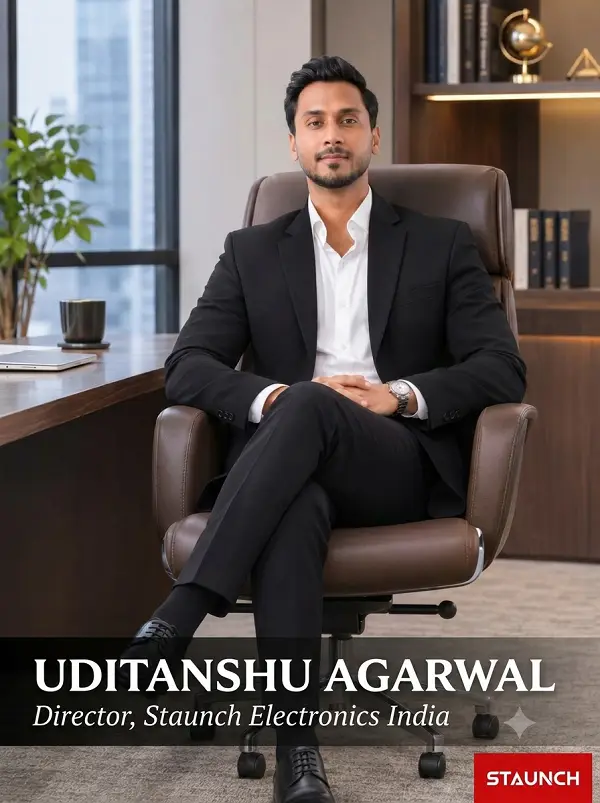
Staunch Electronics India’s manufacturing proposition spans product development, component selection, production and testing across a broad set of consumer electronics. That breadth gives the company a platform to serve brands from early design work through scaled manufacturing. Its next challenge, as director Uditanshu Agarwal describes it, is to deepen local component supply and increase the value created within India’s electronics supply chain.
In a conversation with Vaishali Umredkar, editor of Semiconductor For You, Agarwal discussed the company’s EMS, OEM and ODM work, its manufacturing and test capabilities, growth priorities, and the conditions he believes could help domestic manufacturers expand.
From product brief to production
Staunch describes itself as an end-to-end manufacturing partner, bringing product engineering, research and development, sourcing, manufacturing, testing and quality assurance into one operating model. The company reports a combined manufacturing footprint of 2 lakh sq. ft., a workforce of more than 1,000 employees, over 100 million products manufactured and partnerships with more than 50 brands.
Its product range covers four main areas: power, audio, small appliances and personal care. Power products include lithium-ion batteries and battery packs, mobile phone and smartwatch batteries, power banks, chargers and cables. The audio range includes TWS earbuds, neckbands, headphones, Bluetooth and party speakers, and soundbars. Kitchen appliances include rice cookers, air fryers, kettles, pop-up toasters and infrared cooktops. Personal care products include trimmers, hair dryers, curlers, straighteners and blow brushes.
This mix matters because brands can bring different products to a shared engineering and production platform. The work can begin with customisation or product design, then move through component selection, validation and prototyping before production. Staunch also offers reverse engineering, design for manufacturability and product and cost optimisation. Those activities can expose production constraints while a design is still being developed, when changes are generally easier to incorporate.
Prototyping gives the brand and manufacturing team a chance to assess whether product requirements translate into a workable design. Component validation checks whether selected parts are suitable for the intended product, while design for manufacturability considers how the design will be made at scale. Staunch presents these as connected services: engineering decisions made early can inform production planning and subsequent quality checks.
Testing is part of the manufacturing offer
The company’s facilities combine assembly lines and manufacturing equipment with engineering infrastructure and in-house laboratories. Its stated test coverage includes temperature and humidity, short-circuit performance, battery charge and discharge, battery capacity, drop and weight impact, bump, radio-frequency performance and audio testing.
That range reflects the different demands of the product categories. Battery products require checks tied to capacity and charge or discharge behaviour; audio devices need evaluation of their RF and audio performance; and portable products can be assessed for impact and environmental conditions. Staunch also names specialised equipment including laser welding machines, automatic battery quality testers, laser printing machines and automatic glue dispensers.
These tools support repeatability in the operations for which they are used, while testing provides a way to assess product performance and durability. Agarwal says the company also focuses on traceability, on-time execution, customer support and ISO-certified processes. He cites applicable ISO, ISI and BIS requirements as part of its quality approach. The specific standards and test limits depend on the product; the company’s description does not provide individual test protocols or acceptance thresholds.
For a brand, the integrated arrangement can reduce the number of separate organisations it must coordinate across development, production and testing. It also gives the manufacturer a role in design decisions that affect assembly and inspection. The practical value depends on how closely those services match a product’s requirements, but the model is intended to carry customised products into repeatable manufacturing.
Local suppliers need to meet production demands
Deeper localisation is a central theme in Agarwal’s account of the sector’s development. A domestic component base, he argues, needs to provide more than nearby sources of parts. Suppliers must be able to meet requirements for quality, cost, scale, technology, delivery and compliance consistently.
He identifies several obstacles: globally competitive component pricing, stable quality, access to specialised materials and technologies, the ability to scale output and the need to keep pace with changing product specifications. Testing and validation are also important, particularly for batteries and connected electronics, where performance and safety have to be assessed as part of product development and production.
Building this base takes sustained investment and coordination among component suppliers, EMS companies, OEMs, ODMs and brands. Supplier development and qualification can help manufacturers assess whether a supplier can meet production needs. Investment in process technology and testing can support consistent output. More predictable demand can also give suppliers a clearer basis for investing in capacity.
Staunch says its component selection and validation, reverse engineering, product engineering and design-for-manufacturability work help it assess parts and adapt products for production. As Indian suppliers expand their capabilities, closer engagement could improve responsiveness and supply-chain resilience while increasing the share of product value created domestically. Agarwal places semiconductor development within this wider ecosystem, while describing Staunch’s current business as focused on electronics products and EMS capabilities rather than semiconductor fabrication.
Automation and engineering for repeatability
Staunch’s account of factory technology centres on combining skilled staff, selected automation, engineering practices and testing. The company points to laser welding, automatic battery quality testing, laser printing and automatic glue dispensing as examples of equipment used in its manufacturing operations. It says these tools support process consistency in the relevant tasks.
Engineering work also starts before products reach the line. Component validation and design for manufacturability are intended to address potential production issues during development. Product optimisation can help align a design with manufacturing requirements, while standardised quality checks provide a repeatable basis for inspecting output as volumes grow.
Agarwal describes digital manufacturing and further automation as areas for continued development, with investment guided by product requirements, operating needs and the quality expectations of brand partners. The account does not specify particular digital systems, automation rates or efficiency gains. The emphasis is on selecting equipment and process controls that suit the operation, then maintaining the test coverage needed for each product.
Growth across established product categories
Staunch sees opportunities in categories where it already has manufacturing experience: batteries and power products, wireless audio and hearables, small kitchen appliances, and personal care electronics. The company expects demand for connected, feature-rich and convenient products to create openings for brands to update existing ranges and develop new ones.
In power, that means products such as battery packs, power banks, chargers and cables. Audio opportunities include TWS earbuds, neckbands, headphones, speakers and soundbars. Kitchen products range from rice cookers and air fryers to kettles, toasters and infrared cooktops. Trimmers, hair dryers, curlers, straighteners and blow brushes make up the personal care group.
The company says it plans to prepare by strengthening its engineering, manufacturing and testing platform, investing in research and development, and involving its teams earlier in product development. For battery-related products, its stated test work includes capacity, charge and discharge behaviour and short-circuit performance. The multi-category model lets it serve varied product briefs while drawing on shared engineering and quality infrastructure.
Over the next three to five years, Staunch’s stated priorities are to deepen relationships with existing customers, develop new OEM and ODM partnerships and strengthen capabilities across its current categories. It also aims to build international business by engaging overseas brands seeking manufacturing partners in India. Agarwal says any expansion of the manufacturing footprint or specific investment commitments will depend on customer demand and business requirements.
What the company wants from the next phase
For India’s electronics manufacturers, Agarwal argues that the next phase should move beyond assembly towards component localisation, technology development and higher domestic value addition. He points to support for component manufacturing and production capabilities, competitive access to manufacturing inputs, long-term finance, export access, automation and workforce skills as areas that could help firms build capacity.
His priorities include extending support across a wider range of components, sub-assemblies and production processes; reviewing duties on components and raw materials; and addressing cases where duties on inputs make local production less competitive than finished imports. He also calls for affordable long-term finance, particularly for small and mid-sized manufacturers investing in facilities, machinery and technology.
On exports, Agarwal highlights predictable support, simpler customs processes and help with international market access, branding and logistics. He also points to incentives for automation, robotics, precision manufacturing, quality control and research and development, alongside workforce training. These measures, in his view, would help manufacturers improve productivity and product quality while strengthening their ability to serve international customers.
For Staunch, the core capability is already framed as a connected chain from product engineering through testing and scaled production. Its longer-term opportunity depends partly on how effectively that platform can support new product requirements and international customers. Across the sector, deeper local supplier capability will determine how much more of the electronics value chain can be built within India.