TI Sees India Growth in GaN Power, Electrification and AI Data Centers
- Semiconductor For You
- 310 reads
TI’s India focus spans power conversion, vehicle electrification and data centers, with local engineering support and INR purchasing for eligible customers.
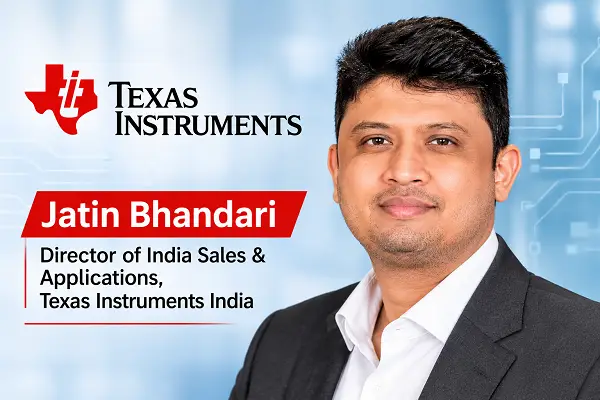
Power conversion sits at the center of several fast-growing engineering needs in India, from electric two-wheelers and solar inverters to AI data centers. At electronica India, Jatin Bhandari, Director of India Sales & Applications at Texas Instruments India, described how the company is working with local engineers on those systems, alongside space-grade electronics and purchasing options in Indian rupees.
TI presented more than 20 live demonstrations at the event, covering sustainable energy, automotive electronics such as remote keyless entry, and wireless connectivity. Bhandari framed the company’s role as direct engineering support: understanding system constraints, helping assess architectures, and offering reference designs that can shorten product development work.
Power density meets system constraints
Designers often have to balance size, weight, power consumption and cost at the same time. Bhandari said TI teams in India work with customers to evaluate those requirements and identify opportunities to improve efficiency and integration. Gallium nitride (GaN) and real-time C2000 microcontrollers are among the technologies TI points to for power-conversion designs where efficiency and power density matter.
The practical value depends on the full system. In electric vehicles, Bhandari said a 2% to 3% efficiency increase can translate directly into more driving range, a relevant trade-off for original equipment manufacturers. That gain has to be considered alongside component cost, thermal behavior and the rest of the vehicle’s power architecture; the interview did not specify a test setup or particular design behind the figure.
Electrification is also extending across two-wheelers. Bhandari cited growing demand for power management, battery management systems, motor control and advanced displays as vehicles become more connected and electrically driven. These subsystems put different demands on a design, but they share a need to manage energy efficiently while fitting the product’s size and cost limits.

Data centers and renewable energy
AI workloads are increasing the amount of processing data centers must support, while operators still have to manage power consumption, heat and system efficiency. Bhandari pointed to Zoho’s 48 V data center racks, which he said use more than 60% TI components. He described TI power-management technology as a resource for engineers designing for those constraints; he did not provide rack-level efficiency or performance figures.
Renewable energy is another area where power conversion and measurement are central. Bhandari identified opportunities across solar conversion, energy storage, power distribution and measurement, including localized 3.6 kW solar inverters that can be adapted to different application requirements. That rating describes the inverter class discussed; the interview gave no further electrical specifications or deployment details.
These examples point to a common engineering task: converting and controlling power while respecting limits on heat, physical size and cost. Reference designs and direct application support can help teams evaluate system choices, but their usefulness depends on how closely they match a product’s operating conditions and requirements.
Radiation-hardened parts for space systems
TI also works with India’s aerospace ecosystem on satellite systems, Earth observation and related applications. Bhandari said the company offers radiation-hardened, space-grade semiconductors and supports missions including Chandrayaan-3 and Mangalyaan. He also cited a contribution to the Earth-observation capabilities of the NASA-ISRO Synthetic Aperture Radar (NISAR) mission.
For space electronics, component selection has to account for the demands of the mission and the system architecture. Bhandari described TI’s approach as engaging with engineers to understand technical challenges and identify suitable semiconductor technologies. He did not name specific parts or provide radiation, temperature or reliability ratings, so those details remain design-specific.
Purchasing in Indian rupees
Alongside engineering support, TI has changed part of the purchasing process for Indian customers. Bhandari said eligible customers can buy backlog orders directly from TI in Indian rupees (INR). Using local currency can simplify transactions for those purchases by reducing the need to manage foreign-currency payments. Eligibility applies, and the interview did not specify which orders qualify.
TI’s India pitch links engineering access with applications where power management is becoming more demanding. For design teams, the next useful details will be application-level: which parts and reference designs fit a particular voltage, thermal envelope, reliability target and supply arrangement.