One-Year Build: KNDS and FORVIA's Wheeled Robot Mule Enters Trials
- Kaif Shaikh
- 750 reads
KNDS and FORVIA built a wheeled load-carrying UGV in one year. Its three-tier control scheme moves from manual teleoperation toward bounded autonomy.
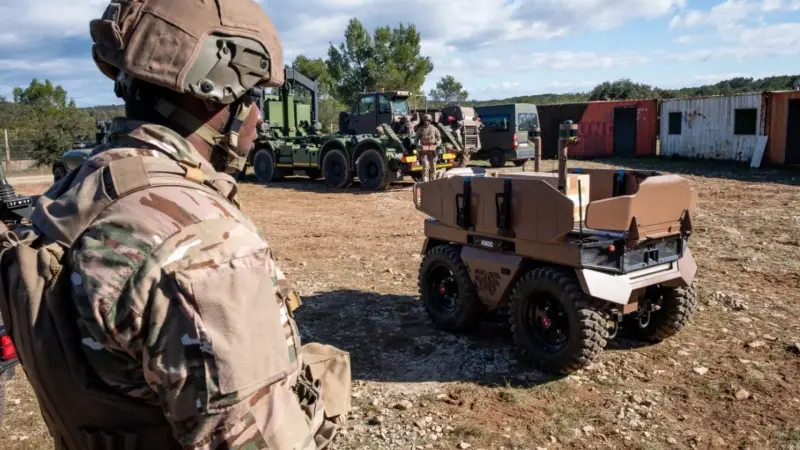
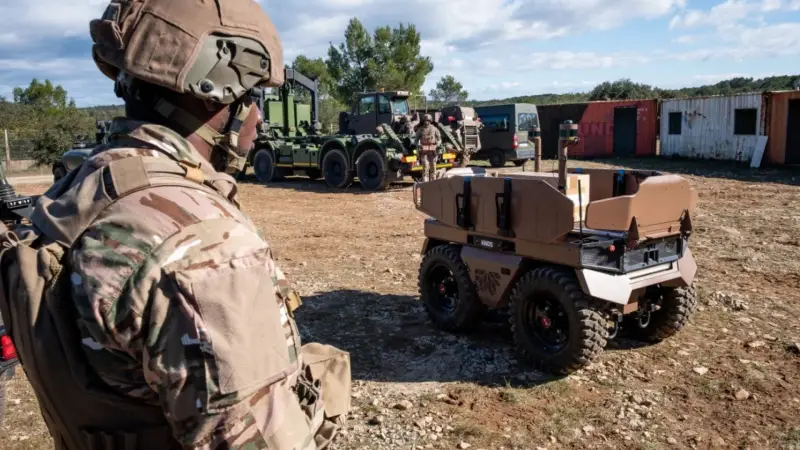
The French Army has started field trials of a wheeled, load-carrying unmanned ground vehicle (UGV) built to haul heavy kit and keep maintenance crews out of harm's way. The robotic mule was handed to the army's Maintenance Brigade during Exercise DOUMENC in November 2026, and it's the first of three vehicles slated for rapid evaluation. What stands out to me isn't the payload, which is modest. It's the schedule. Franco-German contractor KNDS and French automotive supplier FORVIA took the platform from concept to hardware in about one year.
Why a one-year timeline matters
Ground robots usually take a long time to mature because teams tend to chase full autonomy before anything reaches users. This program takes the opposite approach. Engineers are fielding the vehicle in stages so that personnel can train alongside unmanned machines right away, and they're letting operational feedback shape the autonomy work rather than waiting for a finished system.
That's a sensible way to handle the problem. A mule that can be driven by hand is useful on day one. Its sensors, control software and operator procedures can then be refined against real loads and real terrain. Teams in this position typically find that the hardest problems aren't the ones they predicted on paper, and early hardware exposes them far sooner.
Three tiers of control
According to the French Army Technical Section, known by its French initials STAT, the first evaluation ran from November 7 to 11, 2026, during Exercise DOUMENC. The work was coordinated with the procurement organisation of the French Ministry of the Armed Forces and with the Logistics Brigade.
The vehicle carries an open mesh cargo flatbed suited to crates of spare parts, tools and personal equipment over rough ground. The control architecture has three levels:
- Tier one: the operator drives the vehicle directly with a handheld remote controller, with no robotic intelligence involved.
- Tier two: an integrated robotization kit lets a remote operator steer the mule from a distance using live feeds from onboard cameras.
- Tier three: the UGV navigates on its own inside operational boundaries set by the KNDS and FORVIA system architecture.
STAT described the trial as "a first concrete step" toward ground robotics that ordinary soldiers can run routinely. The tiered design makes sense to me because each step can be validated before the next one is added. Teleoperation is the baseline. Camera-based remote driving adds latency, bandwidth and situational-awareness questions that need answers before anyone trusts the vehicle with autonomy. Bounded autonomy, where the machine handles routing and obstacle avoidance inside a defined area, is the hardest of the three to certify. Fencing the operating envelope is a practical way to cut the risk while the software matures.
The source material doesn't give the sensor suite, navigation stack, payload rating or battery specifications, so I won't guess at them. What's clear is that the control scheme is layered on top of a conventional wheeled chassis, which lets the team validate the mechanical platform separately from the autonomy software.
Automotive know-how in a defence programme
The KNDS and FORVIA pairing shows how European defence planners are drawing on commercial automotive manufacturing to shorten development cycles. KNDS brings heavy vehicle engineering and robotics experience. Earlier this year it converted an older tracked vehicle into a remote-controlled platform using its TOXO robotization kit, so the company already has a retrofit approach it can reuse. FORVIA contributes high-volume automotive electronics, sensors and chassis integration.
That division of labour matters. Automotive suppliers are used to designing for cost, for mass production and for long validation cycles across many variants. Heavy-vehicle specialists know how to build for durability, load paths and field maintenance. When the two are combined, the result can start to look like a well-proven car-grade electrical architecture wrapped in a rugged, purpose-built frame. Whether that holds up in service will depend on how the sensors, drive units and power system perform under sustained, dirty, real-world use, and that's exactly what the trials are meant to reveal.
What comes next
French army leadership has set a long-term goal of fielding robotic units by 2040, with logistics and load-carrying mules serving as the entry point before more complex ground systems follow. Alongside the KNDS-FORVIA mule, STAT and French regiments have tested several other unmanned platforms throughout 2026. These include the hydrogen-powered Hermione UGV and compact forward-reconnaissance rovers. Two additional KNDS-FORVIA vehicles are scheduled to join the Maintenance Brigade in upcoming trials, focused on refining autonomous navigation and payload handling under realistic field conditions.
Here's what I'd watch in those trials: how the tier-three boundaries are defined and enforced, how the vehicle behaves when comms degrade and the operator loses the camera feed, and how quickly the maintenance crews move from tier one to tier two. Those answers will say more about the program's real pace than the one-year build time does.