Copper-Sulfur MOF Crystal Pairs Metal-Like Conduction With Infrared Sensitivity
- Mrigakshi Dixit
- 986 reads
A single-crystal copper-sulfur MOF reaches up to 120 S/cm conductivity and 8,100 A/W infrared responsivity, with half-metallic spin behavior, per an Advanced Science study.
Metal-organic frameworks have been a favorite of chemists for years because you can build them almost like molecular Lego. The catch is that most of them are insulators, which keeps them out of many electronics roles. A Taiwan-based team has now reported a crystalline copper-sulfur MOF that changes that picture. It conducts electricity with metal-like behavior, responds strongly to infrared light, and shows half-metallic spin behavior, all in one material.
Why this combination has been hard to get
The trade-off has been stubborn. Metals conduct well but are awkward to tailor at the molecular level. MOFs offer that tailoring, since you can choose metal nodes and organic linkers and predict roughly how the lattice will assemble. Their electrons, though, usually stay localized, so the framework behaves as an insulator. Getting free charge to move through a periodic, customizable lattice has been the sticking point.
The team's answer was a new copper-based crystalline framework. Instead of relying on a loose network of linkers, the structure is built around self-assembled copper-sulfur chains. Those chains give electrons a continuous pathway through the crystal, which is what turns a molecular lattice into something that conducts like a metal.
Metallic transport in a molecular lattice
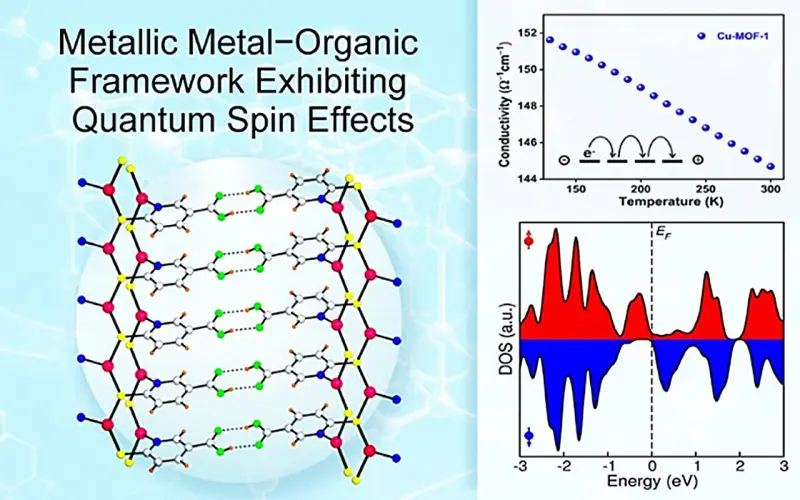
The headline electrical figure is a conductivity of up to 120 siemens per centimeter, measured on single-crystal devices. The authors describe that as unusually high for a crystalline metal-organic framework. For context, many MOFs sit at the insulating end of the scale, so moving into a range like this is a real change in category rather than an incremental gain.
The more telling measurement is temperature dependence. The team reports zero activation energy from temperature-dependent data. In a semiconductor, charge carriers usually need a thermal push to hop between states, and conductivity climbs as temperature rises. A metal behaves the opposite way: resistance typically grows with temperature because scattering increases. A material with zero activation energy is not waiting on thermal help to carry current, which is the signature the authors use to claim genuine metallic charge transport.
That matters for design. If the chain architecture is responsible for the transport, chemists have a handle on it. Changing the metal, the sulfur arrangement, or the surrounding ligands could, in principle, shift the electronic behavior. This is the kind of tunability that conventional bulk metals don't offer.
Infrared response and light-to-current conversion
The crystal's optical behavior is just as notable. Under infrared illumination, it converts weak optical signals into a strong electrical current, with a reported responsivity of 8,100 A/W. Responsivity is the output current per unit of incident optical power, so a value that high means a small amount of light produces a large current. For photodetector designers, that is the number that decides whether a weak signal can be picked out of noise.
Two other properties support that figure. The authors point to long carrier lifetimes, meaning photogenerated charges persist long enough to be collected before they recombine. They also report a wide linear dynamic range, so the response stays proportional across both dim and bright conditions. In practice, a detector with a narrow linear range saturates or loses accuracy at one end of the scene. Covering both ends is what makes a sensor usable outdoors or in mixed lighting.
The team lists several possible uses: high-speed infrared sensors, night-vision cameras, medical imaging, and high-speed optical communication. Those are the applications you'd expect for a fast, sensitive infrared detector, though moving from a single-crystal device to a manufacturable sensor is a separate and much longer step.
Half-metallic spin behavior
Quantum-mechanical simulations revealed a third property. The theoretical modeling indicates the material enters a half-metallic state, where electrons of one spin orientation behave as a conductor while the other spin channel does not. In other words, the material's conduction is spin-selective. Half-metals are of interest for spintronics because they can, in principle, deliver nearly fully spin-polarized current.
Co-corresponding author Dr. Michitoshi Hayashi, a research fellow at the Center for Condensed Matter Sciences at National Taiwan University, framed the result this way: "This work redefines the understanding of MOF conductivity by establishing spin as a key quantum descriptor of electronic transport." That's a strong claim, and it's one the team supports with theory. Experimental confirmation of the spin-selective behavior is the piece to watch.
Spintronics works by using electron spin alongside charge, which can lead to memory and logic devices that are faster and use less energy than charge-only designs. A material that is both metallic and spin-selective, built from a lattice chemists can modify, gives device researchers a new starting point. The authors suggest it could support spintronic memory, logic circuits, and quantum computing hardware.
What comes next
The reported uses extend beyond detectors and spin devices. The team also points to advanced chemical sensors, supercapacitors, batteries, and light-driven energy conversion, citing the material's high conductivity and thermal stability. Those applications depend on different properties, and each would need its own testing under realistic operating conditions.
My read is that the most useful near-term outcome is conceptual. The work shows that a molecular framework can carry metallic transport when its chain architecture is right, and that gives chemists a design rule to test. The gap between a single-crystal lab device and a working component is wide, and crystal growth, scale-up, and stability in real environments will decide how fast any of this moves. Still, a MOF that conducts like a metal and responds to infrared at 8,100 A/W is a material worth tracking closely.
The study was published in Advanced Science, and the full details, including test conditions and modeling methods, are available in the paper at the journal's site.