UC San Diego’s Air-Powered Soft Robot Runs at 4.72 m/s Without Electronics
- Munis Raza
- 798 reads
A one-piece, 3D-printed six-legged robot reaches 4.72 m/s using a two-stage air system, but still depends on a tethered compressor.
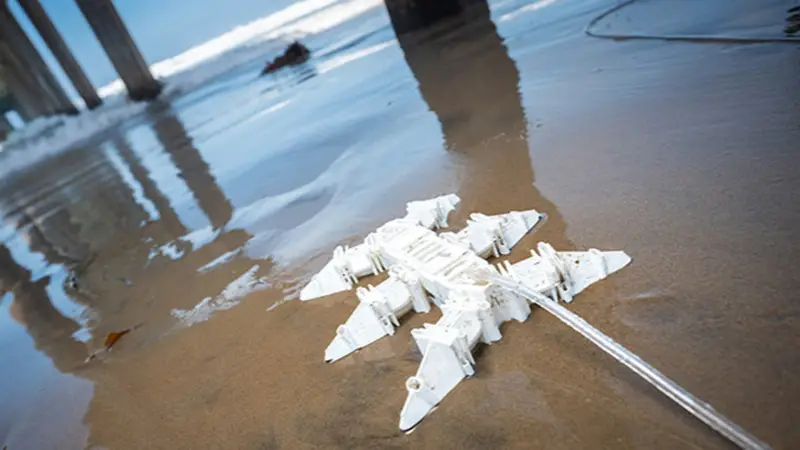
A six-legged soft robot from UC San Diego reaches 4.72 meters per second, or 10.6 mph, using compressed air and no electronics. Its speed is the headline result, but the design change behind it may matter just as much: the robot routes air through two sets of chambers, recovering more of the air’s energy before it exits.
The robot is 3D-printed in one piece from a single material. The UC San Diego team, led by former postdoctoral researcher Yichen Zhai and Professor Michael T. Tolley, tested it on concrete, gravel, lawn, mulch and sand. It also ran down stairs, swam in water and operated underwater. Those demonstrations suggest a machine designed to move across several kinds of terrain, though its air supply remains tethered.
Two stages make better use of compressed air
The robot’s legs move through a connected network of chambers, valves and tubes. Pressurized air flows through that network to drive the walking cycle. Raising air pressure can increase speed, but simply letting high-pressure air pass through a fast-running mechanism can waste energy: the exhaust may still contain substantial pressure when it leaves the robot.
The team addressed that problem with an arrangement inspired by a compound steam engine. In that type of engine, steam expands in stages, doing work first in a smaller cylinder and then again in a larger one. The robot applies a related idea to air. Air first passes through smaller, high-pressure chambers that operate the valves. It then expands into larger, lower-pressure chambers that drive the legs.
That division gives the air another opportunity to do useful work. The smaller chambers handle valve actuation, while the larger chambers supply the motion that carries the robot forward. The result is a reported speed more than 100 times that of the team’s earlier robot, which reached about 4 centimeters per second.
That earlier machine, developed in 2022, was also 3D-printed and air-powered. Its speed was limited by the pressure and airflow available to it. For the newer design, the researchers made the robot and its internal structures larger and stronger so they could work at higher pressure. The staged flow system then helped avoid losing as much energy through the exhaust.
Zhai described the first walking robot as too slow and said the team found a way to make the new version 100 times faster. The comparison puts the advance in context: this is not just a faster gait achieved through a change in leg shape. The team reworked the pneumatic system that powers the gait, addressing both pressure and how effectively the robot uses it.
Terrain tests show where the design can move
The tests covered surfaces with different characteristics, from concrete to loose gravel, mulch and sand. The robot’s ability to move across those surfaces indicates that its soft structure and air-driven legs can tolerate varied footing in the demonstrated trials. The stair run adds another kind of movement test, while swimming and underwater operation show that the robot can function in water as well as on land.
These demonstrations do not establish how long the robot can operate, how much air it consumes in each setting or how its speed changes across surfaces. The published description gives the top speed and names the tested environments, but does not report those additional measurements. For engineering teams considering similar mechanisms, air use and sustained operation will matter alongside peak speed.
The single-piece print is another notable part of the design. A robot made in one print from one material avoids assembling a collection of separate rigid and soft parts, while the internal geometry still has to provide chambers and passages for pneumatic control. The research team sees this as a step toward more complex, powerful robots that could be printed on a desktop using inexpensive materials. Whether that approach can deliver practical machines will depend on the air supply, material performance and the motions future designs can support.
The compressor remains the main constraint
For now, the robot needs a tether to a compressed-air source such as a conventional air compressor. That connection supplies the pressure that drives the valves and legs, but it limits where the machine can go. The researchers plan to investigate designs that use less air, with the aim of running from a portable source such as a compressed-air cartridge.
Reducing air demand would address a central system-level trade-off. Higher pressure helped the team raise speed, and staged expansion improved how much work the air could provide. An untethered version would also need to carry its air supply, making efficiency and available operating time key design considerations. The current results show fast locomotion with an external supply; they do not yet demonstrate autonomous operation.
The team also points to future designs with more complex movement, including steering and object manipulation. Those capabilities would require the pneumatic layout to control more than forward running. The researchers’ earlier work includes electronics-free soft grippers and a walking robot. Other air-powered robots developed by AMOLF in the Netherlands have been reported at 30 body lengths per second, a different measure that describes speed relative to the robot’s size.
Electronics-free construction could be useful in places where electronic components cannot operate, including environments with high radiation or strong magnetic fields, as well as space exploration. Those are proposed applications, not capabilities established by the terrain and water tests. The immediate engineering question is more concrete: whether the two-stage air circuit can preserve its speed advantage while using little enough compressed air to make a portable supply practical.
The research was published in the Nov. 18 issue of Science Robotics. Its clearest result is a soft, one-piece robot that runs at 4.72 meters per second on compressed air. The next milestone is to retain useful speed and movement while reducing dependence on a stationary compressor.