Cambridge Names “Human” Its 2026 Word of the Year as AI Tests Ideas of Identity
- Munis Raza
- 352 reads
Cambridge’s 2026 choice reflects growing questions about consciousness, creative work and personal identity as AI systems take on more human-like tasks.
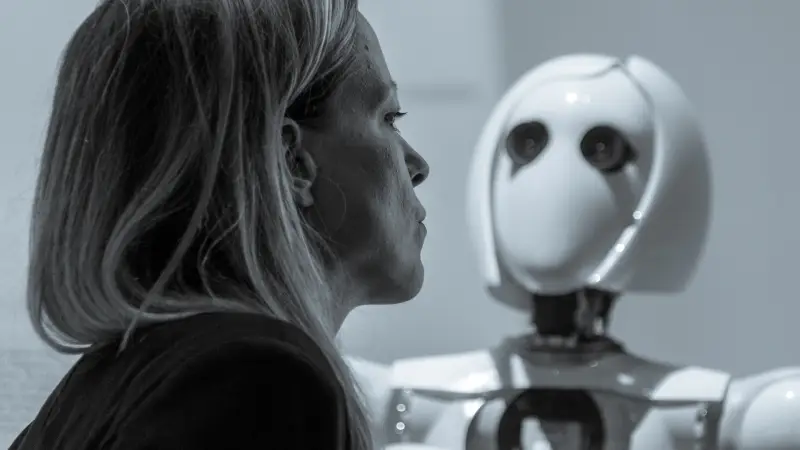
Choosing “human” as the Cambridge Dictionary’s Word of the Year for 2026 captures a practical question now running through work, culture and technology: which qualities should remain distinctly human as artificial intelligence takes on tasks associated with people? The choice reflects debate over the boundary between human and machine, as well as the ways people describe that boundary.
Cambridge Dictionary defines “human” as “having the qualities, faults, and feelings that people have, as opposed to gods, animals, or machines.” That definition points to more than biology. It gathers together emotion, imperfection and judgment—qualities that are difficult to reduce to whether a system can produce convincing text, images or speech.
Tom McClelland, a philosopher of science at the University of Cambridge, said people are reconsidering the distinction between biological and artificial intelligence. “We’re trying to understand the difference between a human mind and an artificial mind, between living beings like us and artificial beings that we’re creating,” he said. “What sets us apart is it consciousness, creativity, or compassion?” The question matters because improved machine performance can make an output appear human without settling what kind of understanding, if any, produced it.
Work and care put the distinction to a practical test
Discussion of AI often starts with whether software and machines can replace human workers. But the deeper issue is how people choose to divide responsibility. A system may help complete a task; deciding who is accountable for its effects, and where human attention matters most, remains a separate question.
Microsoft co-founder and Gates Foundation chair Bill Gates has argued that caregiving should remain among “human reserved jobs.” He has also said AI could help cure diseases and improve education, while emphasizing that people must decide where human involvement should stay central. “The measure of AI’s success should be how much it improves human lives,” Gates said. His position puts the focus on the purpose of automation: speed or capacity alone doesn’t establish whether a change improves the work or the experience of the people involved.
That distinction applies beyond care. In any field where a system generates recommendations or content, the practical questions include who reviews its output, what judgment the task requires and what happens when the result is wrong. The wider debate over “human” gives those questions a shared frame without suggesting that every task performed by a person must remain unchanged.
Creative work and identity are already under pressure
Generative systems have brought the boundary into sharp focus for creative industries. Actors Scarlett Johansson and Cate Blanchett, musicians Billie Eilish and LeAnn Rimes, and authors Jodi Picoult and Jonathan Franzen have joined campaigns opposing machine-generated replicas and the unauthorized use of human-created content by large language models. The dispute concerns both control over existing work and the ability to reproduce recognizable voices or styles.
Digital imitation also makes personal identity harder to protect in practice. Actor Matthew McConaughey trademarked elements of his voice, image and signature catchphrase to guard against unauthorized digital reproduction. Taylor Swift filed trademark applications covering her voice and image. These steps show how familiar identifiers can become assets that need protection when software can reproduce them in new settings.
A convincing imitation raises questions that are different from whether an AI system can perform a task well. People may need to determine whether a recording or image is authentic, whether a person agreed to its use, and who has control over a digital likeness. The source examples do not resolve how those questions should be answered; they show why identity has become part of the technical and cultural discussion.
Human choices will shape AI’s role
Rachel Adams, a University of Cambridge professor specializing in AI governance and human rights, said the technology brings longstanding questions about identity and humanity into sharper focus. “AI is going to be a profound test for humanity. There’s a real risk that it deepens existing inequalities, but it also has the potential to solve them,” Adams said. Her assessment sets out two possible effects without treating either as automatic: the outcome depends in part on how the technology is developed and used.
McClelland likewise argued that AI’s future is not inevitable. Decisions made by people will shape how these systems develop and enter everyday life. That leaves room to weigh benefits against the consequences for workers, creators and the people whose voices or images may be replicated.
Cambridge Dictionary lexicographer Colin McIntosh said advances in AI are changing how people talk about being human. The renewed attention to the word reflects a shift in conversation: capability is only one measure of a machine, while questions of feeling, responsibility and identity concern the people who build, use and encounter it.
Other technology-related contenders included “agent,” referring to AI systems able to operate with some independence, and “analogs,” associated with non-digital activities, according to The Guardian. Their inclusion points to two sides of the same debate: software gaining more autonomy and people finding value in activities that remain outside digital systems. As AI takes on more tasks, the useful question is not simply what it can imitate, but what people want its role to be.