HQ-17A Mobile Air Defense: Range, Reload Time and Radar Trade-offs
- Bojan Stojkovski
- 750 reads
The wheeled HQ-17A pairs onboard radar with eight ready missiles, but reload time and radar exposure shape its limits.
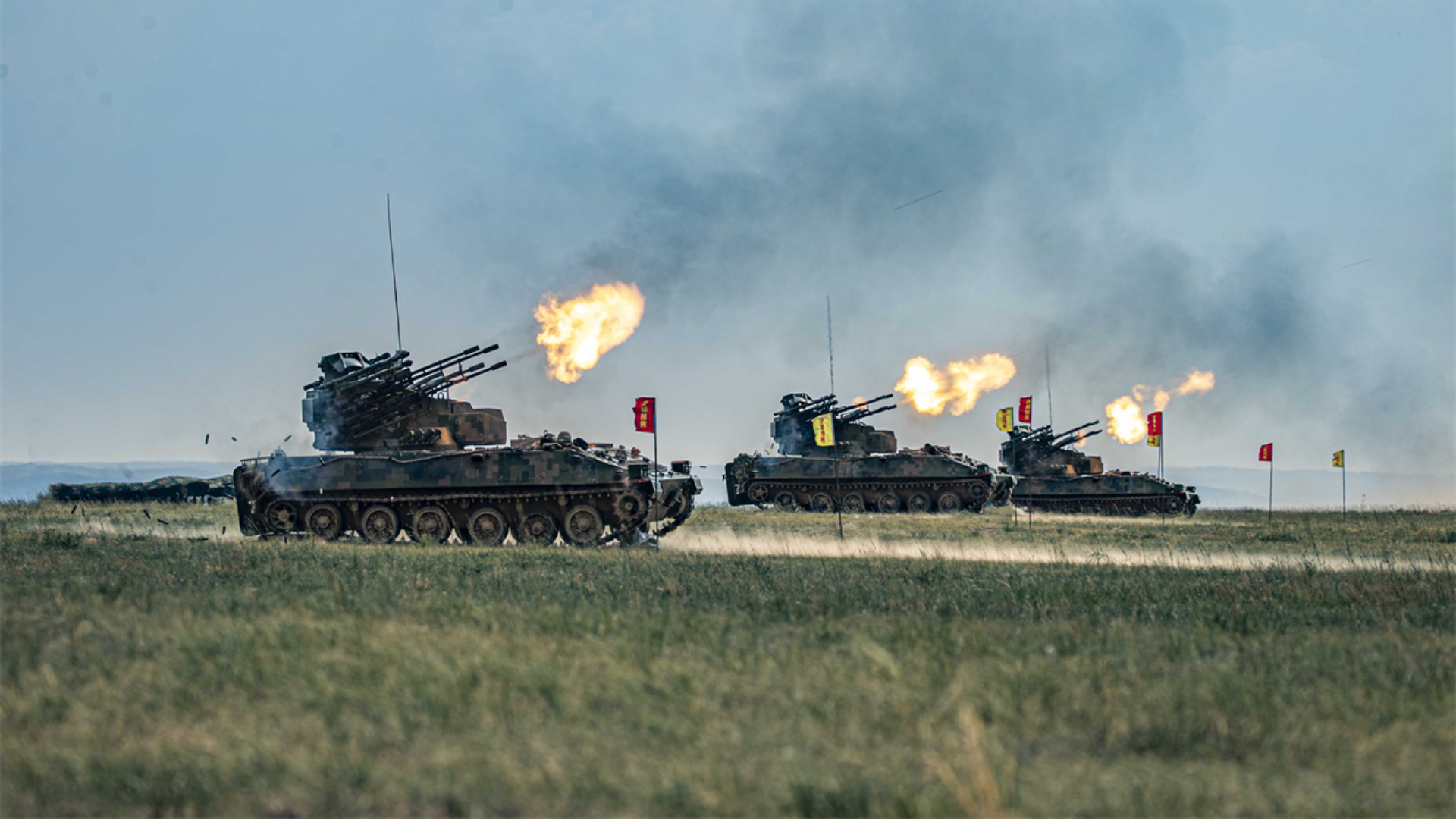
The HQ-17A’s engineering proposition is mobility: a wheeled launcher carries its own radar and eight vertically launched missiles, and is reported to fire while moving. That combination can keep short-range air defense close to moving ground formations. Its practical value, though, depends on more than the launcher’s ability to track and engage a target. Ready ammunition, radar exposure and coordination with other units all affect how long a formation can rely on it.
A training exercise last June illustrated the intended operating pattern. Amphibious armored vehicles moved toward open water as a six-wheeled HQ-17A positioned along the coast fired at a drone representing an incoming cruise missile. The scene connected two separate tasks: supporting vehicles as they move and engaging an airborne threat from a launcher operating nearby. The unit was believed to belong to the 125th Amphibious Combined Arms Brigade. A US Army analysis described that formation as one of six amphibious brigades considered central to a possible landing operation, the South China Morning Post reported.
Mobility changes how the launcher can operate
The HQ-17A is designed to engage aircraft, cruise missiles and precision-guided weapons. Its reported engagement range is approximately 0.9 to 9.3 miles, against targets flying from roughly 33 feet to 32,808 feet above ground. Those figures describe a short-range envelope; they don’t by themselves establish how reliably the system can detect a particular target or engage it under changing conditions.
Each launcher has an onboard radar, so it can detect and engage targets without relying on a separate radar vehicle for every engagement. A typical battery comprises four launchers, with command and ammunition vehicles supporting them. The launcher’s independent sensors and weapons put more of the engagement sequence on the vehicle itself, while the wider battery provides the structure for command and resupply.
The contrast with the tracked HQ-17 points to a key design trade-off. The tracked model can search while moving but must stop to fire. The wheeled HQ-17A is reported to launch missiles while travelling at speeds up to 15.5 mph and to engage as many as four targets simultaneously. Keeping a launcher in motion can help it stay with a moving formation, but firing on the move also puts demands on tracking, stabilization and coordination. The available figures don’t specify test conditions for those reported capabilities.
Eight ready missiles put a limit on endurance
Mobility doesn’t remove the ammunition constraint. Each HQ-17A launcher carries eight ready-to-fire missiles, compared with 16 reportedly carried by newer Russian Tor-M2 launchers. A launcher that expends its ready supply has reduced capacity until it can be reloaded. Reloading an HQ-17 or HQ-17A takes approximately 18 minutes, leaving a meaningful interval when the vehicle’s immediate engagement capacity is lower.
That makes the supporting vehicles and the timing of resupply part of the system’s performance. A four-launcher battery distributes ready ammunition across several vehicles, but the source provides no figures for the battery’s total missile inventory, resupply rate or time needed to bring an ammunition vehicle alongside a launcher. Those details would help determine how well the unit could sustain repeated engagements. Without them, the eight-missile load and approximate 18-minute reload are the clearest indicators of the gap between an initial response and continued coverage.
Radar brings a different trade-off. An onboard radar lets the HQ-17A search for and track airborne targets, but emissions can also make a radar-equipped vehicle easier to detect. Operating near a coastline where drones, rockets and missiles could threaten staging areas would therefore require crews to maintain awareness and coordinate with other air-defense units. The source does not give radar detection ranges, emission-control procedures or the system’s performance against electronic interference, so those aspects can’t be assessed from the reported specifications.
Coverage depends on the network around the launcher
The exercise also showed soldiers aboard amphibious vehicles firing shoulder-launched missiles at drones. That adds another layer of response around the larger launcher, but multiple weapon types don’t automatically create continuous protection. Units still need to detect threats early, share useful tracking information, keep overlapping radar coverage and manage ammunition. A target that arrives outside one vehicle’s coverage, or during a reload, makes coordination and the location of other units matter.
The opposing side is also expanding its uncrewed systems. In August, Taiwan’s legislature approved a six-year funding framework of approximately $7.3 billion covering uncrewed systems, including coastal attack and reconnaissance drones, the South China Morning Post reported. That development makes the challenge broader than intercepting a single drone in a training scenario: the launcher and supporting network would need to handle incoming threats while sustaining coverage and protecting their own sensors.
The HQ-17A’s moving-fire capability and onboard radar offer a way to accompany ground vehicles while retaining a local engagement capability. Its eight ready missiles, reported reload time and dependence on radar-supported detection define the limits of that approach. The practical measure of its value will be how well launchers, ammunition support and other sensors keep operating together as targets appear, ammunition runs down and vehicles change position.