Unpaired Machine Learning Reconstructs Particle Jets More Accurately in Simulated RHIC Data
- Munis Raza
- 708 reads
A label-free model improved jet position, energy and structure estimates in sPHENIX simulations, with real detector data the next test.
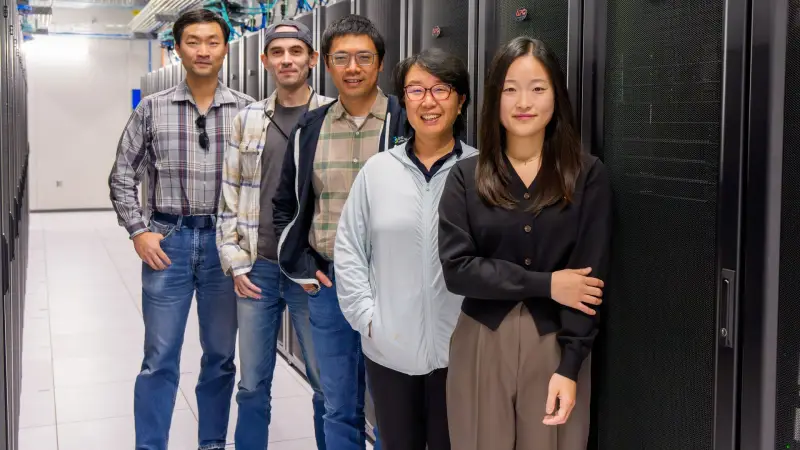
Separating a particle jet from the dense spray around it is a central measurement problem in heavy-ion physics. A machine-learning model developed by researchers at Brookhaven National Laboratory and partner universities has reconstructed simulated jets more accurately than conventional background-subtraction methods. The improvement was strongest for larger jets, where fluctuations from the surrounding particles create a more difficult separation.
The result comes from tests on simulated data for sPHENIX, a detector at the Relativistic Heavy Ion Collider (RHIC). The method has not yet been tested on real detector data, so its performance on measured collisions remains the next key question. If it holds up, researchers could use it to make more precise measurements of how jets change while passing through the quark-gluon plasma.
A signal embedded in collision debris
In heavy-ion collisions, beams of heavy ions collide at nearly the speed of light. The collisions briefly produce quark-gluon plasma, a hot, dense state in which quarks and gluons move freely rather than remaining bound inside individual particles. RHIC, which completed operations in early 2026, was built to study this matter.
Jets are narrow sprays of high-energy particles produced in the collision. As they travel through the plasma, they can lose energy and change their internal structure. Those changes make jets useful probes: their measured properties can help researchers investigate the medium they crossed.
The challenge is that detector data also contains many particles unrelated to the jet being measured. Their contributions overlap with the jet signal, making it difficult to recover the jet’s position, energy and structure. Better background subtraction could therefore improve the precision of jet measurements and the conclusions drawn from them.
Training without labeled collisions
The model uses an unpaired, unsupervised generative approach. Rather than training on examples where a researcher has marked each particle as either part of a jet or part of the background, it learns from two separate kinds of simulated data: pure background from the plasma and ideal simulated jets. It then works out how to extract the jet signal while removing the background.
That setup addresses a practical limitation in experimental physics. Measured collision data does not arrive with labels identifying which detector signals belong to a particular jet and which come from the surrounding event. A supervised model would need such labels to learn the desired separation. By learning from separate samples instead, this approach can tackle the reconstruction problem without requiring labeled real events.
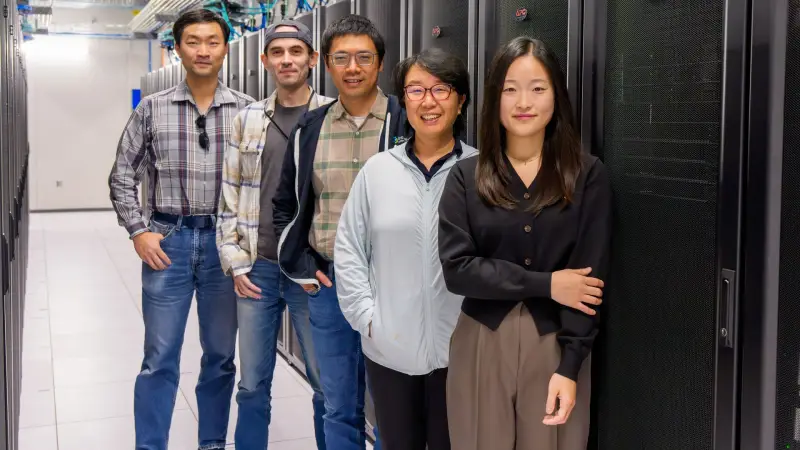
Brookhaven physicist Yeonju Go, who is also an assistant professor at Stony Brook University, likened the task to dividing a crowded image into two components: the jet and everything else. Brookhaven computer scientist Dmitrii Torbunov described why the absence of labels matters for applying machine learning to real experimental measurements.
What the simulation tests show
The team evaluated the model using simulated sPHENIX data. In those tests, it recovered jet positions, energies and internal structure more accurately than conventional background-subtraction methods. The advantage was especially pronounced for larger jets, which are more affected by background fluctuations.
Those findings establish a comparison within the simulations; they do not yet show how the model performs on actual collision records. Simulated samples provide a controlled way to assess reconstruction, while measured data brings the overlapping signals and detector conditions the analysis must ultimately handle. Applying the method to real sPHENIX data will show whether its simulated advantage carries over to experimental measurements.
From simulated events to detector data
sPHENIX collected nearly 300 petabytes during its runs. That scale gives the team a large body of data to work with, but processing it means applying the reconstruction method to an extensive experimental record. Go said this would be the first use of this kind of model in the nuclear and particle physics community.
The researchers also expect the method to apply to calorimeter-based measurements at the planned Electron-Ion Collider and at the Large Hadron Collider in Europe. The proposed reach follows from the model’s use of image-like detector data, where overlapping signals need to be separated. Other experiments facing similar signal-mixing problems may also be candidates, although the reported performance so far is specific to the sPHENIX simulations tested by the team.
A method to validate against real collisions
The project brought together researchers from Brookhaven, Columbia University and the University of Colorado Boulder. Its work was described in Scientific Reports, with support from Brookhaven research funding and the Office of Science.
The practical milestone is now validation on measured collision data. That will test whether an approach that learns from separate simulated jet and background samples can recover useful jet properties amid real detector signals. For physicists studying the plasma, the payoff would be a clearer measurement of how jets emerge from the medium and what those changes reveal about quarks and gluons under extreme conditions.