ALBATROSS Robot Combines Aerial Deployment With Wind-Powered Water Monitoring
- Etiido Uko
- 699 reads
SUTD’s ALBATROSS prototype autorotates into water, rights itself and sails autonomously; reservoir trials reached about 1 km/h and ran for three hours.
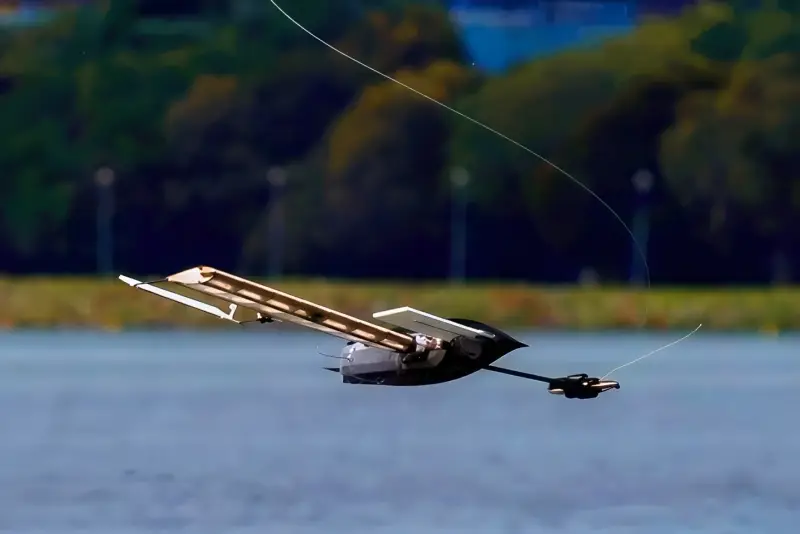
ALBATROSS is designed to solve a deployment problem in remote waters: aircraft can deliver a sensor platform quickly, while a sailing robot can stay afloat and collect data over time. Developed by researchers at the Singapore University of Technology and Design (SUTD), the prototype uses the same rigid wingsails to slow its descent, stabilize its landing and propel it across the water.

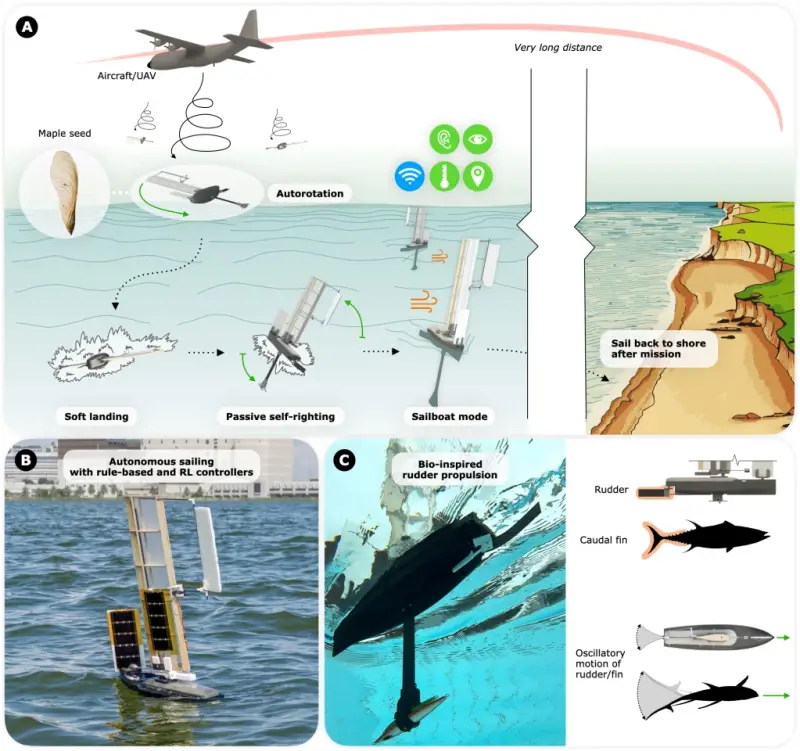
The name stands for Airborne Lander with Buoyant AuToROtating Sailing Sensor. Its central engineering idea is to use passive motion and wind for several stages of a mission, reducing the need for separate landing hardware and powered propulsion. The researchers envision future versions reaching remote waters by aircraft and remaining there for weeks to monitor environmental conditions. That endurance is a goal; the prototype has so far been tested in sheltered settings.

One set of wings for descent and sailing
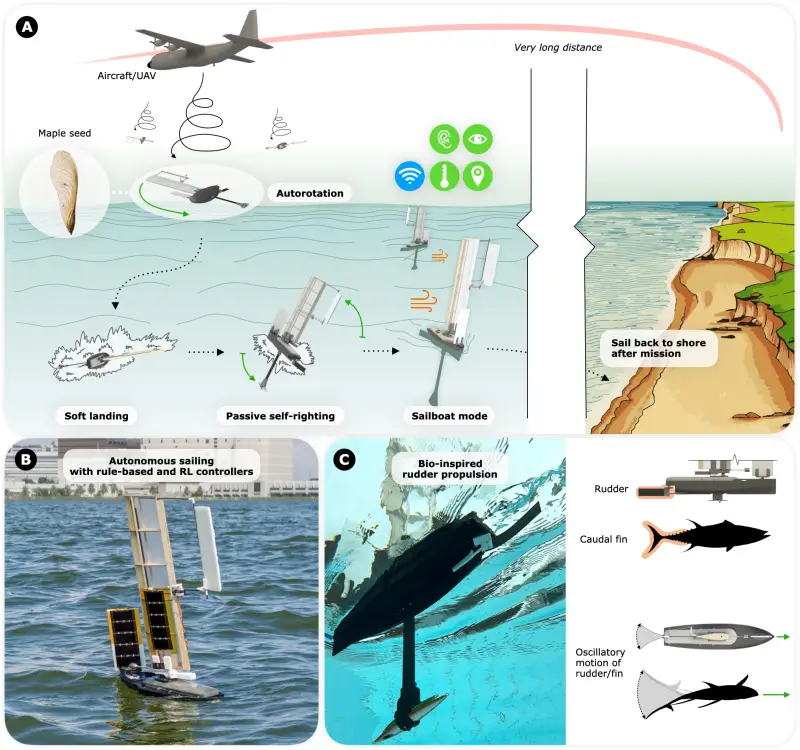
During an aerial drop, ALBATROSS’s two rigid wingsails autorotate, in a manner comparable to a maple seed. Their rotation slows and stabilizes the platform as it falls toward the water. After splashdown, the vehicle rights itself through its weight distribution. The wings then serve as sails, using wind to move the robot, while a fish-tail-inspired rudder steers it.

This arrangement links the landing and surface phases rather than treating them as separate systems. A conventional airborne delivery could require dedicated equipment to reduce impact, while a surface vehicle would need its own means of propulsion. ALBATROSS’s researchers propose that combining those functions could make deployment simpler and support lower-cost, more scalable sensing platforms. Those benefits remain a design rationale, rather than demonstrated cost or fleet-scale results.

“With ALBATROSS, we wanted to use the best of both worlds: the speed of aerial deployment to reach remote waters quickly, and the endurance of sailing to remain there for long-duration monitoring,” said Prof. Foong Shaohui, Associate Head of SUTD’s Engineering Product Development Pillar.
What the tests have shown
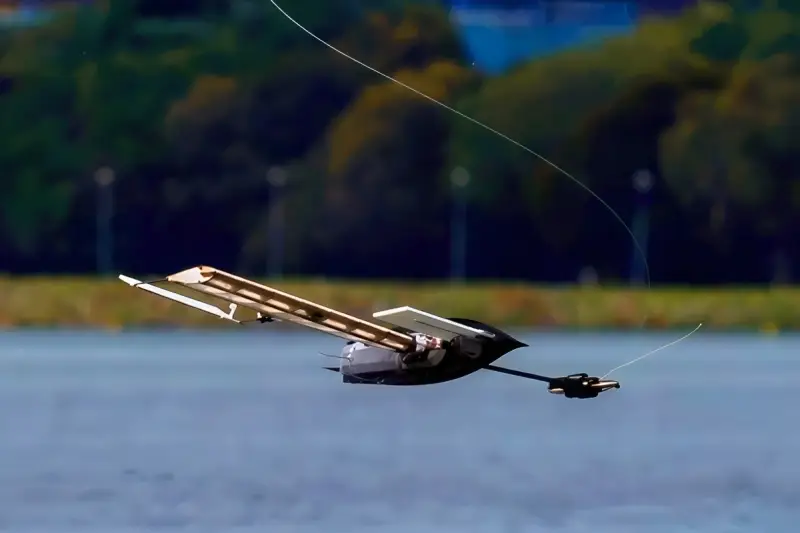
Researchers released a prototype from 150 meters (492 ft). It stabilized during descent, landed with low impact, righted itself and then sailed autonomously. The team estimates that a similar platform without the autorotation system would experience about 18.5 times more impact energy on water. That comparison is an estimate; the account does not provide further test conditions or a measured impact-energy value for the prototype.
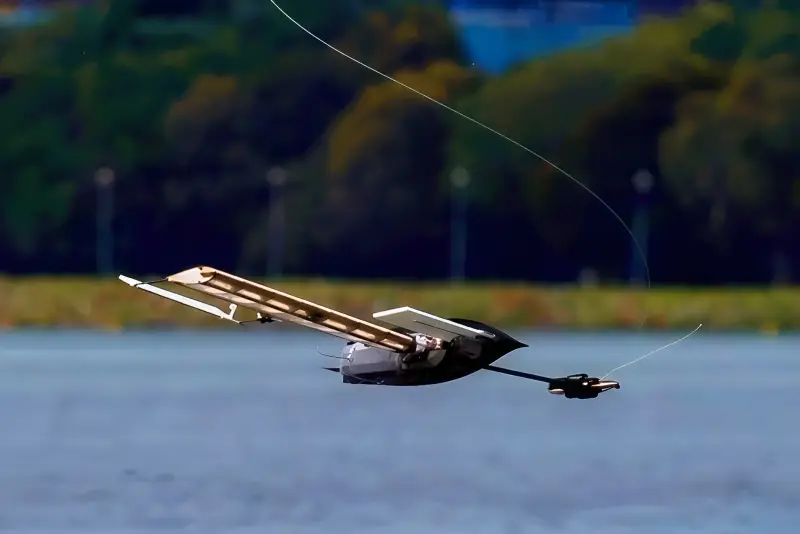
In reservoir trials in Singapore, a larger version reached a peak sailing speed of about 1 km/h (0.62 mph) and operated for about three hours. Onboard sensors collected humidity, heat and wind-direction data. For navigation, ALBATROSS moved between set waypoints using three actuators and three navigation sensors. The trial demonstrates autonomous surface movement and basic environmental sensing in a controlled setting; it does not yet establish how the platform performs in open water or how long it can operate on a full deployment.
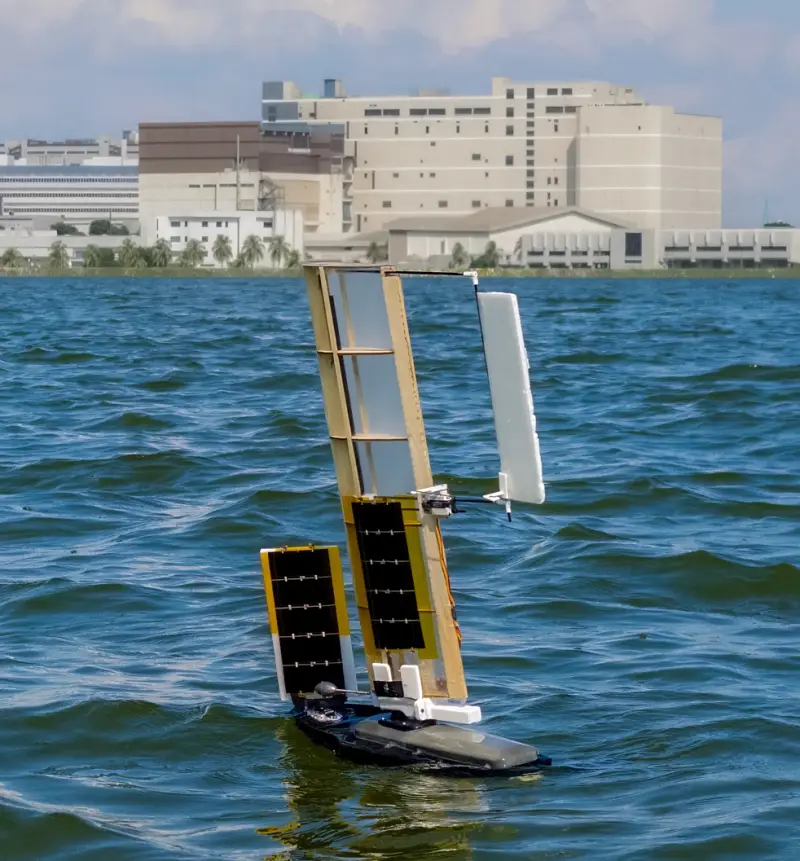
The researchers’ approach depends on the environment supplying much of the vehicle’s motion. Passive autorotation handles the descent, buoyancy and weight distribution help it recover an upright position, and wind drives sailing. This can reduce demand for powered propulsion during surface operation, though the reported trials do not quantify energy consumption or establish performance under changing wind and wave conditions.
Open-water performance is the next test
Remote-water monitoring puts a premium on reaching a site quickly and then staying there. Boats can remain on the water, but may take longer to reach a distant target; aircraft cover distance faster, but cannot themselves provide prolonged surface monitoring. ALBATROSS combines those roles in a single deployable platform. Its practical value will depend on whether it can retain the controlled tests’ stable descent, self-righting behavior and reliable sailing in harsher conditions.

The team identifies preparation for open-sea operation as the next stage. Prof. Foong said the design would need greater ruggedness and durability for more demanding maritime environments. Future versions could also carry a wider set of sensors, including underwater sensors and sonar, and larger energy-storage systems. The current prototype’s reservoir results provide a starting point, but do not establish those capabilities.
Researchers see possible uses in environmental monitoring and climate research, alongside other applications such as search and rescue. For engineering teams assessing the concept, the key question is whether the compact, wind-driven platform can sustain useful sensing when exposed to real open-water conditions. The study was published in Science Robotics.