Feather Star Robot Uses Two Actuators for Three-Dimensional Underwater Motion
- Maryna Holovnova
- 669 reads
Inspired by feather stars, the soft robot uses two actuators and elastic limbs to swim, hover and rotate underwater.

A soft robot built for three dimensional swimming
A soft underwater robot developed at North Carolina State University uses two actuators to swim in three distinct modes, including vertical movement and rotation. Its feather star inspired structure gives it a wider range of motion with fewer actuators than the six that corresponding author Jie Yin says would normally be needed for that capability. That’s a striking reduction in the number of powered inputs, though actuator count alone doesn’t tell us how well the machine performs in water.

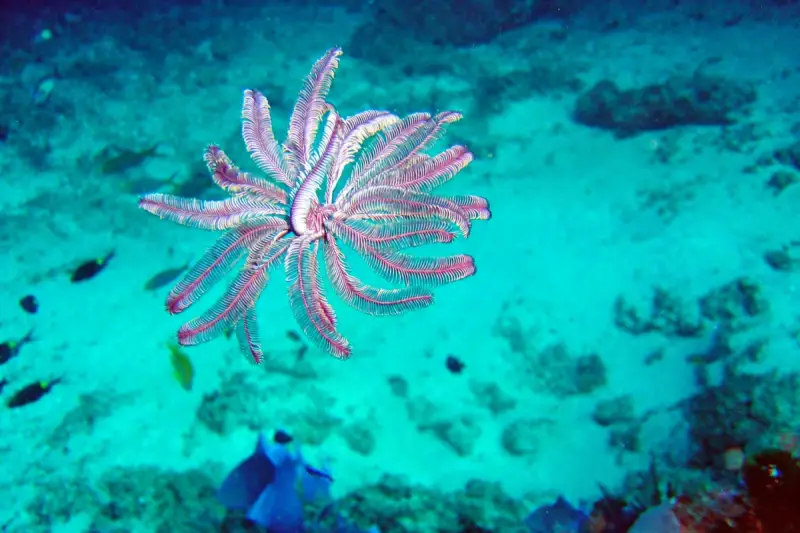
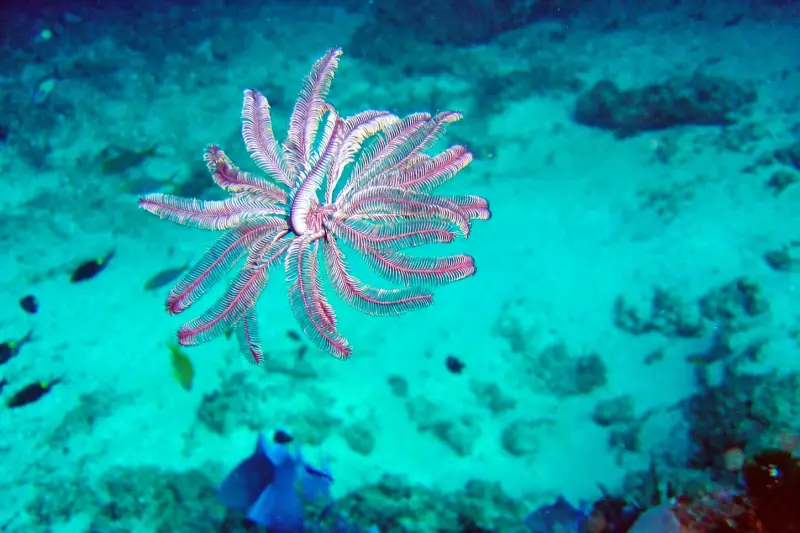
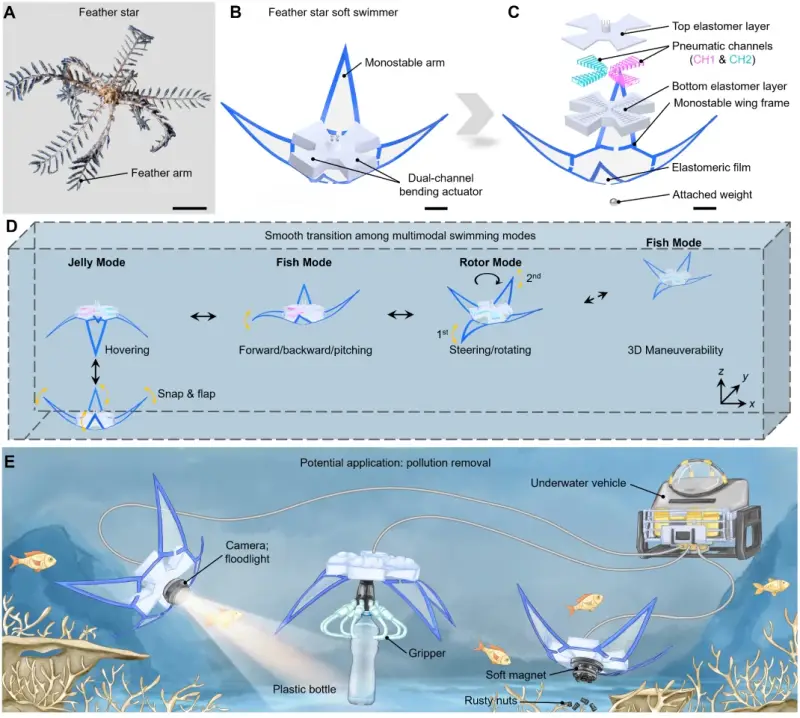
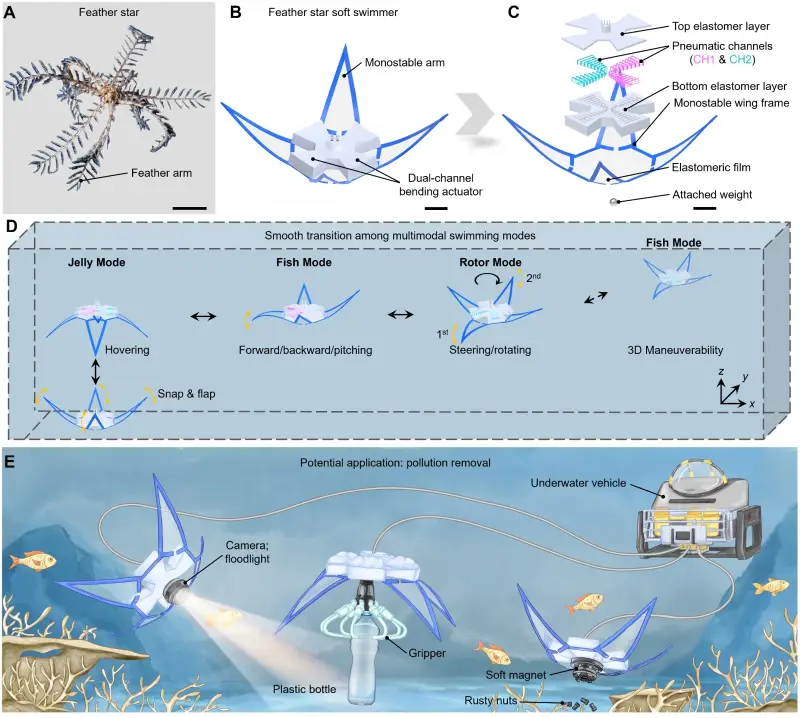
The design addresses a familiar challenge in aquatic robotics: moving forward is relatively straightforward, while changing depth, direction or orientation calls for more control. The research group had previously built a manta ray inspired robot that could swim quickly but lacked three dimensional maneuverability. For the newer machine, the team looked to feather stars, marine invertebrates whose flexible, feather like limbs help them move in multiple directions. The shift in biological model points to a broader design question: can the body itself help manage motion, instead of asking motors and control software to do all the work?

Structure does part of the control work
Adding a separate actuator for every movement can increase a robot’s mechanical and control complexity. Each added actuator also creates another input that a control system must coordinate with the others. The feather star robot instead relies on the way its elastic limbs deform and recover, allowing a small set of actuator inputs to produce different motions. The researchers describe this contribution from the structure as mechanical intelligence: the body’s physical response helps shape the robot’s behavior.

Corresponding author Jie Yin said the design achieves its range of motion with two actuators, where at least six would normally be needed. The reported benefit is a reduction in actuation complexity while retaining several movement options. That’s a useful engineering trade, especially for a machine that needs to maneuver in more than one direction. But the available description doesn’t give dimensions, speed, payload, endurance or test conditions, so those performance measures can’t yet be compared with other underwater platforms.

Three motion modes from two actuators
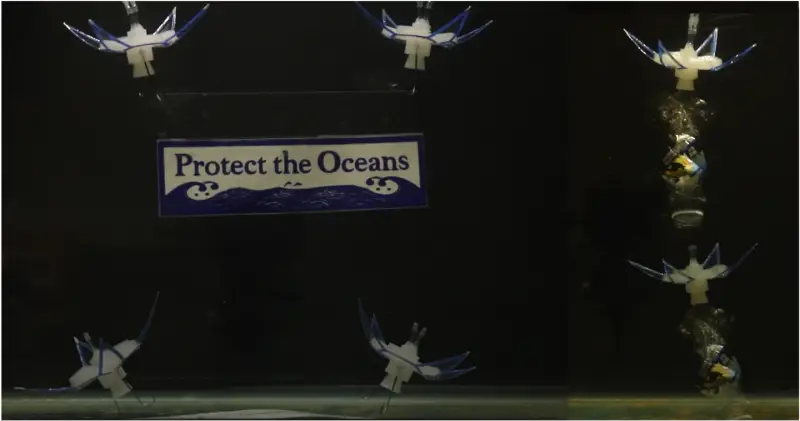
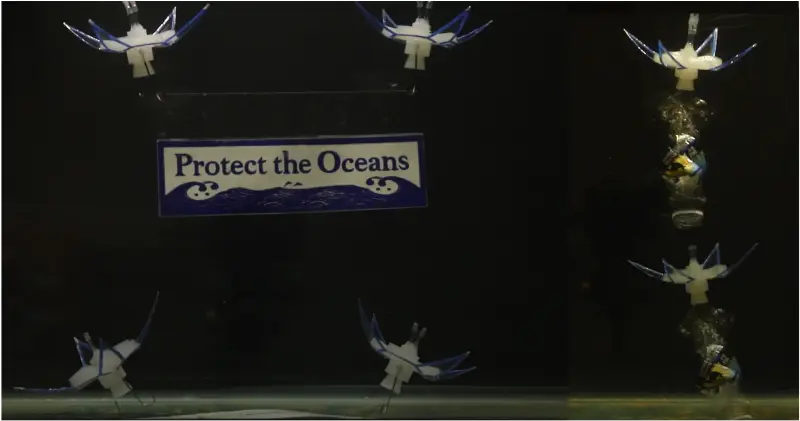
In jellyfish mode, both actuators work together. Their input bends the feather like wings downward, pushing the robot upward. The wings are monostable: once bent, they naturally return to their original shape. That recovery helps the robot descend, so the same elastic behavior contributes to motion in both directions. Repeating the cycle more quickly produces swimming motion; slowing it allows the robot to hover. In practice, the mode links the timing of the actuators with the limbs’ natural return, rather than relying on a separate powered movement for each part of the cycle.
Fish mode uses one actuator to create an asymmetric movement, driving the robot forward or backward. The movement draws on the broad principle of fin and tail propulsion, although the robot’s limb arrangement differs from a fish’s anatomy. Here’s the thing: the important feature is not that the robot copies a fish exactly, but that a change in actuator input creates a different kind of motion through the same flexible body.
Rotor mode comes from alternating the two actuator inputs. The resulting movement turns the robot around its own axis, letting it change orientation without relying on forward travel to steer. That distinction matters underwater, where turning by moving ahead can be awkward when space is limited or the vehicle needs to face a particular direction. Together, the modes provide vertical movement, translation and in place rotation through the robot’s flexible structure and actuator timing. Three useful motions, with two actuators.
What the design could mean for underwater work
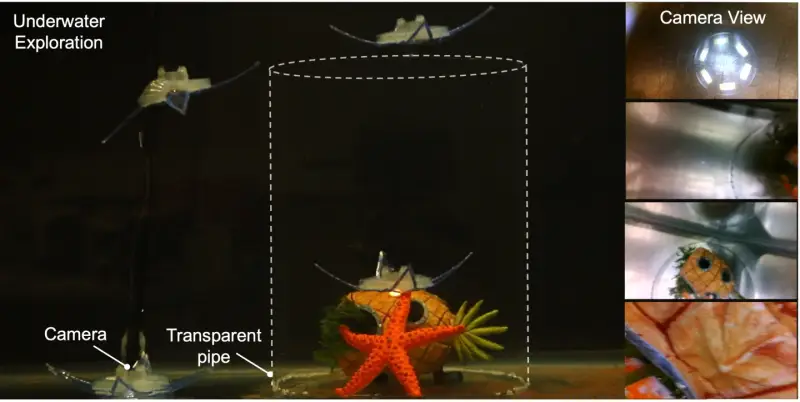
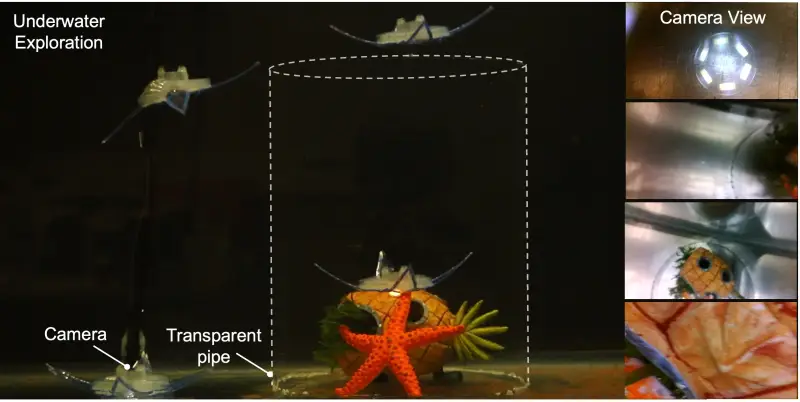
The team sees possible roles for the robot in underwater exploration, including carrying cameras, lifting objects and working alongside other aquatic robots. Those are proposed applications; the information provided doesn’t specify payload capacity or demonstrate a particular field deployment. A camera, for example, would add a practical task for the platform, but the article gives no basis for judging what equipment it can carry or how long it can operate with that load.
For engineering teams, the central idea is the compact actuation scheme: the body’s elastic response contributes to motion instead of requiring a dedicated motor for each degree of movement. If you’re working in this space, that’s the part to watch. Fewer actuators may simplify the mechanism, but a useful robot still needs predictable movement and enough control to perform its assigned task.
The next tests will decide its practical value
This is more significant than it looks: a flexible body that helps generate several motions could change how designers approach compact underwater machines. And yet, a promising mechanism is only the start. Similar systems typically have to be judged by how reliably their motions can be controlled, how the materials respond to repeated deformation, and whether the vehicle can carry the tools a task requires. The supplied information doesn’t answer those questions for this robot.

The design choice may be useful where maneuverability matters and actuator count is a constraint. The next engineering questions are concrete: how controllable each mode remains in different water conditions, how the elastic limbs hold up over repeated cycles, and what equipment the platform can carry. (And this is the part most people overlook.) A reduction in motors matters only if the resulting system still performs reliably when its surroundings and workload change. The researchers’ demonstration establishes a way to produce multiple motions with two actuators; the details needed to assess field use remain open.