KAIST BeetleBot Uses Heated Elastomer Muscles and Finger Gesture Control
- Maryna Holovnova
- 916 reads
KAIST’s BeetleBot pairs 45% contracting elastomer muscles with finger gestures, a pressure-sensing gripper and live camera feedback.
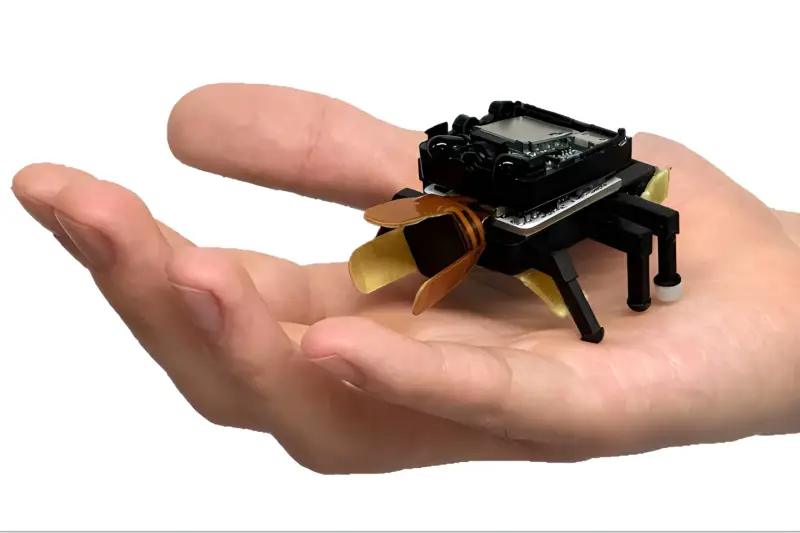
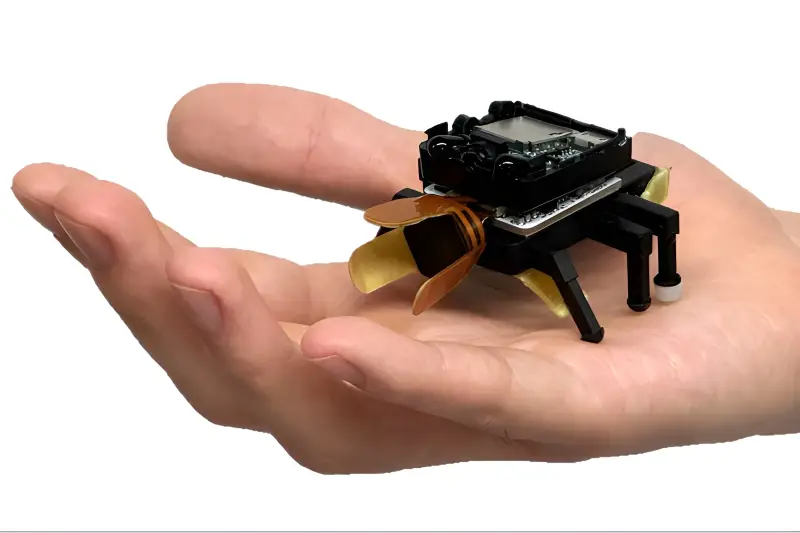
BeetleBot combines soft, heat-driven actuators with a finger-worn control patch and a camera link to its operator. The KAIST research team demonstrated a small beetle-inspired robot that could turn, grasp an object and carry it elsewhere in laboratory tests. Its main engineering constraint is energy: the artificial muscles must be heated to 110 °C to contract.

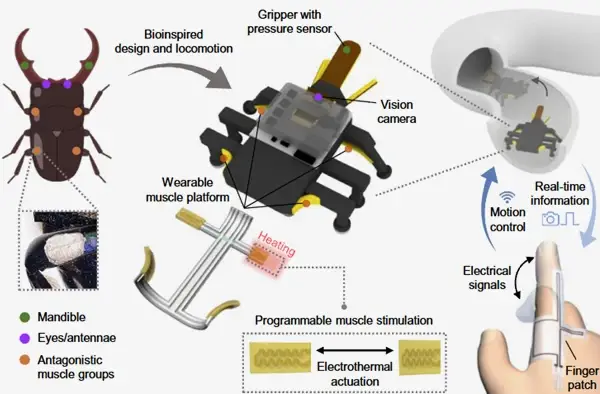
The design takes cues from Mecynorrhina torquata, a large beetle native to the Congo, Cameroon and Uganda. Researchers examined how its leg muscles and joints are positioned and work during movement, then adapted those principles for the robot. The result is a machine whose insect-like form reflects a functional design reference, while its actuation and control come from engineered materials and sensors.

Muscles that contract with heat
BeetleBot’s artificial muscles are 3D-printed from liquid crystal elastomer (LCE). When heated, the material contracts and shortens by 45%; as it cools, it returns to its original shape. Repeating that cycle produces the robot’s muscle-like motion without relying on conventional rigid linkages as the sole means of movement.

Heating is built into the actuator: electric current passes through wires integrated into the muscles, raising their temperature until the LCE contracts. The required temperature is 110 °C (230 °F). Only the muscles need to be heated, rather than the entire robot, but the process still consumes substantial energy. The team identifies that demand as one of the project’s main challenges.

That trade-off shapes what the current design can do in practice. LCE provides a way to produce motion from a soft, printed actuator, but the thermal cycle brings a power cost and a response time linked to heating and cooling. The research team says it wants to improve both energy efficiency and response speed. Those measures will matter as much as the beetle-like body if the robot is to operate usefully across a wider range of settings.
Finger gestures provide four commands
An operator controls BeetleBot with a flexible sensor patch worn on a finger. Bending or moving the finger stretches the patch, changing its electrical resistance. The control system interprets those changes as four commands: move forward, turn left, turn right, and grip an object.

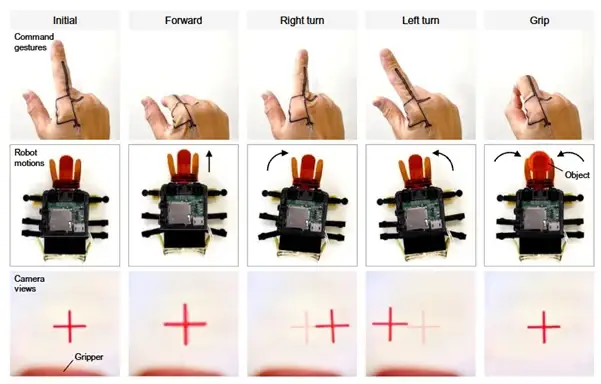
The gesture interface keeps the command set small and direct. The wearer’s finger supplies input, while the robot’s camera provides visual information back to the operator. That two-way link is central to the design: a person can observe what the robot sees, issue a gesture, and assess the resulting movement through the live camera feed.
Prof. Inho Kim of Sungkyunkwan University, the study’s first author, described this link as “bidirectional feedback,” connecting information detected by the robot to the user’s next action. In practical terms, the camera gives the operator a view of the robot’s surroundings, and the operator’s next gesture can respond to what appears in that view. The system therefore combines remote observation with simple manual commands.
A beetle-inspired gripper senses pressure
The gripper draws on beetle mandibles, the jaw-like structures insects use to grasp and hold. Like the legs, it uses LCE muscles that contract to close the mechanism around an object. A pressure sensor measures the pressure applied during gripping, giving the robot a way to register contact as it holds an item.
That sensing matters because a gripper must do more than close: it needs to apply force while maintaining a hold. The reported setup pairs muscle contraction with pressure measurement, while the camera lets the operator observe the task. The available account does not specify gripping-force limits, object-size ranges or how the sensor readings affect actuator commands, so the lab demonstration does not establish performance across different objects or working conditions.
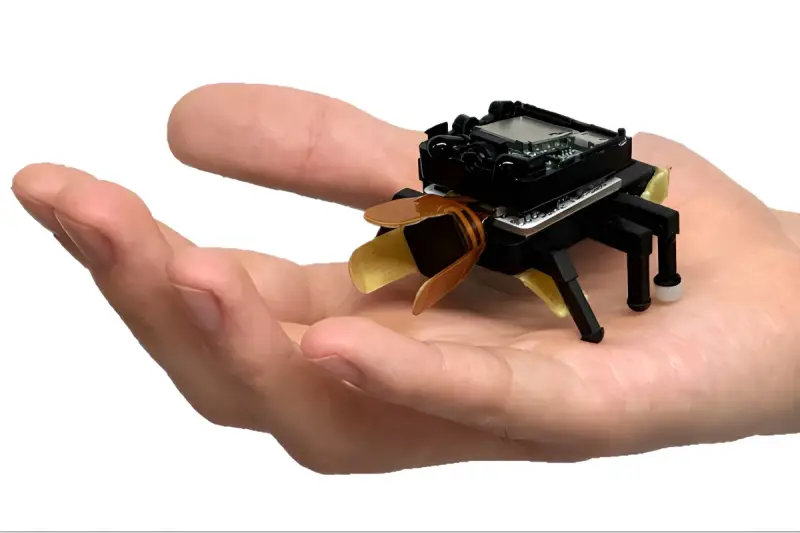
In laboratory tests, BeetleBot navigated turns, reached an object, grasped it and transported it to another location. Those tasks show the leg actuators, finger commands, gripper and visual feedback working together in a basic sequence. The team points to inspection of narrow spaces and retrieval of small items as possible applications, where a compact robot could reach places that are difficult for people to access.
The next development targets are faster response and lower energy use, followed by a fully soft-bodied version intended for use in varied environments. For now, the clearest engineering takeaway is the integrated control loop: heated elastomer muscles create motion, a finger patch supplies commands, and the camera and pressure sensor return information. Its practical reach will depend on reducing the power burden of repeated heating while preserving that coordinated movement and feedback.
KAIST’s description of the work is available from the university.