3D-Printed Robot Moth Forms a UV Sensor Through Its Circulatory System
- Omar Kardoudi
- 715 reads
A pumped chemical mixture turns a selected patch of the moth’s wing into a UV sensor, showing how circulating fluids could add functions to robots.
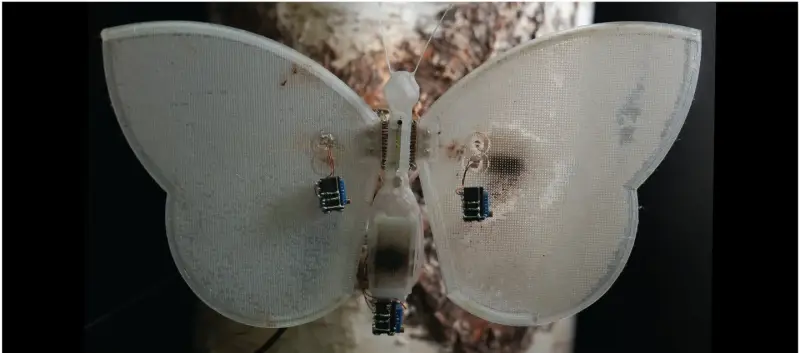
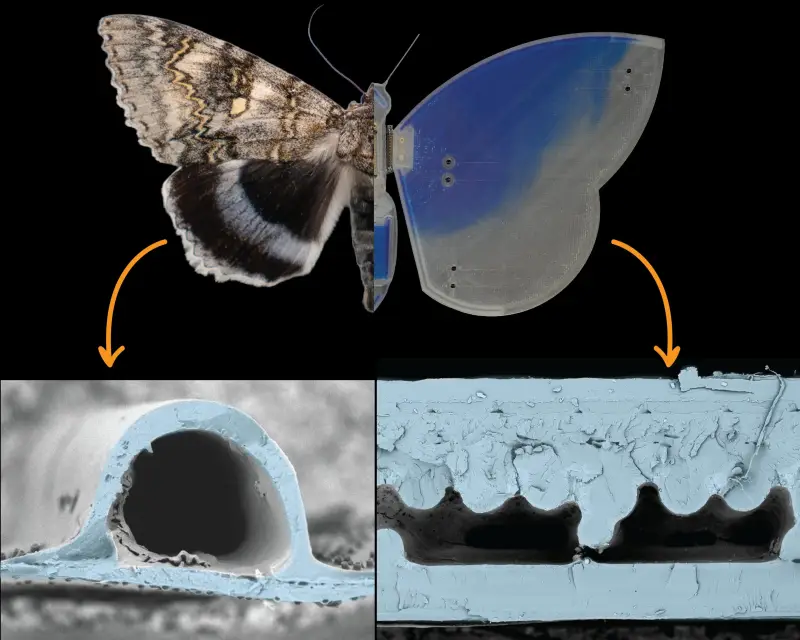
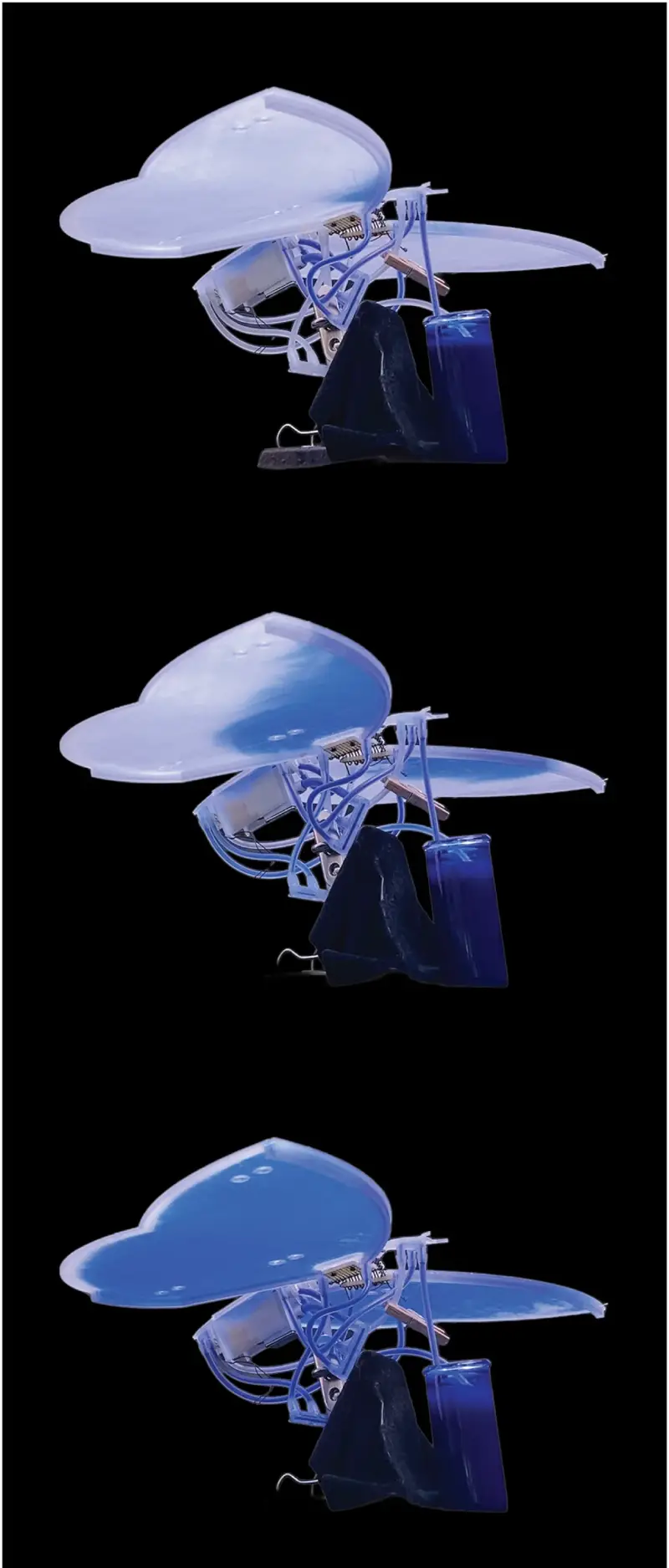
A robot that can form a new sensor in its own body could adapt after deployment, when engineers may not know in advance what a mission will require. A prototype moth-shaped robot from the University of Tartu in Estonia and the Italian Institute of Technology (IIT) demonstrates one way to do that: circulate chemical precursors through printed channels, then use ultraviolet light to turn a chosen patch of its wing into a sensor.

The device doesn’t grow a complete electronic component. It forms the sensing material where it’s needed, while conductive wires embedded during printing connect that material to the robot’s electronics. That distinction matters: the team still determines where the sensor forms, but the material doesn’t have to be installed as a finished component at the start.

Circulating chemicals form the sensing patch
The moth’s body is made from transparent 3D-printed plastic containing tiny channels. A small pump circulates about 3 ml (0.1 fl oz) of liquid through them. Some of the liquid diffuses roughly a hundredth of a millimeter into the surrounding plastic. It carries pyrrole, which can be converted into electrically conductive polypyrrole when exposed to UV light in the presence of a light-activated additive.

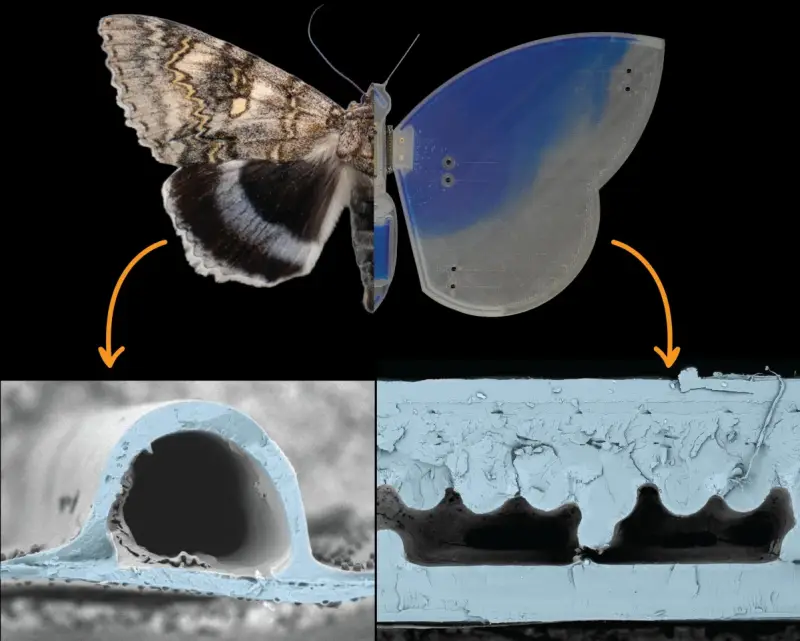
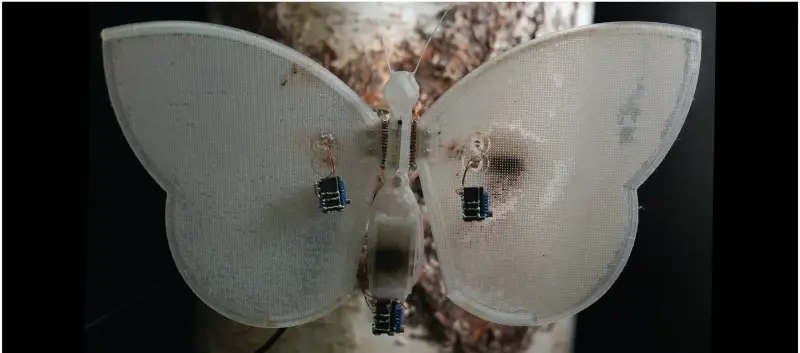
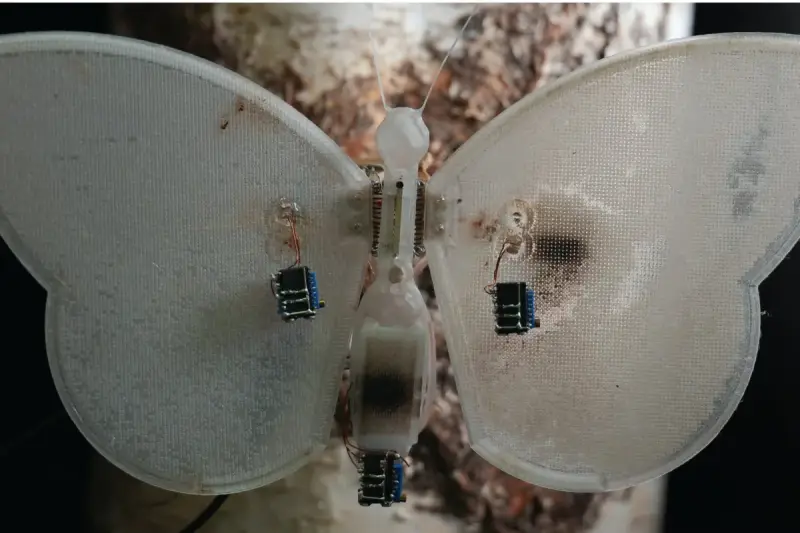
A stencil controls which part of the wing receives UV exposure. The treated area darkens as polypyrrole forms in the plastic. Gold wires threaded through the body during printing detect the resulting electrical change; the researchers grow the sensing material, while the wiring is already in place.

When UV light reaches the patch, its electrical resistance briefly decreases. An onboard chip can use that change to trigger an output, such as blinking an LED or moving the wings. In this setup, the newly formed patch detects UV exposure; the processor and existing wiring turn that response into an action.
Adaptable placement comes with fixed limits
“You can, of course, use a ready-made photodiode, but you'd have to know quite precisely where to put it,” Kadri-Ann Pankratov, a University of Tartu PhD student and first author of the study, said. “Growing the receptor on site means the environment itself can pattern the robot, based on what is actually happening at that time.” The work was published in Advanced Science.
That flexibility is a potential advantage for robots sent into settings where conditions are hard to predict, including collapsed buildings or other planets. The current demonstration, though, relies on decisions made in advance: researchers choose when to fill the channels and use a stencil to choose where the sensor forms. The surrounding environment doesn’t independently direct the process.

The reaction also can’t be undone. The sensor remained functional after four months in storage, and repeated exposure made it more sensitive as residual pyrrole continued reacting. After a UV flash, the sensor takes about five minutes to settle back. These characteristics matter for deployment: the patch can persist, but its response changes over time, and it isn’t a quick-reset sensor in the demonstrated form.
Circulation could carry more than sensor precursors
The moth can’t fly. Its wings move when a nitinol wire, a shape-memory alloy, is heated by an external power supply. The team says batteries could power the wings, but sees more potential in storing energy in the circulating fluid. Pankratov said the researchers have run initial tests using reagents in the fluid to power the onboard microprocessor. The available information doesn’t specify the output or duration of that power, so it remains an early direction rather than a demonstrated replacement for the external supply.
The team’s paper identifies another practical constraint: the fluid and the light must both reach the area where a sensor is to form. The amount of accessible body area, rather than a stated maximum number of sensors, sets the main limit. Researchers can pump fresh precursors into the channels, and some materials might eventually be collected from the environment, but neither capability makes the current moth autonomous.
Other projects point to related uses for robots that work with their own materials. Cornell engineers demonstrated a soft robot with optical sensors that detected damage and healed itself. IIT’s FiloBot 3D-prints its body as it climbs, while a separate 2025 project explored robot blood as an energy store for soft jellyfish and worm robots. The moth adds a different function: its circulating liquid supplies material for a sensor formed after fabrication.
Pankratov says the channels could carry other chemicals, including materials that may allow reversible changes. The same circulation system could also be flushed and reused with the same mixture or a different one. That could make it useful for more than one-time sensor formation, though reversibility and reuse remain possibilities described by the researchers, not capabilities shown in this prototype.
The engineering idea is to treat a robot’s internal fluid network as a route for adding function, not just moving liquid. For now, the team controls the chemistry, placement and timing. Future work will have to show how much of the body can be reached and whether the fluid can support sensing, power or repair in a repeatable way.