Productive Robotics’ OB7AI Uses a Single Mill Scan for CNC Tending
- marketing team
- 406 reads
Launched at IMTS 2026, the seven-axis cobot scans a mill once, then handles part loading and unloading without AI training for each new job.
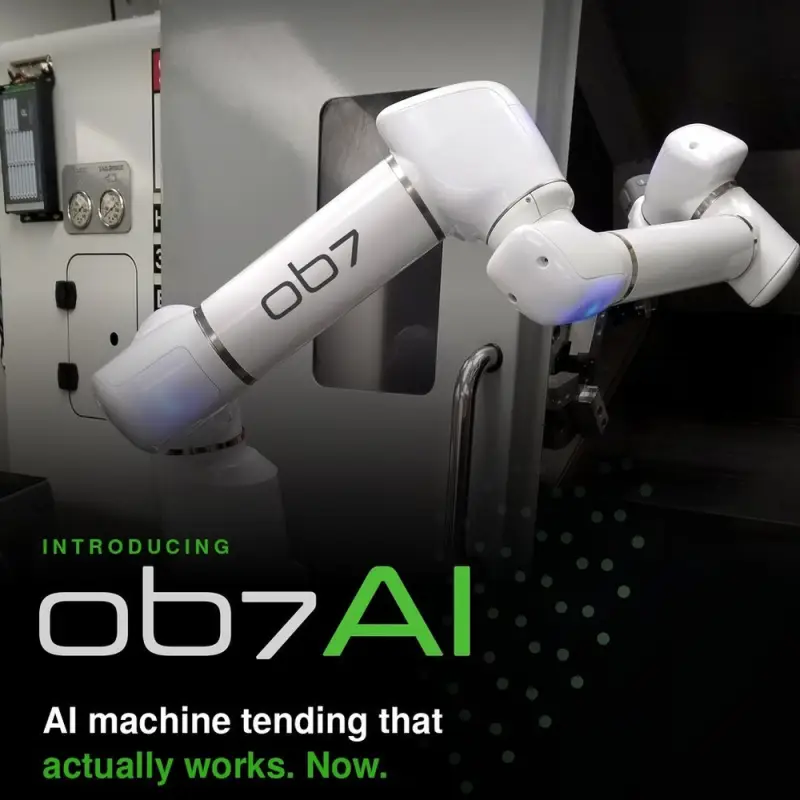
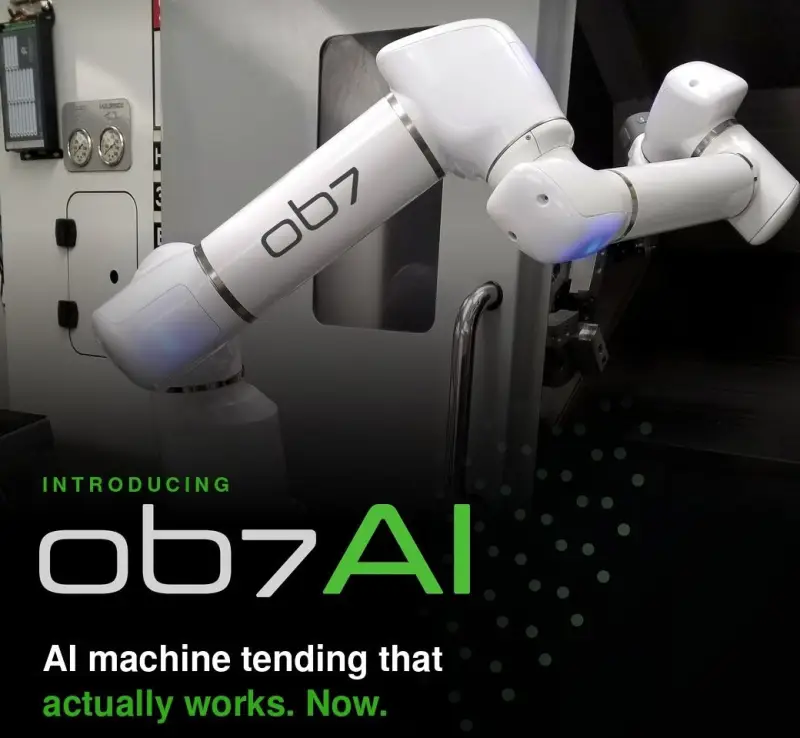
For shops that change parts frequently, the setup time required to automate each job can limit the value of a robot. Productive Robotics says its OB7AI addresses that bottleneck by scanning a CNC mill’s work area once, then locating and handling blanks without a separate AI training cycle for each new part or task.
The company introduced the seven-axis cobot at IMTS 2026, describing it as an extension of its OB7 platform for job shops and contract manufacturers. Its stated application is CNC machine tending: loading a blank into a mill, starting the machining cycle, detecting when that cycle has finished, and unloading the completed part.
A different setup trade-off
Productive Robotics’ existing OB7 cobots are taught by touch. An operator guides the arm through a job using a control handle, with no code required. That approach avoids conventional programming, but it still asks someone to demonstrate each new job. OB7AI shifts part of that setup work to a scan of the machine and surrounding work area.
The distinction matters most when production involves many different parts and relatively short runs. A robot that needs extensive preparation for every changeover may spend too much time being set up to make a small batch worthwhile. OB7AI’s proposed approach is to reduce that recurring teaching task: according to the company, it needs one scan per mill and no AI training cycles for subsequent parts or tasks.
Productive Robotics president Zac Bogart said the existing teach-by-touch method is simple and needs to be performed only once per job, but still consumes operator time. He described the scan based approach as a way for operators to recover that time while the cobot works around the shop’s machines.
From scan to unattended cycle
The initial scan is performed when OB7AI is first placed at a mill. Productive Robotics says the robot maps the work area and learns the locations of items in it. For subsequent work, an operator places blanks on a table and starts the task. The blanks need not be positioned with precision, according to the company, provided there is enough clearance between them for the gripper to reach each one.
Once started, the cobot is described as carrying out the tending sequence on its own. It finds a blank, opens the mill door, places the part in the vise and closes the door. It then presses the cycle start button and reads the CNC screen to determine when machining has finished. The robot reopens the door, removes the finished part and repeats the sequence until the job is complete.
That workflow combines physical handling with machine status detection. The robot has to reach the part and vise, operate the door and start control, then interpret the CNC screen well enough to decide when it can unload. Productive Robotics has not provided detailed specifications for the sensing hardware, screen-reading method, payload, reach, cycle time or supported CNC controls in the supplied product information. Those details will matter to shops assessing fit with a particular mill and process.
Why high-mix shops are the target
Automation economics can be difficult in high-mix, low-volume production because setup effort is spread across fewer parts. If every new job requires an operator to teach a robot, that work can consume a meaningful share of a short run. Reducing the teaching burden could make tending practical for more frequent changeovers, although the actual benefit will depend on the scan, part staging and machine workflow in a given shop.
Productive Robotics presents the system as a way to keep mills producing around the clock, including on small jobs. That is the company’s intended use case, not a published utilization result: no measured production data or test conditions are given. In practice, unattended operation also depends on the wider production setup, including the availability of blanks, suitable fixturing and a process that can run without an operator intervening.
Bogart identified automotive and CNC machining as key markets for cobots using physical AI, and said the added capability could also extend to non-factory settings such as laboratory research and healthcare. The product’s described workflow, however, centers on CNC tending. Shops evaluating it will want to establish how the scan handles their actual machine layout, how reliably it identifies parts and cycle completion, and what happens when a job deviates from the expected sequence.
What to assess on the shop floor
The central claim is a reduction in repeated setup: scan a mill once, stage blanks with adequate gripper clearance, and start the task without training the AI on each new job. That could be useful where operator time spent teaching a robot is a barrier to automating short runs. The next practical question is how consistently the system performs across the range of machines, blanks and production conditions a shop expects it to handle.
Productive Robotics announced OB7AI at IMTS 2026. Its description sets out the operating sequence and the intended high-mix use case, but leaves key integration and performance specifications open. For production teams, the most useful evaluation will be a representative trial on their own mill and parts, with attention to changeover effort, cycle completion detection and the amount of operator oversight required.


