OB7 Seven-Axis Cobot Automates Gear Deburring with Force Control
- marketing team
- 905 reads
Productive Robotics says its OB7 cobot doubled throughput and cut scrap from 10% to 1% while deburring gears at its California factory.

Deburring can set the pace for a machine shop after CNC machining is finished: each part still needs its edges cleaned, and manual grinding ties up an operator on repetitive work. Productive Robotics says its seven-axis OB7 cobot now deburrs gears at the company’s factory in Carpinteria, California. In that application, the company reports scrap falling from 10% to 1% and throughput reaching twice the manual rate.
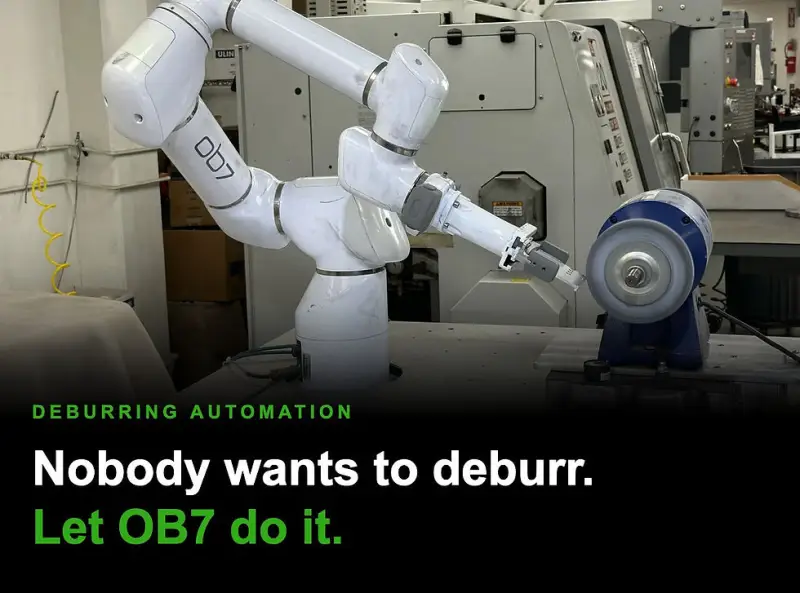
The practical appeal is consistency across a batch and across a shift. The robot picks a part from a staging grid, presents its edges to a bench grinder, then returns the finished part to the grid. Its deburring stage applies a selected force, while the arm follows taught paths around the part. That makes the process less dependent on an operator maintaining the same pressure and motion for every piece.
Force control and reach around the part
The deburring stage’s force setting is adjustable from 1.5 to 14.9 lb. It can compensate for up to 2" of wheel wear, according to Productive Robotics. Those features address two variables that affect contact between a part and a grinding wheel: the force applied during the pass and the changing position of the wheel as it wears.
OB7’s seventh joint rotates ±540°. The company describes this extra rotation as a way to spin round parts against the wheel and work around their circumference. For jobs that require finishing both sides, a regrip station lets the arm set down the part, pick it up again, and continue on the opposite face.

Cycle time depends on the part, ranging from 30 seconds to a few minutes. The staging grid can hold 30, 40 or more parts for an unattended batch, according to the company. That capacity changes how the cell fits into production: an operator can load multiple parts, start the job and move to other work while the robot processes the staged pieces.
Productive Robotics says it has seen the same system deburr its own gears. The company reports a reduction in scrap from 10% to 1% and a twofold throughput increase compared with manual deburring. These figures describe its factory application; the source gives no test duration, part dimensions, sample size or measurement method. Shops evaluating the result for their own work would need to compare scrap definitions, gear geometry, wheel condition and cycle requirements.
Teaching by demonstration
Operators teach the robot by guiding its arm through the required motions. OB7 records those movements for repeated cycles, so the setup described by Productive Robotics does not require writing robot code. The company says a simple part can be taught in 10 minutes, and a saved job can be loaded again in minutes. It also says some customers run batches as small as five parts.
Those figures point to a setup aimed at work with changing part runs, where programming time can otherwise make automation harder to justify. The source does not specify how much adjustment a new part requires, or how the taught path changes for different materials, edge conditions or grinder wheels. Those details matter when estimating changeover time for a particular shop.
Cell footprint and included equipment
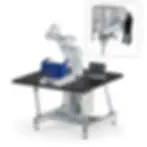
The package includes the seven-axis OB7 arm, its controller and tablet, a PG2 parallel programmable electric gripper, and a force-controlled deburring stage. The stage mounts most common bench grinder motors. A 47" × 47" work table, robot stand, robot machine interface and required cables are also included.
The open cell uses a 47" × 47" footprint, about 16 sq ft, and the company estimates half a day to unpack and set it up. An enclosed option adds a barrier intended to keep metal dust and debris inside the cell. The stated utilities are 110V power and 60 PSI shop air.
Productive Robotics presents the package as a way to move a repetitive grinding task into a dedicated cell while leaving an operator available for other jobs. The reported gains make the gear application a useful reference point, but throughput and scrap performance will depend on the part, the finishing path and the production mix. For a shop considering automation, the key comparison is whether the saved operator time and more consistent contact justify the cell’s footprint and setup for its own parts.


