Schneider Electric’s Lexium Robots Fit into a Connected Automation Stack
- Alex Owen-Hill
- 327 reads
Lexium robots span cobots, SCARA and delta models, with motion control, transport and digital twin tools for integrated factory automation.
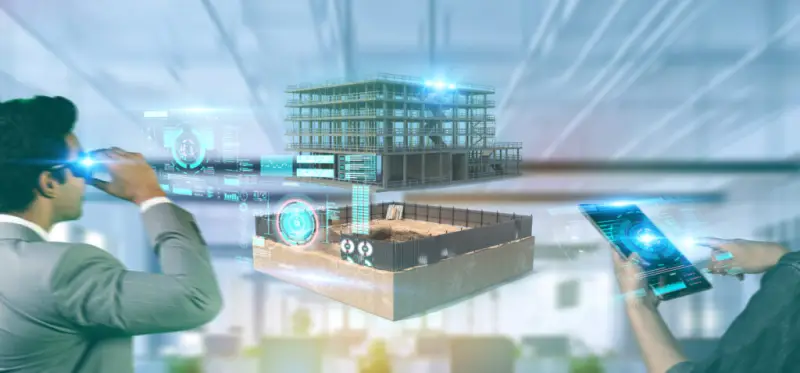
Schneider Electric’s Lexium robots are designed to work within a wider automation system. That matters for manufacturers integrating robot arms with motion controllers, product transport, simulation and energy management. The company’s range covers collaborative robots, SCARA robots and delta robots, while its EcoStruxure and PacDrive products connect those machines to the rest of a production line.
Schneider has been developing industrial robots for almost two decades. Around 2007, it introduced servo-controlled embedded robots for consumer goods machinery. Its later “smart machine” approach connected robots, drives and analytics through the EcoStruxure machine architecture. In 2023, Schneider selected JAKA Robotics as its exclusive collaborative robot partner; the companies are also developing a joint service center for global customers.
Robots within the automation stack
A robot cell needs more than an arm. It may also depend on controllers, conveyors or other product transport, supervisory software and energy management. Schneider’s portfolio spans these layers: Lexium cobots, SCARA and T/P robots; PacDrive 3 motion control with LMC402/802/902 controllers; the Lexium MC12 Multi Carrier; EcoStruxure Machine Expert Twin for digital twin work; SCADA and performance analytics; and the EcoStruxure platform for energy management.
That breadth makes the portfolio relevant to process automation, where robots must coordinate with PLCs and other machines as well as supervisory and analytical software. Industry figures cited for 2025 put global industrial robot installations at more than half a million. The practical issue for factory teams is how those robots fit into the control and data systems around them.
Schneider serves sectors including food and beverage, semiconductor manufacturing, life sciences, logistics and automotive. Two examples from its case study catalog show how the company combines equipment across the automation stack.
Two applications of connected robotics
At its own components factory, Schneider needed one line to assemble seven push button types, each with as many as 31 parts. Engineers combined Lexium SCARA, collaborative and T/P robots with an MC12 multi-carrier platform and a digital twin. The resulting flexible machine replaced three separate assembly lines. Schneider reports that this cut the line’s footprint and investment by a factor of three.
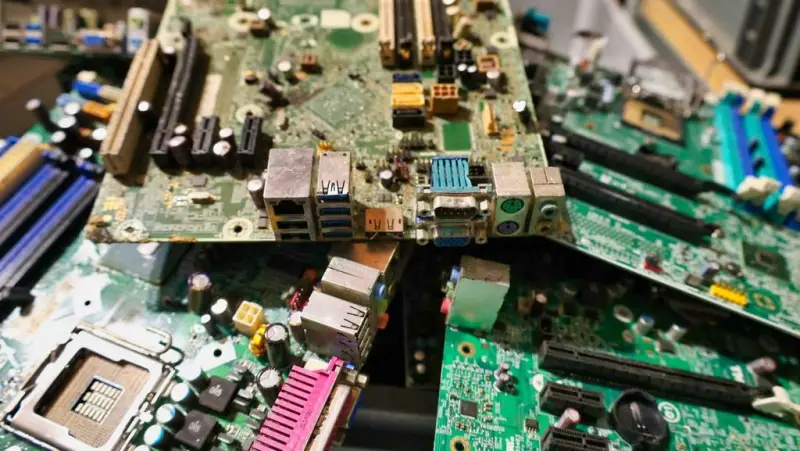
A second application targets semiconductor reuse. An OEM wanted to reduce reliance on semiconductor supply chains and limit electronic waste. Its system combines Lexium cobots and SCARA robots with digital twins and artificial intelligence to desolder and recover microchips from used circuit boards. The example puts the emphasis on recovering components through an automated process.
Programming and simulation choices
EcoStruxure Machine Expert provides a shared environment for developing, configuring and commissioning machines. Lexium SCARA robots can be configured in the software and controlled through Schneider motion controllers. Supported programming languages include ladder, structured text and function block diagrams.
Lexium cobots also support graphical drag-and-drop programming on iOS or Android tablets, along with hand guiding: an operator moves the arm by hand to teach its path. For offline work, RoboDK can be used to program and simulate Schneider robots on a computer without stopping production. Its tools include collision detection, multi-robot setups and CAD/CAM integration.
Three Lexium models and their specifications
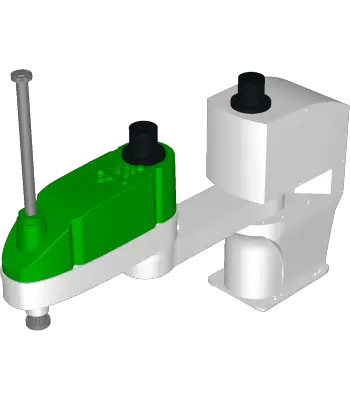
The Lexium SCARA LXMRSP0660300 has a built-in controller, which reduces wiring and cabinet space. It is specified for a 6 kg payload, 600 mm reach, 0.02 mm repeatability and a top speed of 7,750 mm/s. Those figures suit pick and place, assembly and packaging tasks where reach and repeatability need to be checked against the cell layout.
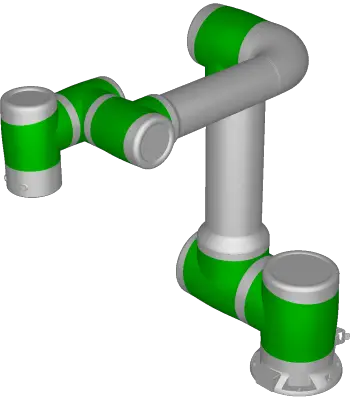
The Lexium Cobot LXMRL18S0000 sits at the higher-payload end of the cobot range. It carries up to 18 kg, reaches 1,073 mm and has 0.02 mm repeatability. It can be mounted on a wall, floor or ceiling, and uses torque feedback to detect collisions. Palletizing, machine tending and welding are among the stated applications.
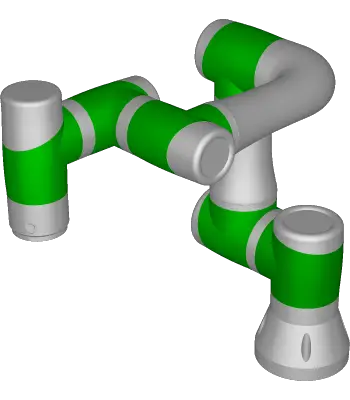
The smaller Lexium Cobot LXMRL03S0000 weighs 12 kg and is specified for a 3 kg payload, 626 mm reach and 0.02 mm repeatability. Its size and weight make it a candidate for light assembly, gluing and part handling, including work where a robot needs to move between stations.
Schneider’s Lexium families also include SCARA models for high-speed assembly and T/P delta robots suited to higher-speed tasks such as packaging. Before selecting hardware, teams can use robot simulation to assess reach and payload against a planned cell, estimate cycle times and check collisions. That lets engineers evaluate how a Lexium model may fit into a connected line before committing to the physical layout.