Electrical Pulse Method Could Cut EV Battery Health Checks to Under Three Minutes
- Mrigakshi Dixit
- 460 reads
UNSW Sydney and DY New Energy are testing pulse diagnostics that estimate used EV battery health in under three minutes, at less than $25 per pack.
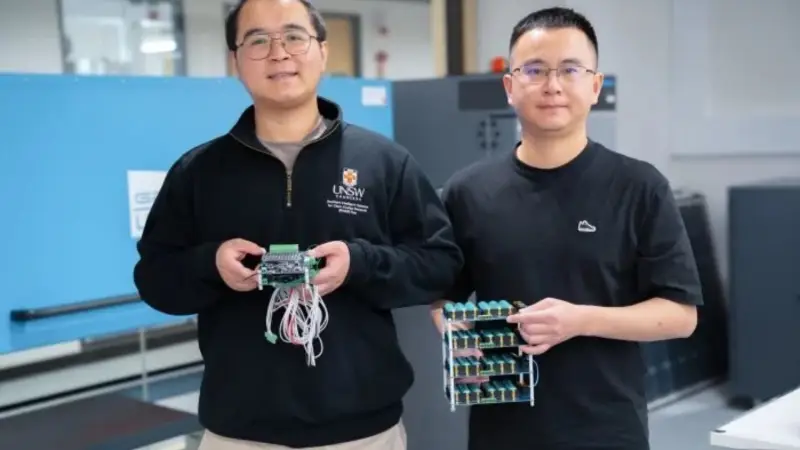
Used electric vehicle batteries may have years of useful service left, but deciding which packs can safely be reused is slow and costly. A project involving UNSW Sydney and battery recycling company DY New Energy aims to reduce that assessment from around 10 hours per unit to less than three minutes. Its approach uses short electrical pulses and statistical models instead of a full charge and discharge cycle.
The difference could affect the economics of sorting retired packs. Current testing is reported to cost roughly $120 per unit and carries a risk of triggering a chemical fire. The proposed platform targets a cost below $25 per pack, with battery health estimates reported at more than 90 percent accuracy. Those figures describe the project’s intended performance; the system still needs validation in industrial conditions.
The work is backed by a $1.3 million collaboration and funding through the Trailblazer for Recycling and Clean Energy Lab to Market Fund. The stated goal is to move the assessment technology from laboratory development into factory workflows, where incoming packs can vary in condition, chemistry and configuration.
What the pulse test measures
Rather than waiting through a complete charge and discharge, the method applies brief electrical pulses and observes how a cell responds. Statistical models use those responses to estimate battery health. The practical promise is speed: a short measurement could give operators an initial basis for sorting batteries without holding each one for much of a working day.
That estimate matters because a pack’s remaining value depends on what it can still do. A battery that no longer meets the demands of long-range driving may still suit stationary storage, where it can support a steadier load. A useful screening system therefore needs to distinguish packs that can be repurposed from those better sent for materials recovery.
The project’s models are being designed for mixed batches containing three common lithium-ion chemistries: lithium iron phosphate (LFP), nickel cobalt aluminum (NCA), and nickel manganese cobalt (NMC). That is a meaningful requirement for deployment. Real recycling operations do not necessarily receive uniform lots of identical cells, so an assessment process has to account for chemistry differences rather than assume every battery behaves alike.
Associate Professor Huadong Mo, a project co-lead, has pointed to the gap between the share of battery components that can be recovered and the small fraction of Australia’s lithium-ion cells currently collected for recycling. He described fast, affordable testing as one of the elements needed to support a local second-life battery industry, with retired packs potentially serving grid and community energy storage.
“As more EVs reach the end of their first life, Australia has a real opportunity to build a local second-life battery industry, with retired batteries supporting grid and community energy storage. Fast, affordable testing is one of the key pieces needed to make that happen, because every battery we can safely give a second life keeps delivering value instead of heading straight to landfill,” Mo said.
Sorting for reuse or recovery
An AI-powered decision engine is planned as part of the platform. It would recommend whether a retired unit should be routed to recycling or considered for stationary energy storage. The recommendation depends on the assessment: the pulse response feeds a health estimate, and that estimate informs the next step in the battery’s handling.
That kind of sorting could help avoid scrapping batteries that remain useful, while directing unsuitable packs toward materials recovery. Up to 95 percent of a battery’s components are recoverable, Mo said. The point of a rapid check is not simply to keep more packs in service; it is to make a timely, informed choice about each pack’s next use.
Engineers are also developing an intelligent Battery Management System (iBMS) module that would put the assessment insights into working battery packs. The intended role is continuous, real-time monitoring. That extends the project beyond intake screening: the pulse test could help assess a retired battery, while the iBMS could track it after it enters a stationary storage system.
Factory validation is the next test
DY New Energy is set to provide operational data, industrial workflows and physical testing facilities. The team’s next major validation step is to assess the technology across more than 500 batteries under real operating conditions. Dr Ziyang Lyu said that performance in laboratories needs to be followed by evidence from factory floors and working energy storage systems before industry adoption.
That trial will show whether the speed and accuracy targets hold across the varied batteries and workflows operators encounter. It will also test whether the platform’s recommendations fit the practical decisions a recycling facility must make. Until those results are available, the reported sub-three-minute assessment and greater-than-90-percent accuracy remain targets to validate at scale.
EV batteries are typically retired from vehicle use when they fall to 70 to 80 percent of their original capacity. The reduced capacity can make them less suitable for long highway drives, while leaving them capable of stationary service. Repurposed packs could support off-grid solar farms, telecom backup systems, EV fast-charging stations and community microgrids for another five to ten years before their materials are recovered.
The engineering question now is whether a brief electrical signature can provide a dependable basis for those choices across mixed, real-world inventory. If the 500-battery validation supports the project’s performance claims, fast screening could make second-life assessment a practical part of routine battery handling.
Related context on lithium-ion battery recycling, EV battery reuse and recovery, and lithium extraction.