IMTS 2026: Knowledge Graphs, MCP and a New Industrial AI Stack
- Knud Lasse Lueth
- 386 reads
IMTS 2026 pointed to an industrial AI stack built around connected data, agent interfaces and human oversight, with early tests reaching robot cells.
Industrial AI is starting to connect the software that describes a factory with the equipment that runs it. At IMTS 2026, the clearest signs were knowledge graphs that add context to plant data, Model Context Protocol (MCP) servers that let agents query industrial applications, and early work on a common way to connect AI agents to physical devices. The pieces are still taking shape, and current robot demonstrations remain proof of concept. But the direction suggests a new layer forming around established systems such as ERP, MES and operational historians.
The International Manufacturing Technology Show ran September 14–19, 2026, at McCormick Place in Chicago. CNC machine tools, additive manufacturing and fabrication remain central to the event, which runs every two years. Yet cloud providers, AI firms and industrial software vendors had a more visible presence this time. The organizer, the Association for Manufacturing Technology (AMT), introduced a dedicated Industrial AI Arena, while Google presented its factory AI pitch and OpenAI showed an agentic maintenance system.
A new stack around systems of record
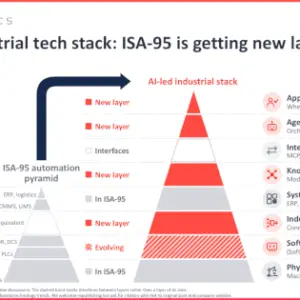
The traditional ISA-95 pyramid, used since the 1990s to describe industrial software, places sensors and programmable logic controllers at the base, followed by SCADA, MES and historians, with ERP above them. Interviews at the show pointed to a broader arrangement: the established applications remain, but new layers sit alongside them. These include a software-defined edge, industrial DataOps, knowledge graphs and ontologies, interfaces such as MCP, agent-to-agent communication and the Model Hardware Standard (MHS), plus AI agents and applications that keep people involved.
The practical question is where factory data gets its meaning. For years, cloud providers often recommended copying information from plant systems into a centralized data lake before analysis. AWS made a different case at IMTS with its Industrial Data Fabric architecture. It uses knowledge graphs, including Amazon Neptune, to connect and contextualize data while it remains in systems such as MES, SAP, product lifecycle management (PLM) software and operational technology historians.
AWS also demonstrated an orchestrator that queries MCP servers for ERP, MES, computerized maintenance management systems (CMMS), PLM and its SiteWise historian, then builds a knowledge graph on demand. Steve Blackwell, AWS head of product engineering and services, said the company had originally used graphs to relate industrial IoT data to information in systems such as MES and SAP. With GraphRAG in Amazon Bedrock Agent Core, he said, an agent can work directly with that connected information to reason across relationships and answer questions.
That emphasis on context matters because a language model can produce a fluent answer without understanding how a plant’s tags, assets and work orders relate. MachineMetrics, which began as a machine monitoring company 12 years ago and now positions its MaximaOS platform as an MES, described its knowledge graph as the company’s “moat.” Chief revenue officer Graham Immerman argued that front ends are relatively easy to build; the valuable work lies in the data models and context behind them.
Agents need visibility and live connections
Trust is another part of the stack. Engineers need to see what an agent did before they can rely on its output in operational work. AWS showed an Engineering Assistant that exposes the steps in its reasoning, the systems it queried, the data sources it used and its confidence scores. That kind of visibility speaks to a recurring concern in engineering: users do not want to assume an agent is right without being able to inspect the basis for its answer.
MCP offers one route for agents to interact with existing software. Anthropic introduced the open protocol in November 2024; the Linux Foundation now oversees it. In a traditional extract, transform, load workflow, teams copy data from separate applications into a data lake before analyzing it. MCP servers instead give agents a way to query data where it resides, and in some cases to take actions using live operational information.
Several vendors presented MCP servers at IMTS, including MachineMetrics, PTC’s Onshape, Rockwell Automation’s Emulate3D, Limble and Vention. Vention chief product officer Brendan Sterne described an MCP workflow in which a user could use Claude Code to work with a design’s geometry and configuration, program the cell, upload the result and run it on a digital twin.
There’s a meaningful difference between MCP implementations. A native server can expose an application’s logic so an agent can make changes or run functions within that application. A wrapper around a closed API may offer read-only access, while a basic connector may move data between systems without understanding what that data represents. Buyers will need to examine the actions each server supports and the context it provides; the MCP label alone doesn’t establish either.
MHS extends the idea to physical equipment
MCP connects agents to software. Anthropic’s Model Hardware Standard aims to provide a similar common interface for physical equipment, including robot arms, sensors and test instruments. Released as a research preview on August 27, 2026, MHS gives each device a standard driver with simple “read” and “write” commands, along with a plain-language description of its capabilities and safety limits. The goal is to let an agent discover and operate supported equipment without custom integration code for each device.
Anthropic says MHS could reduce integration work from weeks or months to hours or minutes. That is a vendor claim, not a measured result reported at IMTS. Early support is concentrated in laboratories, but Universal Robots, Doosan Robotics and AWS are among the companies adding support.
Universal Robots tested the approach with four of its cobots through PolyScope X, its API-first control system. The company built an agent using Claude Opus 4.8 in Claude Code. Given plain-language instructions, the agent discovered the robots and their capabilities, configured them and ran them as a cell, passing payloads between robots within each device’s declared limits.
Universal Robots provided no performance figures and characterized the setup as a proof of concept. It did not demonstrate MHS on the show floor, but discussed the potential with attendees. Chris Savoia, the company’s head of ecosystem, described it as a way to provision robots and assign tasks in natural language through Claude. Vention, whose robot cells often use Universal Robots arms, called MHS an “introspection and control framework”: a way for an AI model to identify the sensors and actuators available to it.
Adoption will move at different speeds
The demonstrations also showed how differently equipment makers are approaching physical AI. Fanuc, a Japanese automation company, had declined to discuss the topic at Automatica 2025. At IMTS 2026, it showed two physical AI demonstrations with Google and AWS, both still in research and development. Universal Robots appeared further along in opening its platform to AI applications, launching its Gen 7 cobot at the show.
Industrial software vendors are also making different choices about how much autonomy to allow. MaintainX cofounder Nick Haase said the CMMS company aims to be “a half step behind.” That position reflects a broader divide: some vendors are testing agent actions, while others are moving more cautiously. For now, people remain in the loop, particularly where an agent’s decisions could affect production equipment or maintenance work.
The emerging architecture links several efforts. Knowledge graphs supply relationships and meaning; DataOps helps prepare and manage industrial data; MCP lets agents reach software applications; and MHS is intended to give them a consistent way to interact with devices. When those elements connect with maintenance and predictive maintenance software, they could help close the loop from a sensor signal to a repair task. The systems are not yet operating that loop autonomously at scale.
IMTS 2026 therefore offered a useful view of where engineering teams may need to focus: not only on the agent interface, but also on data context, access rights, observability and the limits declared by each connected device. The new stack keeps familiar records in place while adding ways to connect and act across them. The next test is whether vendors can make those connections dependable enough for routine factory work, while giving engineers clear visibility into what an agent sees and does.


