MIT’s Thin Muscle-Powered Robot Swims by Following Light
- MIT News
- 527 reads
A gel film and light-responsive muscle cells power a two-finned swimmer that can steer through a water maze.
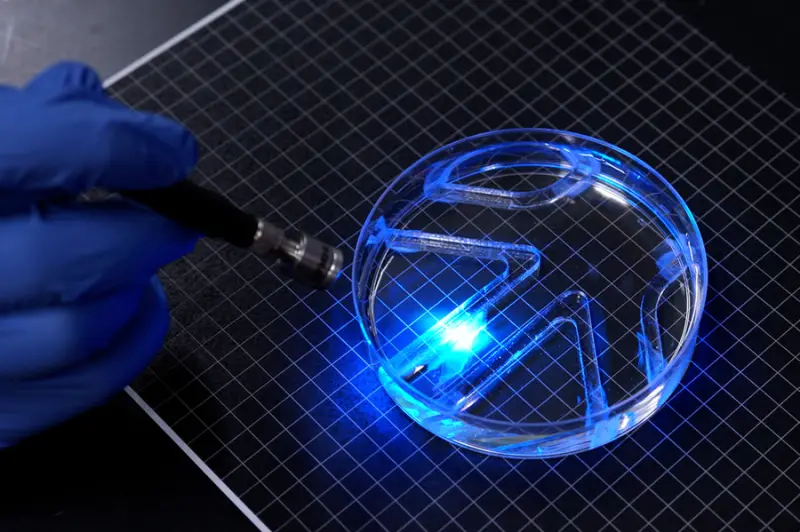
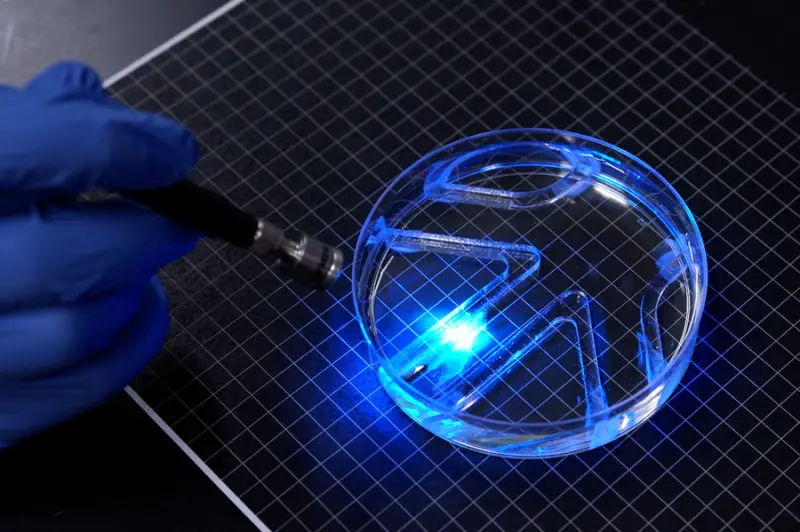 MIT engineers developed a soft robot that flaps through water in response to flashes of light. Photo credit: Melanie Gonick, MIT.
A single, hair-thin layer of living muscle can propel a small robot through water when its supporting structure is designed to hold the cells in alignment. MIT engineers used that combination of muscle and gel to build a thin, two-finned swimmer that steers by responding to light.
The robot’s body is a film of gel about the length and width of a stick of gum. Each half forms a fin lined with muscle cells genetically engineered to twitch when illuminated. Light directed at one fin makes its muscle contract and flap the fin, pulling the robot through the water. By changing which fin receives light and when, the researchers can control the swimmer’s direction and speed.
The team demonstrated the approach by guiding the robot through a simple maze in a dish of water. Its fastest recorded pace was about four body lengths per minute. That is slow beside an Olympic swimmer, who can cover up to 65 body lengths per minute, but comparable to the cruising rate cited for a cow shark.
“It takes a lot of force to move through water versus air,” says study author Ritu Raman, an associate professor of mechanical engineering at MIT. “The robot’s quite strong, given its size.”
Building a better support for muscle
The work builds on an earlier project from Raman’s group, which developed an iris-inspired disk of artificial muscle tissue. In that design, muscle cells grew on a gel disk patterned with concentric and radial grooves. When stimulated with light, the cells stretched and squeezed the disk in multiple directions, producing motion that resembled the opening and closing of an eye’s pupil.
That experiment showed that muscle cells could grow in a thin layer and be arranged to produce controlled movement. But the movements were only about 100 microns. The new project set a different target: generate enough force to move a robot through water.
The team found that the gel beneath the cells was central to that goal. In the earlier design, the cells grew on fibrin, an ultrasoft gel that could shrivel under the forces generated by contracting muscle. For the swimmer, the researchers tested the gel’s composition and stiffness, as well as the shape and dimensions of its surface grooves.
Grooves help guide cells into alignment as they grow. The team compared shapes including a narrow, square-bottomed trough and a long, curved valley. Cells aligned better in the squarer grooves. That alignment matters because cells organized in the same direction can fuse into fibers, producing stronger, more coordinated muscle tissue.
The researchers also replaced fibrin with gelatin methacrylate, or GelMA, a material used in tissue engineering. They prepared GelMA gels with different stiffnesses and observed how the cells developed on their surfaces. Cells aligned more effectively and produced the greatest force on stiffer gels. The team found that a half-millimeter-thin GelMA film supported a single cell layer while remaining light enough for the cells to stay attached as they contracted.
Two muscles, controlled by light
After optimizing the gel and groove pattern, the researchers grew cells on both sides of a thin, two-finned structure. Square-bottomed grooves guided the cells into aligned fibers, forming the robot’s muscle layers. The team also trained the cells with a routine of flashing lights to strengthen their contractions.
Each fin acts as an independent muscle. Illuminating one side makes that fin flap; illuminating both sets of cells makes both fins move. In the maze demonstration, researchers moved a light source by hand above the submerged robot. The swimmer followed the light, changing its fin motion to navigate the route.
 MIT graduate student Maheera Bawa is pictured in Raman Lab. The team optimized muscle movement to generate enough force to propel a swimmer. Photo credit: Melanie Gonick, MIT.
The researchers describe the device as the first very thin, two-dimensional robot powered by muscle tissue to demonstrate locomotion. Many biohybrid robots built by Raman’s group and other researchers use bulky, three-dimensional blocks of lab-grown skeletal muscle, which require millions of cells. A thinner structure could take fewer cells to fabricate and may move more efficiently, though the study does not establish a production cost or compare the swimmer’s efficiency with other robots.
Raman sees potential for living-muscle robots in delicate tasks, including exploring environments that are too fragile or unpredictable for conventional hardware. Living tissue is soft, responds to its surroundings and can heal itself, she says. Those traits could matter in aquatic monitoring, where a small, compliant device might interact with its surroundings differently from a rigid machine.
The prototype’s shape is still basic; the researchers designed it first to show that an optimized muscle layer could generate enough force to swim. Raman says the next step is to refine the body design for faster movement. For now, the maze run demonstrates the engineering principle behind the device: supporting muscle cells with the right gel and groove geometry can turn small contractions into directed motion through water.