Electric Motor Array Shows How Mechanical Coupling Can Coordinate Actuators
- The Conversation
- 678 reads
A tabletop motor array developed at the University of Bristol produces muscle-like coordination through a shared backbone, pointing to simpler robot actuation.
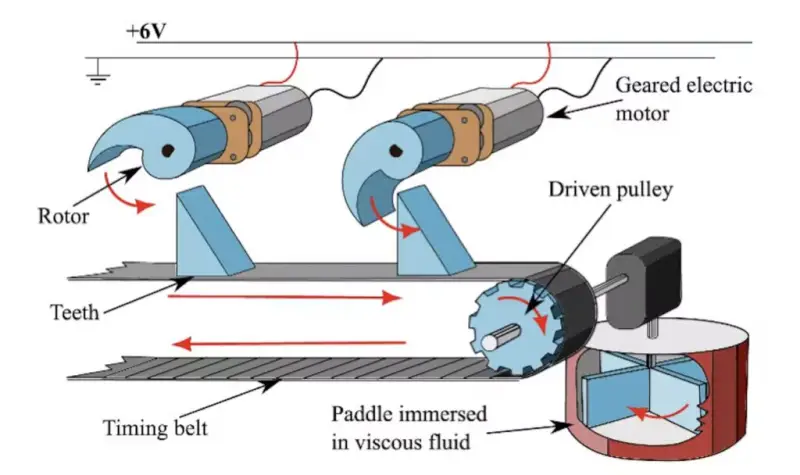
A robot with many actuators may not need a controller to direct every unit separately. A University of Bristol team has built a tabletop array of electric motors in which a shared mechanical backbone helps the motors coordinate as they engage and disengage. The setup produces several behaviours seen in muscle, including changing participation as load rises and waves of coordinated motion.
The work, led by mathematician Hermes Bloomfield-Gadêlha with colleagues at the University of Bristol, was published in the Royal Society journal Interface. It tests a specific idea: coordination among many force-producing units might emerge from how they are mechanically connected, without a central controller continuously instructing each one.
A shared structure links the motors
Muscle provides the biological model. Its smallest force-producing unit is the sarcomere, built from actin protein filaments and myosin molecular motors. Myosin repeatedly attaches to actin, pulls, and releases. Across a muscle, many such units contribute to actions that range from holding a cup steady to moving against a heavier load.
The team did not attempt to reproduce myosin’s chemical cycle. Instead, its mathematical model represented each force-producing unit as a cycling rotor that contributes force when mechanically engaged with a shared backbone. When disengaged, it drops out of the connected system.
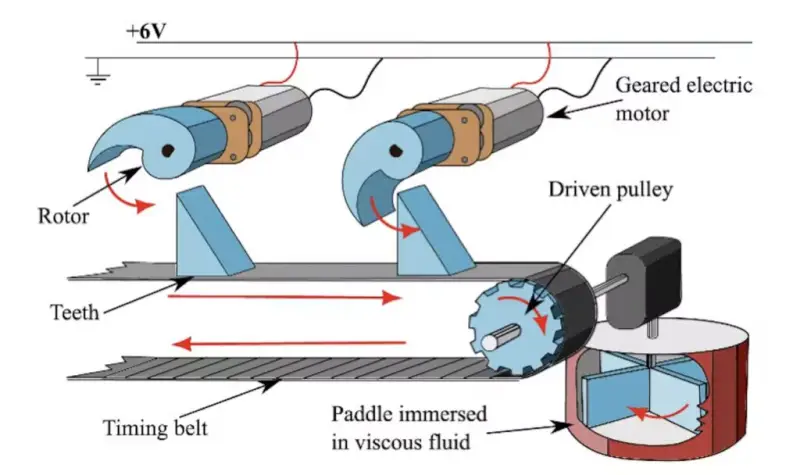
To explore whether this arrangement could work in hardware, the researchers built a line of ordinary electric motors linked through a mechanical backbone. The motors pulled against a thick fluid, which supplied resistance comparable to a viscous load. In the device, each motor briefly contacted the moving backbone, pushed on it, then let go. The backbone carried the effects of that push along the array, so one motor could influence another through the structure without direct communication.
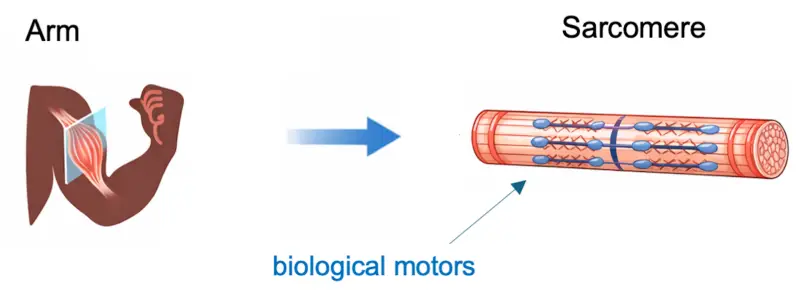 The sarcomere is the smallest functional unit of muscle.
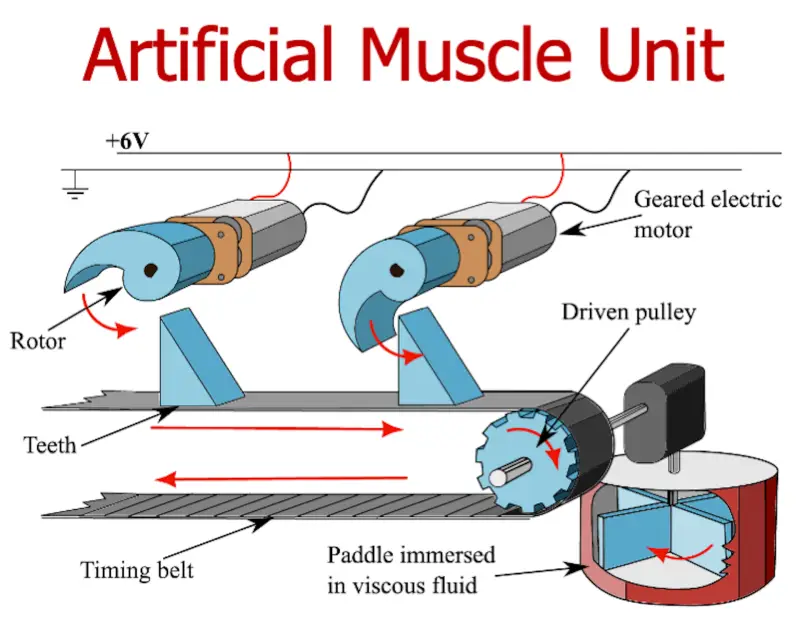 Illustration of the artificial muscle unit used in the study.
Collective behaviour emerges under load
The researchers found muscle-like patterns in both the mathematical model and the physical device. As resistance increased, the motors developed a collective relationship between load and speed. More units contributed effectively at higher loads, so participation shifted with the mechanical demand.
The array could also pull unevenly. Under some conditions, periods of coordinated pulling gave way to sudden slips, a pattern that echoes behaviour observed in experiments on actomyosin. In other conditions, coordination formed travelling waves that moved along the motor line rather than keeping every unit in step at once.
These results point to the backbone as an active part of the system’s behaviour. Its motion transmits force and feedback between units, while the changing connections allow the network to reorganise over time. The researchers’ model therefore treats the scaffold as more than a support: its mechanical properties help determine whether local activity adds up to coordinated movement.
Related mechanics in cilia and flagella
Muscle is one example of many small motors working through a shared structure. Cilia and flagella, found on some eukaryotic cells, use molecular motors distributed along a slender internal scaffold. In sperm, a flagellum’s motion supports swimming; cilia help move fluids in airways and other tissues.
The scaffold inside these structures is called the axoneme. It transmits forces along its length and helps turn local motor activity into bending waves. As with the Bristol motor array, the arrangement of the structure shapes how individual forces combine into a larger movement pattern.
Bending waves generated by motor activity help propel swimming sperm.
What the setup suggests for robotics
Robotic systems often rely on sensors, feedback loops and control algorithms to coordinate multiple actuators, with gearing or ratchets sometimes added to maintain stability under load. That approach can be complex and vulnerable to errors. The Bristol experiment suggests another design route: arrange actuators so the body of the machine transmits force and feedback, allowing some coordination to arise from the mechanics.
This could be useful in soft robotics, where flexible materials and artificial muscles already make the structure an important part of how a machine moves. The study does not establish a ready-made replacement for existing control systems; it demonstrates a physical principle in a simplified array. But it offers a design question for engineers: can a robot’s structure guide actuator behaviour well enough to reduce the amount of coordination each unit needs from electronics?
For now, the main result is a working model in which mechanical coupling produces load-sensitive participation, slips and travelling coordination waves. Future robotic designs can test how far that principle carries when actuator layouts, materials and tasks become more complex.


