October 2026 Robotics: Faster-Seeming Approaches, Single-Camera Racing and New Biohybrid Motion
- IEEE Robotics and Automation Society (RAS)
- 716 reads
October’s robotics work spans human perception, autonomous control, muscle-powered prototypes and industrial deployment, with practical limits still to resolve.
Robotics research in October ranged from a perceptual quirk that could affect how people react to mobile machines to systems operating with a single camera, living muscle tissue or a robot’s feet. The common engineering challenge is turning limited sensing and physical capability into reliable movement. At the same time, new training facilities and industrial deployments show how quickly teams are trying to move robotic systems from controlled trials into working environments.
Approach direction changes perceived speed
Researchers at Toyohashi University of Technology found that a mobile robot can seem faster when it approaches from behind than when it approaches from the front, even when both move at the same physical speed. In five experiments involving a real robot and virtual reality, 92% of participants showed this bias.
For the first experiment, participants learned two reference speeds: 0.5 and 1.0 metres per second. They then judged approaches at speeds between those values. Follow-up tests indicated that the effect did not come from the robot’s appearance or motor noise. The team instead links it to visual factors involved in turning to look at an approaching object from behind. The study is described in research on approach direction and perceived speed.
That difference matters for robot motion planning around people. A controller that uses physical speed alone may miss how an approach is experienced, especially when someone has to turn to see the machine. The researchers say further work is needed to establish whether this bias changes comfort, perceived safety or people’s actual avoidance behaviour. Until then, the result identifies a perception factor for human robot interaction, rather than a tested design rule.
Fast flight with a camera and inertial sensing
Delft University of Technology engineers developed MonoRace, an autonomous racing drone system designed to navigate demanding courses at extreme speed using a single camera. The system combines a monocular rolling-shutter camera with an inertial measurement unit (IMU), and can operate in a competition environment without external motion tracking. The team reports that it outperformed human drone champions.
A monocular camera provides visual information from one viewpoint, while the IMU measures the drone’s motion. Combining those inputs supports flight without the external tracking infrastructure often used to follow a vehicle through a course. The research describing the AI system and the team’s MonoRace explanation frame the result around high-speed autonomous navigation. The source gives no numerical course times or margin over the human competitors, so the reported comparison is best read as a performance claim rather than a quantified benchmark.
Muscle tissue and legs become actuators
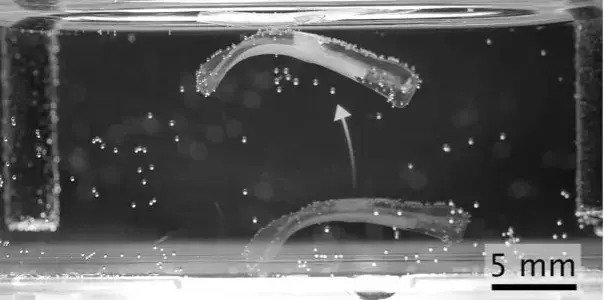
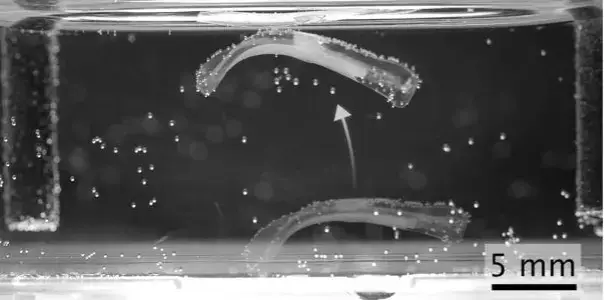
At ETH Zurich, researchers designed lab-grown mouse muscle tissue and its soft hydrogel scaffold together. Computer simulations helped identify arrangements that translate muscle contractions into larger movements. Each bioactuator is about 1.5 centimetres long; the prototypes powered by them could jump, swim, walk and grasp. The team reports up to 11 times more range of motion than earlier systems using a comparable amount of muscle tissue.
Co-designing the tissue and scaffold addresses a central mechanical problem in biohybrid devices: contraction alone does not guarantee useful movement. The support structure shapes how that force becomes displacement. The work points to how geometry and material arrangement can affect the output of a small actuator, while the reported prototypes show several forms of motion. Their performance remains tied to the tested lab-grown tissue and prototype designs; the source does not describe long-term operation or deployment outside the research setting. The project is described by ETH Zurich, with a related study in Nature Communications (2026).
Another ETH Zurich team showed that a quadruped can solve a giant Rubik’s Cube using its feet. One foot holds the 4.6-kilogram cube steady while the other turns its layers; the robot also flips and repositions the cube while maintaining balance. In tests, it completed three autonomous solves, taking about 30 steps and eight to nine minutes for each solve. The demonstration is described in the team’s project details and research paper.
The task combines visual perception, balance and repeated precise contact with an object that can move under force. That combination is useful to study because legged robots may need to manipulate objects in settings where they have no hands or their feet are the only available tools. The demonstrated solve is a specific, structured task; the source does not establish how the technique would transfer to other objects or less predictable surroundings.
Industrial activity: company plans, deployments and training
German industrial robot startup RobCo reached a reported USD1 billion valuation in October after the sale of USD40 million of shares. The company plans to launch Alfie, a two-armed, self-learning robot for industrial tasks, in March 2027. Those details describe a planned product and a company transaction; the source does not provide technical specifications for Alfie or results from industrial testing.
GXO Logistics, Inc. and Agility Robotics announced an expansion of their work on humanoid automation, with plans to deploy Agility’s Digit robots at GXO sites in North Carolina and Tennessee. The report identifies the locations and intended use in logistics, but gives no deployment schedule, operating results or task-level performance data.
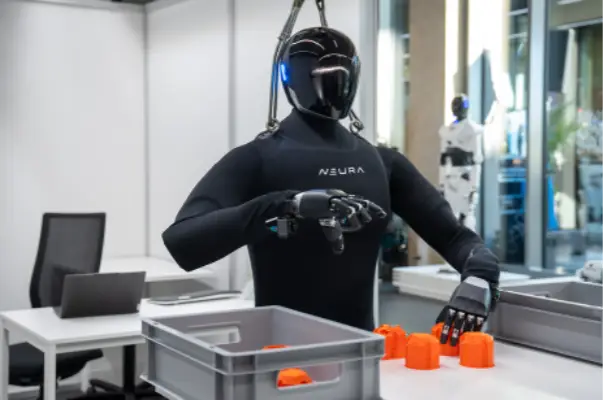
A new training and research center, TUM RoboGym, opened in October. Created through work between the Munich Institute of Robotics and Machine Intelligence (TUM MIRMI) at the Technical University of Munich (TUM) and NEURA Robotics, it will initially host around 100 humanoid and service robots across 48 training cells. The facility is intended for embodied artificial intelligence research and for training robots in specific skills and processes. Its cell-based layout gives the teams a place to develop and assess those capabilities, though the source does not specify what skills each cell will cover.
Teradyne Robotics, the company behind Universal Robots and Mobile Industrial Robots, announced a partnership with Sereact to develop industrial AI systems for retail, logistics and manufacturing. Sereact’s Cortex platform is trained in NVIDIA Isaac Sim using NVIDIA Cosmos open world models, then post-trained with reinforcement learning and benchmarked on Teradyne Robotics hardware before deployment. This sequence connects simulation, additional learning and hardware evaluation. The source does not name deployment sites or report benchmark results, so its practical value will depend on how the platform performs on the tasks and equipment it is intended to support.
Robots as a subject of public art
At Seoul’s Buk-Seoul Museum of Art, artist Kwon Byungjun’s exhibition I Embrace You uses wobbling humanoid robots and sound to explore responses to people perceived as strangers. The work draws on the arrival of Yemeni refugees on Jeju Island in 2017. Its imperfect robots struggle to move but continue reaching out and opening their arms to visitors. Their performances combine movement with sounds from lullabies, nature and artificial intelligence. The exhibition runs until 16 May 2027; details are available from the Buk-Seoul Museum of Art.
Across these projects, the practical question is how movement performs under real constraints: what people think a robot is doing, what it can infer from limited sensors, and how its body makes contact with the world. October’s demonstrations offer evidence on specific tasks, while questions of comfort, transfer to new conditions and sustained operation remain open.


