Weave Welding Patterns and Mechanized Oscillation for Consistent Welds
- BUGO
- 955 reads
Weave motion helps fill wider joints, while mechanized oscillation controls torch width, speed and dwell to improve repeatability on production seams.
Weave welding gives operators a way to distribute filler metal across wider joints, but its value depends on controlling the torch path, travel speed and heat input together. Mechanized oscillation can make that movement more repeatable over long seams, where small variations in manual technique become harder to avoid.
Choosing between weave and stringer beads
A weave bead is formed by moving the torch or electrode side to side as it advances along the joint. The lateral motion spreads weld metal over a broader area and gives the operator a way to manage fusion at the joint edges. A stringer bead follows a narrower path with little side-to-side movement.
Stringer beads are often used for root passes, narrow grooves and applications where tighter heat input control is needed. Weave beads can suit wider grooves and some out-of-position welds. Neither approach is automatically better: joint preparation, travel speed and welding parameters still determine whether the result is sound. The choice also depends on joint geometry, material thickness, welding position and process.
Patterns shape bead placement
Different weave paths affect how weld metal is distributed and how the weld pool behaves. The selected pattern should match the joint and position, as well as the requirements of the approved welding procedure.
- Zigzag: Repeated side-to-side movement can provide coverage across groove and fillet welds. In vertical-up welding, brief pauses at the sidewalls can support fusion while limiting excessive buildup in the center.
- Triangle: A repeated triangular path distributes filler across the joint. It can be used for vertical-up groove welds when the procedure calls for controlled progression and attention to both sidewalls. Travel speed and motion need to be coordinated to avoid letting the weld pool accumulate excessively.
- Figure 8 and box: Figure 8 motion lays down overlapping loops across a wider area; a box pattern uses angular transitions between the joint edges. Either may suit certain groove or fillet applications, depending on position and procedure. Overhead work calls for particular care with weld pool size and heat input.
Controlled edge dwell can help improve sidewall fusion. In suitable joints, a wider bead may also reduce the number of passes required. Weaving can support more uniform coverage and help operators manage bead placement in vertical and other out-of-position work. Those gains depend on the material, joint design and qualified procedure. Excessive weaving can raise heat input or contribute to defects.
Why manual consistency is difficult to sustain
Hand weaving asks the operator to maintain a consistent width, travel speed and pause at each sidewall. Even small changes can affect bead appearance and fusion. On an extended seam, fatigue can make it harder to repeat the same movement from start to finish.
Poorly controlled motion may contribute to undercut, lack of fusion, excessive reinforcement or unnecessary heat input. Recognizing common weld defects and their causes helps teams catch problems before they affect production. For repetitive work, manually holding every part of the torch path steady can become a production constraint.
What mechanized oscillation controls
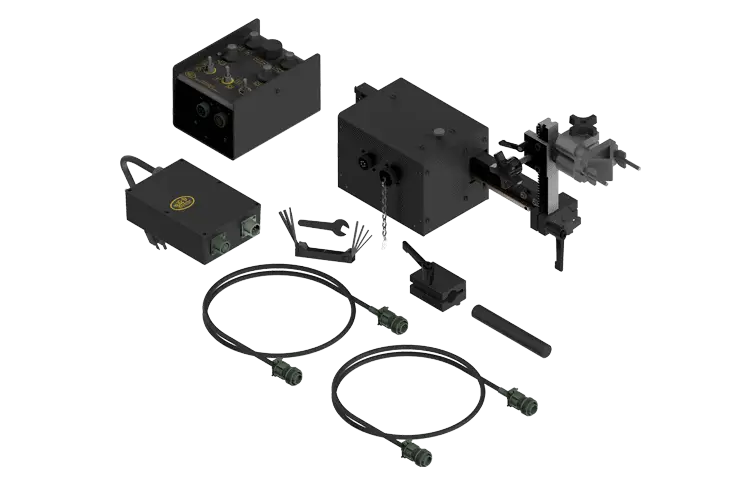
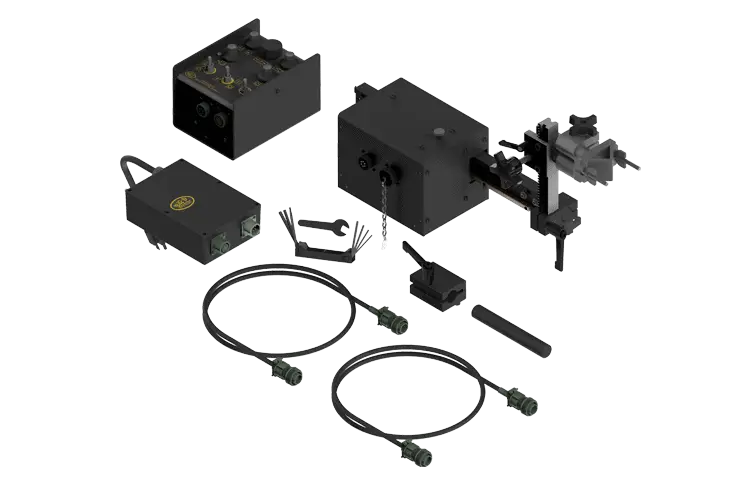
A welding oscillator moves the torch laterally while maintaining forward travel. Operators can set the oscillation width, which determines how far the torch crosses the joint; oscillation speed, which sets the rate of side-to-side movement; and sidewall dwell, which controls how long the torch pauses near each edge. Together, these settings let teams establish repeatable motion for a particular application.
Mechanized welding systems can reduce variation associated with manual torch manipulation. They don't replace correct welding parameters or inspection, but they give the operator greater control over torch movement throughout the weld. Bug-O Systems describes its weave welding systems as equipment for reducing variation in that movement.
For long, straight seams, oscillation can be paired with track equipment that controls forward travel as well as lateral motion. This combination can help maintain torch position along large plates, tanks and ship panels. Bug-O's track welding equipment is intended for such applications, where coordinating travel and weave can reduce repetitive manual movement.
Where repeatable setups matter
Weaving and mechanized oscillation are relevant to shipbuilding, storage tank fabrication, structural steel manufacturing and heavy equipment production. These sectors often involve large components, repeated joints or demanding production schedules. Shipyards, for example, work with long plate seams and substantial welded assemblies; mechanized movement can support consistency across repeated operations in the shipbuilding welding process.
The strongest case for equipment setup comes when the joint configuration and production requirements make repeatability valuable. Before production, teams need to assess joint dimensions, welding position and travel requirements, then coordinate oscillation settings with voltage, current, wire feed speed and travel speed. Applicable procedure specifications guide that setup.
Preparing operators and equipment
Equipment alone doesn't establish a sound process. Operators need to know how to set up the system, adjust its parameters and identify unacceptable weld conditions. Training should connect the oscillator settings to the welding parameters and the actual joint, so that repeatability supports the procedure rather than substituting for it. Bug-O provides weld training resources for mechanized equipment users.
The practical takeaway is to treat weave motion as a controlled process variable. A suitable pattern and tuned settings can help fill wider joints and maintain consistent bead placement; mechanized travel and oscillation become most useful when long or repeated seams make manual consistency difficult to sustain.