Seven Uncrewed Cargo Aircraft Explore Different Routes to Pilotless Flight
- Kaif Shaikh
- 867 reads
From vertical takeoff designs to automated turboprops, seven projects show how cargo aircraft are being adapted for remote and uncrewed operations.
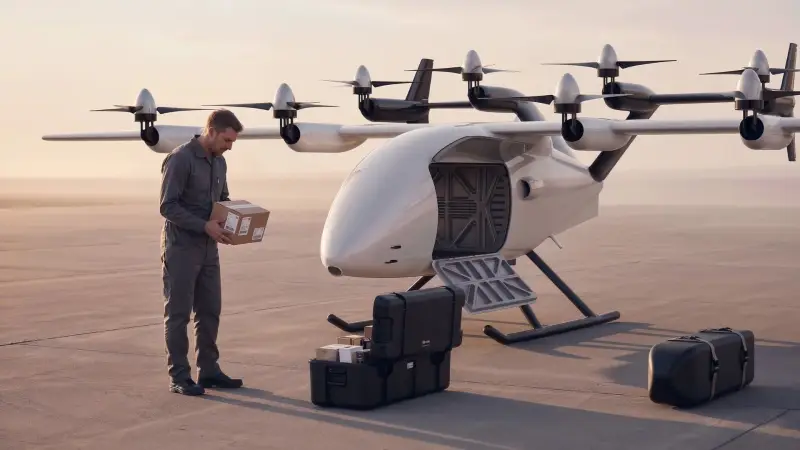
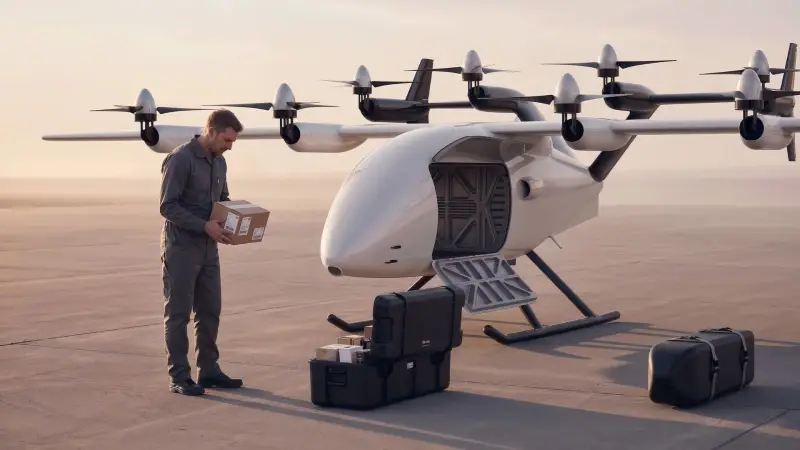
Uncrewed cargo aircraft are taking several engineering paths toward the same goal: moving freight without a pilot onboard. Some lift vertically and switch to wingborne flight; others adapt familiar aircraft or use conventional runways. Their payloads range from small parcels to several thousand pounds, and their maturity varies from early design studies to flight demonstrations. That spread matters: a successful demonstration, a remotely supervised aircraft and a future concept represent different steps toward routine cargo service.
Vertical lift with hybrid propulsion
Elroy Air’s Chaparral pairs vertical-lift propellers with a separate propulsion system for forward flight. Its hybrid-electric design is intended to take off and land without a runway, while modular cargo pods let operators load items such as medical supplies and spare parts without requiring infrastructure at the destination.
The aircraft is designed to carry more than 500 pounds (227 kg) over distances of up to 450 miles (724 km). In September 2026, it completed a series of autonomous, uncrewed cargo flights in Louisiana. The aircraft carried packages, medical supplies, tools, food and water under air traffic control oversight, with no pilot onboard. Those flights show the design operating in a real delivery setting, though a demonstration alone doesn’t establish routine commercial service.
Skyways’ Skyreach also combines vertical takeoff and landing with fuel-powered forward flight. Unveiled in November 2026, it builds on the company’s V3 Block 2 platform, using eight electric motors for vertical lift. Customer flights were scheduled to begin in December.
Skyways specifies more than 18 hours of flight and an operational range exceeding 1,300 miles (2,092 km) in its maximum-fuel configuration. The seven-cubic-foot (0.2 cubic meters) cargo bay is intended to accommodate different payloads, including temperature-controlled freight. Its combined fuel-and-payload capacity is 100 pounds (45 kg), so operators must trade cargo weight against range. Production has started in Austin, Texas, following completion of the production design and progress in flight qualification testing.
Fixed-wing aircraft for heavier loads
Poseidon Aerospace’s Egret is designed around a different trade-off: a larger payload and long range, with runway access required. The planned aircraft has a wingspan of approximately 50 feet (about 15 meters) and is designed to carry up to 4,000 pounds (1,814 kg) over more than 1,000 nautical miles (1,151 miles). It is intended to use paved or unpaved airstrips, and front and rear cargo doors are meant to simplify loading and unloading.
Egret is being developed for autonomous operation or remote control. Its quarter-scale Seagull demonstrator has already flown, helping validate parts of the design and control architecture. Poseidon raised $60 million in Series A funding in September 2026 to advance flight testing and establish its first production line. The company expected the full-scale aircraft’s first uncrewed flight by the end of 2026.
Textron Aviation and Merlin are taking an adaptation approach with the Cessna SkyCourier UX concept. Introduced in September 2026, it pairs the twin-engine SkyCourier with Merlin’s Pilot autonomous flight software. The proposed aircraft is intended to carry approximately 6,000 pounds (2,722 kg), with room for up to three LD3 containers, and could use unimproved runways.
The concept also raises a packaging question: removing the cockpit could free cargo volume. A forward-loading arrangement and integrated loading equipment are under consideration. SkyCourier UX remains at the engineering-study and evaluation stage; no autonomous prototype or production schedule has been announced.
Adapting existing aircraft
Reliable Robotics is working to automate the Cessna 208B Grand Caravan rather than design a new airframe. Onboard computers, sensors and automated flight controls are intended to manage taxiing, takeoff, navigation and landing, with a remote operator supervising from a ground control station.
In October 2026, the company demonstrated cargo flights at Albuquerque International Sunport. A safety pilot remained onboard while the aircraft was remotely piloted from the company’s California base. The trials therefore showed automated and remote operations, not routine pilotless service. Using an existing aircraft could offer a more direct development route than building a new airframe, although the demonstrations described here still involved an onboard safety pilot.
Bell and Near Earth Autonomy are adapting the Bell 505 helicopter for uncrewed logistics. The work combines the existing airframe with Near Earth’s Captain autonomy system and changes to cargo handling. Bell announced its selection for the project in April 2026; the intended result is a prototype meeting or exceeding the customer’s performance requirements. The aircraft remains in development, so its progress depends on completing the autonomy and cargo-system integration.
A tiltrotor in ground testing
Czech aerospace company Zuri unveiled an uncrewed cargo tiltrotor in August 2026. Its hybrid-electric layout is designed to take off vertically, then use fixed-wing flight for the cruise portion of a delivery. The planned useful load is 165 kg (364 pounds), including fuel and cargo.
Zuri estimates a design range of 679 km (422 miles), falling to 569 km (354 miles) with a 30-minute fuel reserve, at a cruising speed of approximately 220 km/h (137 mph). The full-scale Technology Demonstrator 2.0 is undergoing ground testing and systems integration in Prague. Flight testing was planned for early 2027, supported by a €6 million (about $6.9 million) first tranche of Series A financing. Zuri describes the aircraft as remotely piloted, with automation handling flight tasks under ground-based supervision.
Together, these projects show why “uncrewed cargo aircraft” covers several distinct operating models. Payload, runway access, range and the level of ground supervision vary sharply. For operators, the practical test will be whether a design can carry its intended load over its intended route while fitting the infrastructure and oversight available at each end.