IRis ESP32 Remote Learns and Replays Infrared Codes
- Ananthu Ashok
- 354 reads
IRis captures and retransmits common IR protocols, with microSD code imports and a 3D printed enclosure. Its AC support and hardware testing are limited.
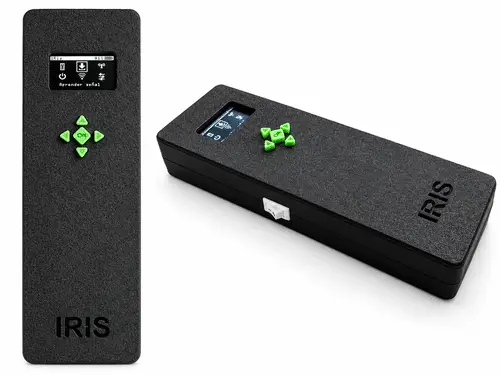
IRis turns an ESP32 development board into a programmable infrared remote that can learn commands from existing controllers and replay them later. Its practical strength is flexibility: it can decode several familiar protocols, preserve unsupported signals as raw captures, and import stored definitions from a microSD card. The trade-offs matter, though: air conditioner state commands are unsupported, and the builder’s hardware testing covered NEC remotes only.

Capture, identify, and replay
Maker Nicolas Ruiz Neiman built IRis around an ESP32-WROOM-32 development board. A TSOP38238 infrared receiver captures transmissions from other remotes. For protocols the firmware recognizes, it stores the protocol along with address and command data. The supported decoders are NEC, Samsung, Sony SIRC, RC5 and JVC.

That decoded representation gives the project a way to retain commands as structured data. When a signal uses a protocol outside the supported list, IRis keeps a raw capture for replay instead. That approach broadens the range of signals the remote can reproduce, while decoded storage remains available for the protocols the firmware understands. The source doesn’t specify how raw captures are handled across different timing conditions, so compatibility beyond the described tests remains an open practical question.
Transmission comes from two TSAL6200 infrared LEDs driven through an NPN 2N2222 transistor. The transistor provides the switching stage for the LEDs, while the ESP32 controls the command timing. Neiman reports that the assembled unit operated a TV from approximately two metres. The estimated current was 34mA per LED, calculated from circuit values rather than measured during operation; it should be read as a design estimate, not a measured result.

Controls, display, and stored definitions
Five tactile buttons provide the user input, and a 1.3-inch OLED displays the remote’s interface. The design supports either an SSD1306 or SH1106 display, giving builders a choice between two listed controller families. An optional microSD card adds another route for loading commands: IRis can import remote definitions in the .ir format used by the Flipper-IRDB collection, from the card’s /irdb directory.
The project also includes a “Be Gone” mode that sends power-off codes for devices in a selected category. That function depends on having suitable codes available, whether learned or loaded; it isn’t a universal shutdown mechanism. In routine use, the combination of onboard buttons, screen, learned commands and removable storage makes IRis a standalone controller rather than a project that requires a separate phone or computer for each operation.

Power and physical build
An 18650 lithium-ion cell powers the unit through an XL6009 boost converter set to 5V. A USB-C charging module with protection recharges the cell. The design uses perfboard PCBs and a 3D-printed PLA enclosure, with printer-friendly case files included in the project repository. These choices make the build accessible to hobbyists who can assemble a through-hole prototype and print a custom housing, while leaving room to modify the enclosure or board layout.

There is a specific operating constraint around charging: the remote should be switched off while the cell is being charged because the charging module provides no way to transmit power to the device during charging. The battery meter also estimates remaining capacity rather than reporting a direct measurement. Builders should therefore treat the displayed level as an indication, not a precise state-of-charge reading.
Where compatibility stops
IRis does not decode complete state commands, a format commonly used by air conditioner remotes. Some AC controllers send a frame that encodes a broad set of settings together, rather than a simple command associated with an individual key. Since this design does not support decoding that complete state, learning and replaying AC functions may not work as expected.
Another limitation is that a keypress transmits only one frame. The source describes no repeated-frame transmission, which some receiving devices may expect for reliable command recognition. Together, these constraints make IRis a better fit for experimenting with common consumer-device remotes than for assuming full compatibility with every infrared controller.
Firmware and project files
The firmware is written in C++17 and built with PlatformIO using the Arduino-ESP32 framework. The author reports about 210 tests run on a PC, but says these do not establish that every function works correctly on the assembled hardware. Although the firmware includes decoders for multiple protocols, the reported hardware testing was limited to NEC remotes. That distinction is useful when judging the project: the code has broader stated protocol support than the physical validation demonstrates.
The firmware is released under the GPL-3.0 license. The repository includes hardware specifications and printable enclosure files, and the GPIO assignments are collected in include/board_pins.h so developers can adapt the pin mapping for other ESP32-compatible boards. The project files are available in the IRis GitHub repository.
For builders, the main value is a compact, modifiable platform for capturing and replaying familiar IR commands, with both learned codes and removable-card imports. The key next step is validating the assembled hardware with the specific remotes and receiving devices it is meant to control, especially where protocol support, range or repeated frames could affect operation.