Prelta PS4395 and PS5395 Relays Add Adjustable Current Trip Delays
- Saba Aafreen
- 625 reads
Prelta’s AC and bipolar DC relays combine adjustable trip thresholds, selectable delays and three output types for equipment monitoring.
Choosing when a protective output changes state is the key design choice in Prelta Systems’ PS4395 and PS5395 current-sensing relays. Both models let an engineer set a current trip point and a time delay, then select from three output types. The PS4395 is for AC monitoring; the PS5395 covers bipolar DC.

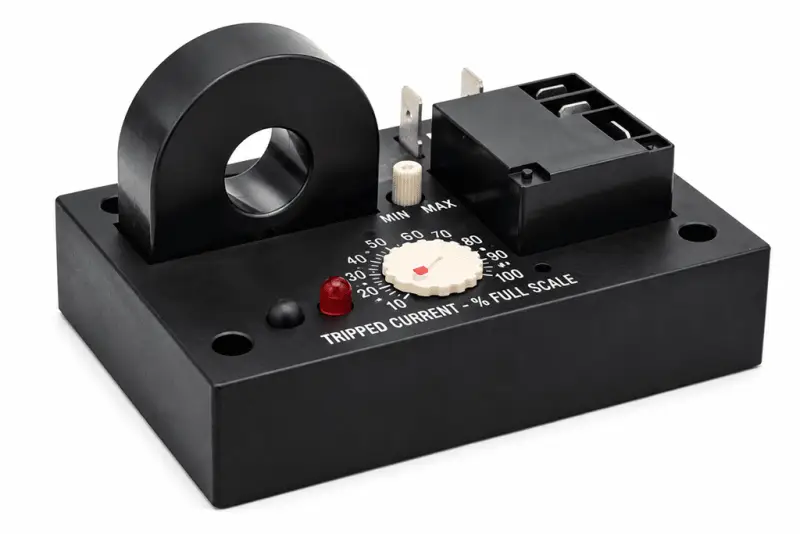
That combination gives equipment designers control over two parts of a response: the current level that triggers a change, and how long the relay waits before switching its output. The relays are intended for applications including motors, pumps, fans and heaters, where a change in current can provide a signal for monitoring or protective control.

Two models for different current types
According to Prelta Systems, the PS4395 monitors AC from 1A to 100A at frequencies from 60Hz to 400Hz. The PS5395 monitors bipolar DC, with four available ranges: 1-10A, 3-30A, 6-60A or 10-100A. The model choice therefore depends first on whether the monitored conductor carries AC or bipolar DC, and then on which stated range suits the application.

Both relays detect current in a conductor and change an output when the measured level crosses the configured trip point. The source describes operation for current rising above or falling below that point. That makes the adjustable threshold relevant to both overcurrent and undercurrent conditions, depending on how the monitoring task is configured.
For a machine designer, this is a way to turn a current condition into a discrete control signal. A motor drawing an unexpected current, for example, can be made to trigger an output after the chosen delay. The relay itself provides the sensing and switching functions; the surrounding control system determines what action follows from the output.

Delay settings shape the response
The PS4395 and PS5395 offer selectable on-delay options of 0.5-6 seconds, 2-25 seconds, 0.1-1 second, or no delay. These settings govern how long the output takes to change after the trip condition is reached. A delay can help prevent a brief current excursion from producing an immediate output transition, while a no-delay setting allows the output to respond without that configured wait.

The available ranges span different response times, but the supplied specifications don’t describe how each option is adjusted within its range or provide accuracy, repeatability or reset behaviour. Those details matter when matching a relay to a machine’s operating cycle. Engineers evaluating an installation will need to confirm the adjustment method and switching behaviour against the product documentation and the needs of the control circuit.
Threshold and delay settings work together. A trip point determines what current condition counts; the delay determines when that condition is passed on to the output. For equipment with short operating transients, the timing choice may be as important as the current setting. The source provides the selectable delay spans, but no test conditions or performance figures for particular loads.
Three output choices
Each model offers a 20A single-pole double-throw (SPDT) relay, an opto-isolated NPN transistor output, or an opto-isolated zero-crossing triac. These options provide different ways to interface the sensing relay with a control circuit. The transistor and triac outputs are opto-isolated, while the SPDT option provides relay contacts.
Prelta specifies the SPDT contact rating as 20A normally open and 10A normally closed at 240V AC resistive load. That rating is tied to the stated resistive-load condition; it should not be read as a rating for every kind of load. The supplied information does not give equivalent load ratings for the transistor or triac outputs, so those interfaces require separate specification checks when selecting a model and wiring the control system.
Conductor access and system fit
Both relays include an internal current sensor with a half-inch aperture. The conductor being monitored must fit through that opening for the internal sensor to be used. Prelta also says remote transformers can be used when monitoring larger conductors, offering an alternative where the built-in aperture is too small.
The practical selection questions are therefore straightforward: AC or bipolar DC, the required current range, the response delay, output interface, and conductor size. The product description supplies those core choices, along with the SPDT contact rating, but does not state dimensions, supply requirements, measurement accuracy or environmental limits. Those specifications will be needed to check fit and performance in a particular panel or machine.
For engineers adding current-based monitoring to motors, pumps, fans or heaters, the PS4395 and PS5395 package an adjustable trip point and delayed output in two versions for different current types. The decisive next step is matching the model, range and output to the actual conductor and control circuit, then checking the full specifications for the installation.